The Coastal Health District of Georgia serves the counties of Bryan, Camden, Chatham, Effingham, Glynn, Liberty, Long & McIntosh

Posts by District_PIO


Vaccinate Your Pre-Teen

What would you rather face, a shot that lasts a second or a disease that lasts a lot longer?

“Preteens are at an age where they are becoming more aware of their health decisions. They know they should go to the doctor and get vaccinated, yet many times they just don’t go — and parents don’t see it as a priority,” said Sheila Lovett, Immunization Program Director for the Georgia Department of Public Health. “Parents, make it a priority to vaccinate your preteen against preventable diseases.”

According to the Georgia Department of Public Health Rule (511-2-2), all students born on or after January 1, 2002, entering or transferring into seventh grade and any “new entrant” into eighth -12th grades in Georgia need proof of an adolescent pertussis (whooping cough) booster vaccination (called “Tdap”) AND an adolescent meningococcal vaccination (MenACWY). This law affects all public and private schools including, but not limited to, charter schools, community schools, juvenile court schools and other alternative school settings (excluding homeschool).

Vaccines are the best defense we have against serious, preventable and sometimes deadly contagious diseases. They help avoid expensive therapies and hospitalization needed to treat infectious diseases like influenza and meningitis. Immunizations also reduce absences both at school and after school activities and decrease the spread of illness at home, school and the community.

The CDC currently recommends the following vaccines for preteens and teens:

  • Tetanus, Diphtheria and Pertussis (Tdap)
  • Influenza (flu)
  • Human Papillomavirus (HPV)
  • Meningococcal Disease (MenACWY)

For more information, click here.


Georgia Department of Public Health Babies Can’t Wait Program Seeks Public Comment Until May 2, 2018

March 2, 2018                                                                                                                                                         

ATLANTA – The Georgia Department of Public Health (DPH) Babies Can’t Wait (BCW) program invites interested persons to participate in a 60-day public comment period for the Federal Fiscal Year (FFY) 2018 Annual State Application under Part C of the Individuals with Disabilities Education Act (IDEA). Stakeholders, early intervention providers, parents and members of the public are encouraged to comment. The grant application and revised policy may be reviewed online or at locations throughout the state.

Participants can submit comments by mail, email, fax or in person:

  1. Written comments will be accepted by mail until May 2, 2018:
    Babies Can’t Wait
    Attn: Lisa Pennington, Deputy Director Early Intervention
    2 Peachtree Street NW, 11th Floor
    Atlanta, GA 30303-13422
  2. Email comments will be accepted until May 2, 2018:

DPH-MCHDO@dph.ga.gov  (Subject line: Part C or Public Comment)

  1. Fax comments will be accepted until May 2, 2018:
    State BCW office fax: (404) 657-7307
  2. In person comments at a public hearing:
    See available locations below.
District Date/Time Location Contact
Cobb-Douglas

(3-1)

March 15, 2018

4 p.m. – 6 p.m.

Cobb County Board of Health

1738 County Services Road Suite 200

Marietta, GA 30008


Yvette James

Early Intervention Coordinator

(770) 319-4717

Yvette.James@dph.ga.gov

Rome

(1-1)

March 22, 2018

4 p.m. – 6 p.m.

Northwest Health District

1309 Redmond Road, NW

Rome, GA 30165


Scottie Worthington

Early Intervention Coordinator

(706) 802-5076

Scottie.Worthington@dph.ga.gov


Valdosta

(8-1)

March 29, 2018

4 p.m. – 6 p.m.

South Health District

206 S. Patterson Street, 3rd Floor
Valdosta, GA 31603


Judy Threlkeld

Early Intervention Coordinator

(229) 245-6565

Judy.Threlkeld@dph.ga.gov

DPH invites interested persons to attend public hearings and present public comments. To allow an opportunity for all to be heard, comments will be limited to five minutes.

About Babies Can’t Wait

The Babies Can’t Wait (BCW) program is Georgia’s statewide early intervention system for infants and toddlers with special needs, from birth to age three, and their families. BCW enhances the capacity of families to meet the special needs of their child to ensure each young child with significant developmental delays achieves his or her maximum developmental potential. To learn more about DPH Babies Can’t Wait program, please call (404) 657-2850 or (888) 651-8224 or visit http://dph.georgia.gov/Babies-Cant-Wait.

About the Georgia Department of Public Health
The Georgia Department of Public Health (DPH) is the lead agency in preventing disease, injury and disability; promoting health and well-being; and preparing for and responding to disasters.

DPH’s main functions include: Health Promotion and Disease Prevention, Maternal and Child Health, Infectious Disease and Immunization, Environmental Health, Epidemiology, Emergency Preparedness and Response, Emergency Medical Services, Pharmacy, Nursing, Volunteer Health Care, the Office of Health Equity, Vital Records, and the State Public Health Laboratory. For more information about DPH, visit dph.ga.gov.


Georgia Department of Public Health’s Maternal and Child Health Section Title V Program Seeks Public Comment March 1 – April 15, 2018

March 1, 2018                                                                                                                                                         

PUBLIC NOTICE

 ATLANTA – The Georgia Department of Public Health’s (DPH), Maternal and Child Health, Title V Program invites interested persons to participate in a 45-day public comment period for updates to the Federal Fiscal Year (FFY) 2019 Annual State Application Guidance. Healthcare and community partners, families and members of the public are encouraged to comment and may review the proposed grant application’s revised guidance online.

Comments will be accepted in three ways:

  1. Email comments will be received until April 15, 2018:

DPH-MCHDO@dph.ga.gov  (Subject line: Title V Public Comment)

  1. Fax comments will be received until April 15, 2018:

State Title V Office fax: (404) 657-7307

  1. Personal comments will be received at a Public Hearing Webinar:

DPH invites interested persons to attend a Public Hearing Webinar at which

proposed changes to national and state performance measures will be

discussed. To allow an opportunity for all to be heard, comments will be limited to

five minutes.

The Title V Block Grant is a federally funded grant provided to 59 U.S. states and jurisdictions. The mission of Title V legislation is to promote the health of women, infants, children and youth, including those with special health care needs, and their families. Activities for the block grant are grouped into five (5) domains or focus areas. These include: women/maternal health, infant/perinatal health, child health, adolescent health, and children with special health care needs. The Maternal and Child Health Section of the Georgia Department of Public Health administers the Title V Block Grant in Georgia.

To learn more about DPH’s Maternal and Child Health Title V Block Program, please call (404) 657-2850 or (888) 651-8224 or visit http://dph.georgia.gov/TitleV


Date/Time Webinar Title Contact
March 15, 2018

Noon – 1 p.m.

MCH Title V Guidance Changes for FFY2019 Performance Measures Sherry Richardson, Title V Team Lead

(404) 651-7692

Sherry.Richardson@dph.ga.gov

March 27, 2018

Noon – 1 p.m.

MCH Title V Guidance Changes for FFY2019 Performance Measures Sherry Richardson, Title V Team Lead

(404) 651-7692

Sherry.Richardson@dph.ga.gov


To access the webinar, please follow the two steps below.  You will need to complete both steps to join the webinar:

  1. Click on the following link:

https://join.freeconferencecall.com/sherry_richardson

You will be prompted to enter your name and email address, then enter the room.

  1. To join the conference line, please dial the number listed below:


Dial in number          1 (605) 475-4764
Access Code            856767#

Due to the high volume of participants who are expected to join this webinar, we recommend that you call in 10 minutes before the start of the webinar. If you get a busy signal, please hang up and call again.

Questions and Comments are encouraged. Please feel free to email your questions to the Georgia Title V Maternal and Child Health Block Grant: DPH-MCHDO@dph.ga.gov.

Agenda
Noon                  Welcome Remarks
12:05 p.m.          Revisions to Program Guidance – Overview/Rationale
12:10 p.m.          National/State Performance Measure Updates
12:15 p.m.          Comment Period (40 minutes)
12:55 p.m.          Closing Remarks

About the Georgia Department of Public Health
The Georgia Department of Public Health (DPH) is the lead agency in preventing disease, injury and disability; promoting health and well-being; and preparing for and responding to disasters from a health perspective. DPH’s main functions include: Health Promotion and Disease Prevention, Maternal and Child Health, Infectious Disease and Immunization, Environmental Health, Epidemiology, Emergency Preparedness and Response, Emergency Medical Services, Pharmacy, Nursing, Volunteer Health Care, the Office of Health Equity, Vital Records, and the State Public Health Laboratory. For more information about DPH, visit www.dph.georgia.gov.

Flu Information

Flu is widespread in Georgia, and more than three hundred individuals have been hospitalized with flu-related illness. The Georgia Department of Public Health (DPH) has confirmed 25 flu-related deaths so far, but that number is expected to increase.

Flu symptoms and their intensity can vary from person to person, and can include fever, cough, sore throat, runny or stuffy nose, body aches, headache, chills and fatigue. If you think you have the flu, call or visit your doctor.

In some cases, healthcare providers may recommend the use of antivirals such as Tamiflu® or Relenza®. Antiviral drugs are prescription medicines (pills, liquid, an inhaled powder or an intravenous solution) that fight against the flu in your body. Antiviral drugs work best for treatment when they are started within two days of getting sick. Antivirals are used to treat those at high-risk for flu complications – young children, the elderly, individuals with underlying medical conditions and women who are pregnant. Most otherwise-healthy people who get the flu, however, do not need to be treated with antiviral drugs.

The predominant strain of flu circulating in Georgia and around the country is influenza A (H3N2). This strain can be particularly hard on the very young, people over age 65, or those with existing medical conditions. H3N2 is one of the strains contained in this year’s flu vaccine along with two or three others, depending on the vaccine.

There are other things you can do to help prevent the spread of flu:

  • Avoid close contact with sick people.
  • Try to cough or sneeze into the corner of your elbow and not your hand, or cover your nose and mouth with a tissue when you cough or sneeze. Throw the tissue in the trash after you use it.
  • Wash your hands with soap and water. If soap and water are not available, use an alcohol-based hand rub.
  • Avoid touching your eyes, nose, and mouth. Germs spread this way.
  • Clean and disinfect surfaces and objects that may be contaminated with germs like the flu (door knobs, desk surfaces, computer keyboards, etc.)
  • If you are caring for a sick individual at home, keep them away from common areas of the house and other people as much as possible. If you have more than one bathroom, have the sick person use one and well people use the other. Clean the sick room and the bathroom once a day with household disinfectant. Thoroughly clean linens, eating utensils, and dishes used by the sick person before reusing.
  • If you are sick, stay home from school or work. Flu sufferers should be free of a fever, without the use of a fever reducer, for at least 24 hours before returning to school or work.

[JPG, 488.04 KB]

For Parents
Flu Guide for Parents
Is it a cold or the flu?

For Schools
Information for Schools & Childcare Providers
How to Clean & Disinfect
Cover Your Cough Flier [PDF, 218.44 KB]

For Healthcare Providers
Resources for Health Professionals

For additional flu information and resources,
click HERE.

[JPG, 474.67 KB] Spanish version of The “red” cover your cough poster for health care facilities asking people to cover their cough and clean their hands.

#MoveWithHeart and Celebrate American Heart Month

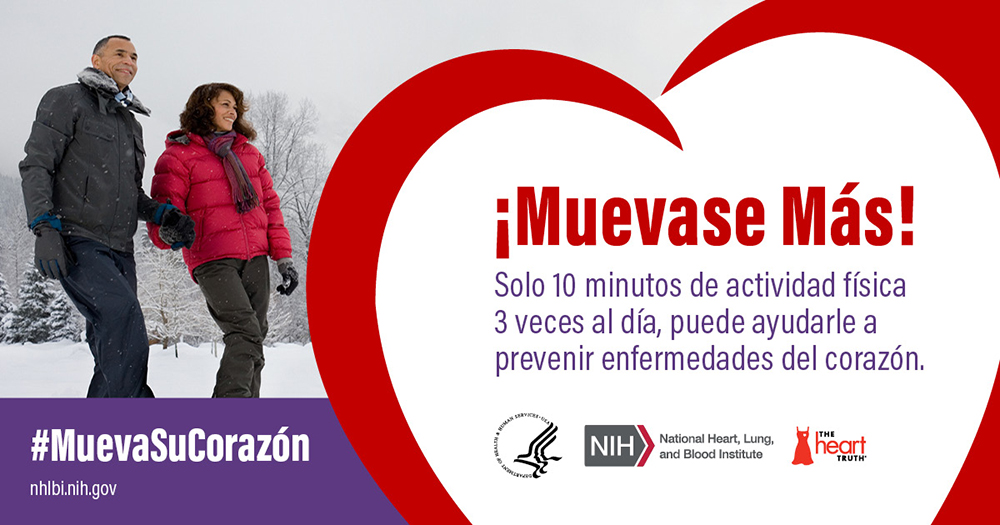
[JPG, 600.09 KB] Try these tips each day for a month to keep your heart healthy.

If you’re looking for some easy ways to take better charge of your health this year, here’s one: get up and move. Not only does physical activity help improve your overall health, it protects your heart, too, according to the National Heart, Lung, and Blood Institute (NHLBI). To make the point, and mark American Heart Month this February, NHLBI is launching a #MoveWithHeart campaign. Here are some facts—and some “get-moving” tips and resources—to inspire you to sit less and move more.

Why move more everyday?
Heart disease is a leading cause of death among African Americans in the United States, but fortunately adding more physical activity to your daily routine can help your heart and improve your overall health. Think about it: Being sedentary or inactive makes you nearly twice as likely to develop heart disease than if you’re active.

Being active can:

  • Strengthen your heart (even if you have heart disease)
  • Improve blood flow
  • Lower your blood pressure and cholesterol levels
  • Give you more stamina and help you cope with stress
  • Help you control your weight
  • Help you quit smoking

Many types of activity can help your heart, whether it’s shooting hoops, taking an exercise class at your local recreation center, or walking during your lunchbreak. The bottom line for you and your family: Get up and get moving!

For more information about the benefits of physical activity visit the NHLBI website.

How much is enough?
As little as 60 minutes a week of physical activity such as walking briskly helps your heart. For major health benefits, aim for at least 150 minutes (2½ hours) a week. Walk around your neighborhood or the track at a nearby school, or start a walking club after church.

If you want to get the same benefits in less time, try for 75 minutes of activities, such as playing a full game of basketball, jumping rope, or working out to a fun YouTube fitness video. It’s up to you how you reach your own personal targets. For example, 30 minutes of physical activity 5 times a week is one option if you’re aiming for 150 minutes a week.   

Can’t carve out that much time at once? Don’t chuck your goal, chunk it! Try 10 minutes a few times a day, for example. You’ll know your workout counts if:

  • Your heart is beating faster
  • You’re breathing harder
  • You break a sweat [JPG, 315.18 KB]

Remember: more activity means a bigger boost to your health, so try to stay active between workouts. Here are some ideas:

  • Take the stairs.
  • Stand up when you change television channels.
  • When you hear good music, don’t just sit there, dance!
  • Stand up during meetings, or better yet, suggest a walking meeting.
  • Park in the farthest space from your destination.
  • Get off the bus one stop early.
  • Play with your kids at the playground.

When to check with your doctor

If you have a chronic health condition such as heart disease, arthritis, diabetes, or other symptoms, talk with your doctor first. Learn more about risks of physical activity for certain groups on NHLBI’s website.

Getting regular physical activity can mean fewer doctor visits, hospitalizations, and medications. Choosing to move more whenever possible is one of the best choices you and your family can make.

It’s Not Too Late to Get a Flu Shot

Flu is widespread throughout Georgia and more than 300 people have been hospitalized with flu-related illness across the state. According to the Centers for Disease Control and Prevention (CDC), flu season usually peaks between December and February; however, flu season can last into spring.

“This has been an extremely rough flu season and the entire country has been hit hard,” said Health Director for the Coastal Health District, Lawton Davis, M.D. “It’s not too late to get vaccinated against the flu and we want to encourage those who have not been vaccinated to take advantage of this opportunity.”

Flu symptoms include fever, cough, sore throat, runny or stuffy nose, body aches, headache, chills, fatigue, and sometime diarrhea or vomiting.

There are other things we can all do to prevent getting or spreading the flu:

  • Avoid close contact with sick people.
  • If you get sick with flu-like illness, stay home for at least 24 hours after the fever is gone except to get medical care or for other necessities. The fever should be gone without the use of fever-reducing medications.
  • While sick, limit contact with others as much as possible to keep from infecting them.
  • Try to cough or sneeze into the corner of your elbow and not your hand, or cover your nose and mouth with a tissue when you cough or sneeze. Throw the tissue in the trash after you use it.
  • Wash your hands with soap and water. If soap and water are not available, use an alcohol-based hand rub.
  • Avoid touching your eyes, nose, and mouth. Germs spread this way.
  • Clean and disinfect surfaces and objects that may be contaminated with germs like the flu.

For more information on this year’s flu season and the flu vaccine, go to cdc.gov/flu.

Additional Flu Information

Flu Inactive Vaccine Information Statement [PDF, 311.81 KB]

Flu Inactive Vaccine Information Statement SPANISH [PDF, 343.64 KB]

Flu Guide for Parents [PDF, 574.97 KB]

Free Mammograms for Women in Chatham Co. Who Meet Eligibility Criteria

The Chatham County Health Department’s Breast and Cervical Cancer Program (BCCP) is partnering with the St. Joseph’s/Candler Mobile Mammography Program to offer free mammograms from 9 a.m. to 3 p.m. on Monday, February 12, at the Chatham County Health Department located at 1602 Drayton Street. Women who meet certain annual income guidelines and are 40-64 years of age without insurance will be eligible to receive a screening mammogram at no cost.

Appointments are preferred but walk-ins will be accepted. To make an appointment, please call 356-2946.

Click HERE for more information on BCCP.

Widespread Flu in Georgia: Protect Yourself and Prevent the Spread of Flu

From the Georgia Department of Public Health
January 12, 2018

If you have not gotten a flu shot yet, do not wait any longer! Flu is widespread in Georgia, and more than three hundred individuals have been hospitalized with flu-related illness. The Georgia Department of Public Health (DPH) has confirmed four flu-related deaths so far, but that number is expected to increase.

The predominant strain of flu circulating in Georgia and around the country is influenza A (H3N2). This strain can be particularly hard on the very young, people over age 65, or those with existing medical conditions. H3N2 is one of the strains contained in this year’s flu vaccine along with two or three others, depending on the vaccine.

“It is not too late to get a flu shot,” says J. Patrick O’Neal, M.D., DPH commissioner. “Every individual over the age of six months should get a flu vaccine – not just for their own protection, but to protect others around them who may be more vulnerable to the flu and its complications.”

Flu symptoms and their intensity can vary from person to person, and can include fever, cough, sore throat, runny or stuffy nose, body aches, headache, chills and fatigue. If you think you have the flu, call or visit your doctor.

In some cases, healthcare providers may recommend the use of antivirals such as Tamiflu® or Relenza®. Antiviral drugs are prescription medicines (pills, liquid, an inhaled powder or an intravenous solution) that fight against the flu in your body. Antiviral drugs work best for treatment when they are started within two days of getting sick. Antivirals are used to treat those at high-risk for flu complications – young children, the elderly, individuals with underlying medical conditions and women who are pregnant. Most otherwise-healthy people who get the flu, however, do not need to be treated with antiviral drugs.

There are other things you can do to help prevent the spread of flu – tried and true measures your mother taught you.

  • Frequent and thorough hand-washing with soap and warm water. Alcohol based gels are the next best thing if you don’t have access to soap and
  • Cover your nose and mouth when coughing and sneezing to help prevent the spread of the flu. Use a tissue or cough or sneeze into the crook of your elbow or arm.
  • Avoid touching your face as flu germs can get into the body through mucus membranes of the nose, mouth and
  • If you are sick, stay home from school or work. Flu sufferers should be free of a fever, without the use of a fever reducer, for at least 24 hours before returning to school or

If you are caring for a sick individual at home, keep them away from common areas of the house and other people as much as possible. If you have more than one bathroom, have the sick person use one and well people use the other. Clean the sick room and the bathroom once a day with household disinfectant. Thoroughly clean linens, eating utensils, and dishes used by the sick person before reusing.

To learn more about influenza log on to www.flu.gov.


About the Georgia Department of Public Health

The Georgia Department of Public Health (DPH) is the lead agency in preventing disease, injury and disability; promoting health and well-being; and preparing for and responding to disasters. DPH’s main functions include: Health Promotion and Disease Prevention, Maternal and Child Health, Infectious Disease and Immunization, Environmental Health, Epidemiology, Emergency Preparedness and Response, Emergency Medical Services, Pharmacy, Nursing, Volunteer Health Care, the Office of Health Equity, Vital Records, and the State Public Health Laboratory. For more information about DPH visit www.dph.ga.gov.

Rabies Precautions Issued in Camden County

A stray cat in Woodbine tested positive for rabies after biting a woman. The incident took place at close to the 12000 block of Hwy. 17 near intersection on Hwy. 17 and Grover Rd. The resident who was bitten has been advised to follow up with a healthcare professional. Increased raccoon activity has also been reported in downtown St. Marys near the elementary school. Camden County residents are encouraged to stay away from and report any animals acting strangely to Camden County Animal Control at 912-576-7395.

Several species of wild animals that are native to coastal Georgia – including raccoons, foxes, and bats – can carry rabies. Rabies is a potentially deadly virus that is primarily spread by infected animals. The Camden County Health Department Environmental Health office offers these tips to protect you and your family from rabies:

  • Avoid contact with animals you don’t know.
  • Make sure your pets receive the proper immunizations. Dogs and cats should get rabies vaccines by four months of age, followed by a booster shot one year later, and another one every year as prescribed by your veterinarian.
  • Do not handle, feed, or unintentionally attract wild animals with open garbage cans or by leaving pet food out at night.
  • Never adopt wild animals or bring them into your home. Do not try to nurse sick animals to health. Call animal control or a properly licensed animal rescue agency for assistance.
  • Teach children to never handle unfamiliar animals, wild or domestic, even if they appear friendly. “Love your own, leave other animals alone” is a good principle for children to learn.

Symptoms of rabies in animals include a change in behavior, biting, aggression, showing no fear of natural enemies (such as humans), foaming at the mouth, and paralysis. If an animal ever bites you, seek medical care immediately and contact Camden County Animal Control at 912-576-7395 and the Camden County Health Department Environmental Health office at 912-729-6012.

Free Mammograms for Women in Chatham Co. Who Meet Eligibility Criteria

The Chatham County Health Department’s Breast and Cervical Cancer Program (BCCP) is partnering with the St. Joseph’s/Candler Mobile Mammography Program to offer free mammograms from 9 a.m. to 3 p.m. on Monday, October 18, at the Chatham County Health Department located at 1602 Drayton Street. Women who meet certain annual income guidelines and are 40-64 years of age without insurance will be eligible to receive a screening mammogram at no cost.

Appointments are preferred but walk-ins will be accepted. To make an appointment, please call 356-2946.