The Coastal Health District of Georgia serves the counties of Bryan, Camden, Chatham, Effingham, Glynn, Liberty, Long & McIntosh

Bryan News


Health District Encourages Precautions Against Impacts of Wildfire Smoke

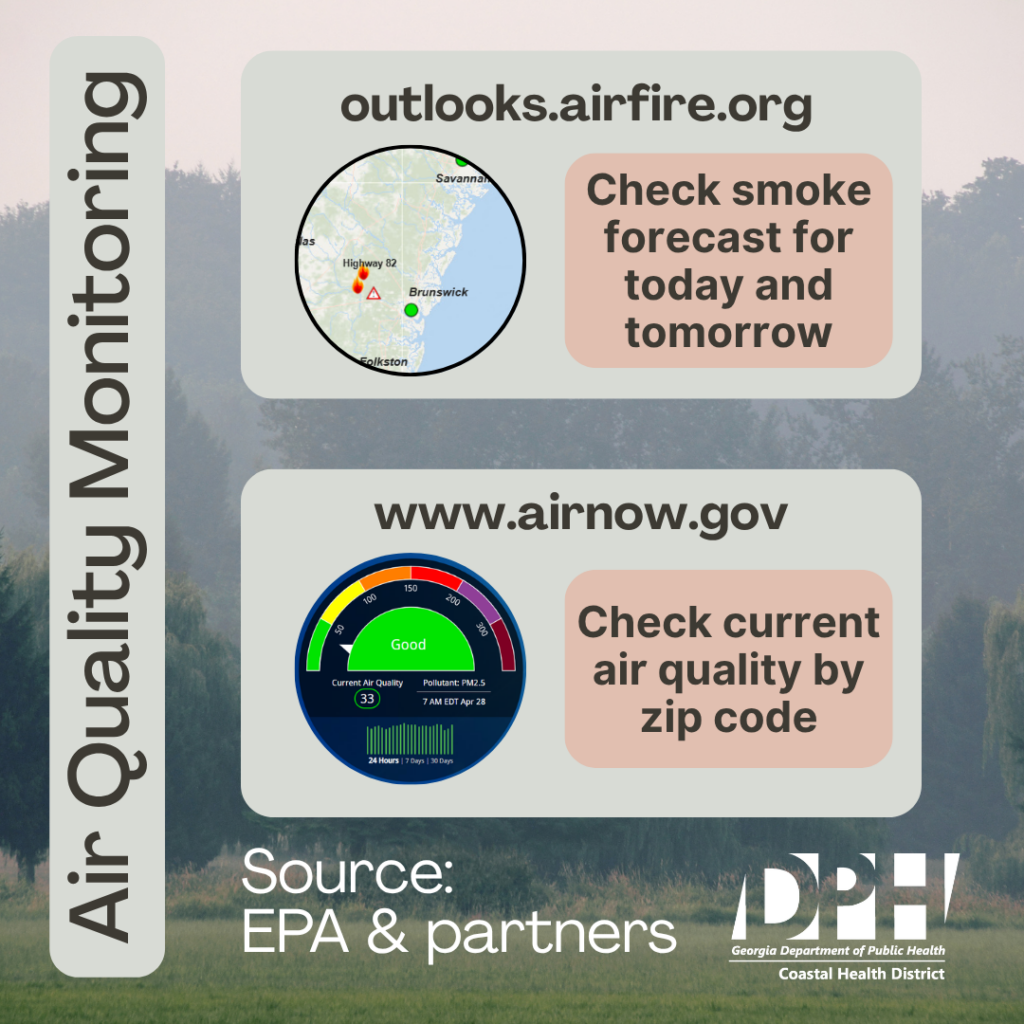
As of Sunday, April 26 at 2 p.m., Glynn County air quality has significantly worsened and is now at a hazardous level, according to the latest report from the Environmental Protection Agency (EPA) at airnow.gov.

When readings are hazardous, the EPA recommends everyone stay indoors and reduce activity levels. If you have asthma or other lung disease, make sure you follow your doctor’s directions about taking your medicines and following your asthma management plan.

Air quality levels in Savannah show a moderate level of air pollution.

You can get much more information at airnow.gov/wildfires.


The Coastal Health District is encouraging residents to take precautions as wildfire smoke impacts air quality across the Coastal Health District. Wildfires are currently burning in Brantley and Clinch Counties, and smoke can be expected in the air over southeastern and coastal Georgia in the coming days.

Wildfire smoke can make anyone sick, but some people have a higher risk of health problems associated with wildfire smoke. People at increased risk include individuals with chronic conditions like asthma, Chronic Obstructive Pulmonary Disease (COPD), diabetes, chronic kidney disease, or heart disease. Pregnant women, children, and first responders are also at higher risk.

If wildfire smoke is impacting your area, you’re encouraged to:

  • Stay inside and away from the smoke.
  • Keep indoor air as clean as possible. Keep windows and doors closed. Run an air conditioner if you have one but keep the fresh air intake closed and the filter clean to prevent outdoor smoke from getting inside. You can also use fans inside the home to help stay cool.
  • Avoid activities that increase indoor pollution such as smoking or vaping, spraying aerosol products, burning candles or incense, or vacuuming unless your vacuum has a HEPA filter.
  • Keep airways moist by drinking plenty of water.
  • Follow the advice of your health care provider about medicines and your respiratory management plan if you have asthma, COPD, or any other lung or heart disease. Seek medical attention if you are having difficulty breathing or if your symptoms worsen.

Residents are encouraged to monitor messages from their local county emergency management agency and check air quality index reports online at airnow.gov.

Health Departments Offer Free Testing Events in April for STI Awareness Month

Health departments in the Coastal Health District are offering free testing events for sexually transmitted infections, or STIs, during STI Awareness Month in April.

STI testing is always available without an appointment during clinic hours at health departments in coastal Georgia. But during these special events, STI testing will be offered at no cost. A full list of free STI testing events is at the bottom of this page.

One in five people in the U.S. has an STI. Many infections don’t have obvious symptoms at first, but if left untreated, they can cause severe, long-term health problems and spread to partners.

STI testing is important for anyone who is sexually active, including adolescents, adults, and pregnant women.  STIs can cause serious health problems for pregnant moms and can be passed to their unborn babies.

The good news is, all STIs can be treated, and most can be cured. Routine STI testing can help individuals get treatment early, protect their health, and have open, informed conversations with partners. Testing is quick, confidential, and often easier than people expect.

In 2024, more than 2.2 million STIs were reported across the United States. Overall, rates have declined in recent years but are still much higher than STI rates of a decade ago, reinforcing the need to continue prioritizing STI prevention, testing, and treatment.

Free STI Testing Events in the Coastal Health District

Bryan County

  • April 22, 8-11am and 1-4pm, 430 Ledford St., Pembroke
    Appointments preferred but not required
  • April 14, 8-11am and 1-4pm, 66 Capt. Matthew Freeman Dr., Richmond Hill
    Appointments preferred but not required

Camden County

  • April 16, 8am-12pm and 1-5:30pm, 101 Winding Rd., Kingsland
    Appointments preferred but not required

Chatham County

  • April 13-17, 8-11am and 1-4pm, Mon. through Thurs., 8a-1p on Friday
    1395 Eisenhower Dr. & 1602 Drayton St., Savannah
    No appointment needed

Effingham County

  • April 13-17, 8-11am and 1-4pm, Mon. through Thurs., 8a-12p on Friday
    802 Hwy. 119 South, Springfield
    Appointments preferred but not required

Glynn County

  • April 16, 8am-12pm and 1-5pm, 2747 Fourth St., Brunswick
    No appointment needed

Liberty County

  • April 13-17, 8-11am and 1-4pm, Mon. through Thurs., 8a-12p on Friday
    1113 East Oglethorpe Hwy., Hinesville
    Appointments preferred but not required

Long County

  • April 20-24, 8-11am and 1-4pm, Mon. through Thurs., 8a-12p on Friday
    584 N. Macon St., Ludowici
    Appointments preferred but not required

McIntosh County

  • April 14, 8-11am and 1-4pm, 1335 GA Hwy 57, Townsend
    Appointments preferred but not required

Health Department in Pembroke To Reopen March 30 After Renovations

The Bryan County Health Department’s Pembroke Clinic and Environmental Health Office will reopen on Monday, March 30. The site was closed temporarily for renovations and repairs.

Until March 30, services will be available at the Bryan County Health Department Richmond Hill location. For assistance, please call the Richmond Hill Clinic at 912-756-2611 or the Environmental Health Office at 912-756-2636.

*Note: Both sites (Richmond Hill and Pembroke) are closed for training on the last business day of the month, which means both locations will be closed on Tuesday, March 31st. This is not related to the renovation.

DPH Confirms Measles Case in Bryan County Resident

The Georgia Department of Public Health (DPH) has confirmed measles in an unvaccinated Bryan County resident. There is no history of international travel, but the individual recently traveled out of state. DPH is notifying individuals who may have been exposed to the virus and are at increased risk of developing measles.

Measles is highly contagious and spreads through the air when an infected person coughs or sneezes. The measles virus can stay in the air or on surfaces for up to two hours after an infected person has left the room.

Measles symptoms typically appear 7 to 14 days after exposure, including high fever, cough, runny nose, and watery eyes. Then, a rash of tiny red spots appears. It starts at the head and spreads to the rest of the body.

The MMR (measles, mumps, rubella) vaccine can prevent measles and rubella. The vaccine is safe and effective, and parents with questions about the vaccine or the vaccination schedule can consult their physician. The Centers for Disease Control and Prevention (CDC) recommends that children receive their first dose of MMR vaccine between 12 and 15 months of age and a second dose between 4 and 6 years of age. For babies aged 6-11 months travelling internationally, the CDC recommends a single dose of the MMR vaccine before travel, followed by two additional doses after their first birthday.

More than 95% of the people who receive a single dose of MMR will develop immunity to all three viruses. A second dose boosts immunity, typically enhancing protection to 98%. Individuals who are vaccinated with the MMR vaccine also help protect others who are too young or medically unable to be vaccinated.

People with measles symptoms should contact their healthcare provider immediately. DO NOT go to the doctor’s office, the hospital, or a public health clinic without first calling to let them know about your symptoms. Healthcare providers who suspect measles in a patient should notify public health immediately.

This is the second reported measles case in Georgia in 2026. There were 10 confirmed measles cases in Georgia in 2025.

For more information about measles, log on to https://dph.georgia.gov/epidemiology/acute-disease-epidemiology/vaccine-preventable-diseases/measles or
https://www.cdc.gov/measles/index.html.

Coastal Health District Issues Warning After Report of Fake Health Inspector in Glynn County

The Coastal Health District is warning individuals and businesses after receiving a report that an unknown person falsely claimed to be a health inspector and threatened to close a Glynn County restaurant. The restaurant manager reported the incident to the Glynn County Health Department on Monday, Feb. 10, stating that the encounter occurred over the weekend with an angry patron who made the false claim.

Because the individual did not ask for money or favors, law enforcement was not involved. However, the Coastal Health District is sharing the following information to help protect individuals and businesses from potential fraudulent encounters.

“We take incidents like this very seriously, because we take integrity and professionalism seriously,” said Environmental Health Director Brant Phelps. “This is a good opportunity to let folks know what to expect from our health inspectors and how to recognize suspicious behavior.”

County health inspectors:

  • Carry official identification cards. Businesses may ask to see the inspector’s ID and may call the county environmental health office to verify credentials.
  • Never accept money in the field. Fees for permits and other environmental health services are paid directly to the health department and are never collected in cash.

If the behavior of someone claiming to be a health inspector seems suspicious, contact the county environmental health office to verify their identity. Never pay for environmental health services in cash or directly to an individual in the field.

Know Your Numbers: Health Departments Host Heart Health Events in February

Show your heart some love this month and get free blood pressure and blood glucose screenings during events at your local health department.

The Chatham County Health Department is hosting its 3rd Annual Heart Health Fair on Thursday, February 12 from 3:00 to 6:00 p.m. at the clinic located at 1395 Eisenhower Drive. There is no cost to participate and no appointment is needed.

The event will include free blood pressure screenings, blood glucose tests, raffle prizes, and refreshments, plus door prizes for the first 30 attendees! The health fair will also feature information and education from several community partners.

These other free blood pressure and blood glucose screening events are scheduled throughout the Coastal Health District:

Bryan County

  • Feb. 19, 8am – 12pm
  • Richmond Hill Clinic at 66 Captain Matthew Freeman Dr.

Camden County

  • Feb. 13, 10am – 12pm
  • 101 Winding Rd., Kingsland

Chatham County

  • Feb. 9, 8am – 12pm
  • Main clinic at 1395 Eisenhower Dr.
  • Feb. 11, 1 – 5pm
  • Midtown clinic at 1602 Drayton St.
  • Heart Health Fair, Feb. 12, 3-6pm
  • Main clinic at 1395 Eisenhower Dr.

Effingham County

  • Feb. 11, 8am – 12pm
  • 802 Hwy 119 South, Springfield

Glynn County

  • Feb. 20, 10am – 12pm
  • 2747 Fourth St., Brunswick

Liberty County

  • Feb. 10, 1 – 5pm
  • 1113 E. Oglethorpe Hwy.

Long County

  • Feb. 27, 10am – 12pm
  • 584 N. Macon St., Ludowici

McIntosh County

  • Feb. 6, 10am – 12pm
  • 1335 GA Hwy 57, Townsend

Why Get Screened?

High blood pressure can lead to serious health problems, but you and your healthcare team can take steps to lower your blood pressure if it’s too high. The only way to know is to get checked with a simple blood pressure screening.

Another important routine test is a blood glucose screening, which checks for health concerns like prediabetes and diabetes. Once you know your blood glucose levels, you can make any needed adjustments to your diet, exercise, or medications to improve your health.

The Coastal Health District has several programs to help you manage blood pressure and blood glucose levels. Find out more about these programs and other local resources at any of these heart health events and on our Healthy Living web page.

Raccoon Tests Positive for Rabies in Ellabell

A raccoon in Ellabell in north Bryan County has tested positive for rabies. The Bryan County Health Department’s environmental health office reminds all residents to avoid contact with wild animals and ensure pets are properly vaccinated against rabies.

A resident contacted the health department Monday after their family dog killed a raccoon in their backyard over the weekend. The residence is near Interstate 16 and Highway 280 in Ellabell. The raccoon was sent to the public health laboratory where it tested positive for rabies. Fortunately, the dog was up to date on its rabies vaccination, and no humans were exposed to the raccoon.

This incident is a reminder that several species of wild animals in our area can carry rabies, including raccoons, foxes, and bats. Rabies is a potentially deadly virus that is primarily spread by infected animals. The following tips can protect you and your family from rabies:

  • Avoid contact with animals you don’t know.
  • Make sure your pets receive the proper immunizations. Dogs and cats should get rabies vaccines after 12 weeks of age, followed by a booster shot within one year and vaccination every 1-3 years depending on veterinary recommendation and vaccine used.
  • Do not handle, feed, or unintentionally attract wild animals with open garbage cans or by leaving pet food out at night.
  • Never adopt wild animals or bring them into your home. Do not try to nurse sick animals to health. Call animal services or a properly licensed animal rescue agency for assistance.
  • Teach children to never handle unfamiliar animals, wild or domestic, even if they appear friendly. “Love your own, leave other animals alone” is a good principle for children to learn.

Symptoms of rabies in animals include a change in behavior, biting, aggression, showing no fear of natural enemies (such as humans), foaming at the mouth, and paralysis. If an animal ever bites you, seek medical care immediately and contact Bryan County Animal Services at 912-851-3817 and the Bryan County Environmental Health office at 912-756-2636.

DPH Confirms Measles Case in Georgia

The following press release was issued by the Georgia Department of Public Health on January 12, 2026:

The Georgia Department of Public Health (DPH) has confirmed a measles case in a baby too young to receive routine measles vaccination. The baby, who acquired the virus while traveling internationally, lives in the Coastal Health District. DPH is working to identify individuals who may have been exposed to measles through contact with the child.   

Measles is very contagious and spreads through the air when an infected person coughs or sneezes. The measles virus can stay in the air or on surfaces for up to two hours after an infected person has left the room. 

Measles symptoms typically appear 7 to 14 days after exposure, including high fever, cough, runny nose, and watery eyes. Then, a rash of tiny red spots appears. It starts at the head and spreads to the rest of the body. 

The MMR (measles, mumps, rubella) vaccine can prevent measles and rubella. The vaccine is safe and effective, and parents with questions about the vaccine or the vaccination schedule can consult their physician. The Centers for Disease Control and Prevention (CDC) recommends that children receive their first dose of MMR vaccine between 12 and 15 months of age and a second dose between 4 and 6 years of age. For babies aged 6-11 months travelling internationally, the CDC recommends a single dose of the MMR vaccine before travel, followed by two additional doses after their first birthday. 

More than 95% of the people who receive a single dose of MMR will develop immunity to all three viruses. A second dose boosts immunity, typically enhancing protection to 98%. Individuals who are vaccinated with the MMR vaccine also help protect others who are too young or medically unable to be vaccinated.

 People with measles symptoms should contact their healthcare provider immediately. DO NOT go to the doctor’s office, the hospital, or a public health clinic without first calling to let them know about your symptoms. Healthcare providers who suspect measles in a patient should notify public health immediately.

This is the first reported measles case in Georgia in 2026. There were 10 confirmed measles cases in Georgia in 2025.

For more information about measles, log on to https://dph.georgia.gov/epidemiology/acute-disease-epidemiology/vaccine-preventable-diseases/measles or https://www.cdc.gov/measles/index.html.

Free Flu Shot Events for Uninsured Children and Adults

Flu activity is high in Georgia, and if you haven’t already received your flu shot this season, it’s not too late to get vaccinated. Health departments in the Coastal Health District are offering free flu shot events for children and adults without health insurance.

Free flu shot events for individuals without health insurance coverage (while supplies last):

Bryan County

  • January 12-16 at the clinics in Pembroke and Richmond Hill
  • No appointment needed Monday-Wednesday, 8am-11am & 1pm-4pm, Thursday, 8am-11am & 1pm-6pm, and Friday, 8am-1pm.

Camden County

  • January 1-as long as supplies last
  • No appointment needed Monday-Wednesday, 8-10:30am and 1-3:30pm, Thursday from 8-10:30am and 1-5pm, and Friday from 8-10:30am.

Chatham County

  • January 1-as long as supplies last
  • Appointments are required. Call 912-356-2441 to schedule an appointment at the clinic at 1395 Eisenhower Drive, or 912-651-2587 to schedule an appointment at the midtown clinic at 1602 Drayton Street.

Effingham County

  • January 1-31
  • No appointment needed Monday-Wednesday, 8am-11am & 1pm-4pm, Thursday, 8am-11am & 1pm-6pm, and Friday, 8am-1pm.

Glynn County

  • January 1-31
  • No appointment needed Monday-Wednesday, 8am-11am & 1pm-4pm, Thursday, 8am-11am & 1pm-6pm, and Friday, 8am-1pm.

Liberty County

  • January 5-9
  • No appointment needed Monday-Wednesday, 8am-11am & 1pm-4pm, Thursday, 8am-11am & 1pm-6pm, and Friday, 8am-1pm.

Long County

  • January 1-as long as supplies last
  • Appointments are required. Call 912-545-2107 to schedule an appointment.

McIntosh County

  • January 1-as long as supplies last
  • Appointments are preferred but walk-ins are accepted. Call 912-832-5473 to schedule an appointment.

Patients with health insurance may also receive no-cost flu shots, as most insurance plans cover flu vaccine at no charge to the patient. Call the health department nearest you to confirm that your health insurance is accepted.

Everyone 6 months of age and older should get a flu vaccine every season. Vaccination is especially important for individuals at higher risk of complications from flu, such as:

  • Adults age 65 and older
  • Children under age 2
  • People who are pregnant
  • People who are obese
  • People with weakened immune systems
  • People with chronic lung conditions like asthma, COPD, and cystic fibrosis
  • People with neurologic and neurodevelopment conditions
  • People with heart disease
  • People with endocrine, blood, kidney, liver, or metabolic disorders

Flu vaccine reduces your risk of getting an influenza infection. If you do catch the flu, the vaccine can lessen the length and severity of your illness.

You can also protect yourself from the flu by avoiding people who are sick, washing your hands often, and improving air quality by bringing in fresh outside air, purifying indoor air, or gathering outdoors.

Health Departments Begin Offering Updated COVID Vaccine

Public health departments in the Coastal Health District are now offering the updated COVID vaccine for the 2025-26 respiratory virus season. Supplies are limited in some locations as vaccine shipments continue to arrive, so call your local health department to confirm availability and schedule an appointment.

The health departments in Bryan, Camden, Chatham, Effingham, Glynn, Liberty, Long, and McIntosh Counties will offer the Pfizer brand of COVID vaccine which is approved for use in individuals 5 years of age and older.

Vaccination is particularly beneficial for adults age 65 and older and individuals of any age with health conditions that increase their risk of getting very sick from COVID infection. Risk factors include cancer, lung disease, diabetes, heart conditions, overweight and obesity, pregnancy, and more. For a list of potential risk factors for COVID-related complications, visit the website cdc.gov/covid/risk-factors.

No prescription is needed to receive a COVID vaccine. According to the latest CDC guidance, individuals may make their own informed decisions after receiving information about the COVID vaccine.

The cost of COVID vaccination is covered by most health insurance plans, and low-cost vaccination options are available for individuals without health insurance coverage.


Frequently Asked Questions & Answers

Who is eligible to receive the new COVID vaccine at the health department?

  • The health department is offering the 2025-26 vaccine by Pfizer which is approved for use in individuals 5 years of age and older.

What about children younger than 5? Can they get vaccinated?

  • The COVID vaccine by Moderna has been approved for use in children from 6 months to 4 years of age but is not available in the health departments of the Coastal Health District. Please check with your pediatrician’s office or local pharmacy to see if they have the Moderna vaccine for young children.

I thought only older individuals or those at high risk could get vaccinated.

  • The latest CDC guidance emphasizes that the benefits of vaccination are highest for those people most at risk of severe illness from COVID infection. However, individuals may make their own informed decisions after receiving information about the COVID vaccine.

Who is considered at high risk for COVID-related complications?

  • Individuals over age 65 are at highest risk of getting very sick from COVID, and more than 81% of deaths from COVID complications occur in people over age 65.
  • Certain health conditions increase a person’s risk of severe illness from COVID at any age, including cancer, lung disease, diabetes, heart conditions, overweight and obesity, pregnancy, and more.
  • For a list of potential risk factors for COVID-related complications, visit the website cdc.gov/covid/risk-factors.

Do I need a prescription to get a COVID vaccine?

  • No prescription is needed to receive a COVID vaccine. According to the latest CDC guidance, individuals may make their own informed decisions after receiving information about the COVID vaccine.

How much will the COVID vaccine cost at the health department?

  • Most health insurance plans will cover the cost of COVID vaccination, including plans through Medicaid and Medicare. The health department also has low-cost vaccination options for individuals without health insurance coverage.

My health department doesn’t have the COVID vaccine I need in stock. What can I do?

  • Most communities have several options for COVID vaccination through doctor’s offices and retail pharmacies, particularly for individuals with health insurance coverage.
  • Each of our county health departments gets a very limited supply of vaccine we can use for patients without insurance coverage each month. If your county health department does not have low-cost doses available for individuals without insurance, you may want to call around to some of the neighboring counties to see if they have the low-cost vaccine in stock. Click here for contact information for all the county health departments in the Coastal Health District.