The Coastal Health District of Georgia serves the counties of Bryan, Camden, Chatham, Effingham, Glynn, Liberty, Long & McIntosh

Liberty News


Human Case of West Nile Virus Confirmed in Coastal Health District

The Georgia Department of Public Health (DPH) has confirmed the first human case of West Nile Virus in the Coastal Health District in 2026. The individual is an adult resident of Chatham County. This is the second confirmed human case in Georgia this year to date.

West Nile Virus (WNV) is a potentially serious illness transmitted to humans through the bite of an infected mosquito. According to the Centers for Disease Control and Prevention, 80% of people who get WNV won’t have symptoms. Those who do develop symptoms typically experience fever, headache, body aches, joint pain, vomiting, diarrhea, or rash. However, a small number of people will develop severe symptoms affecting the central nervous system, which could be fatal. Last year there were 18 confirmed human cases of WNV in Georgia residents, and 1 in the Coastal Health District.

There is no vaccine to prevent WNV, and no treatment other than supportive care for the symptoms. The Coastal Health District reminds everyone to take precautions to avoid mosquito bites.

Mosquitoes that carry WNV are more likely to bite during the evening, night, and early morning. Wearing insect repellent containing the chemical DEET or picaridin will help keep mosquitoes away. Eliminate standing water around the home and yard to keep mosquitoes from breeding.

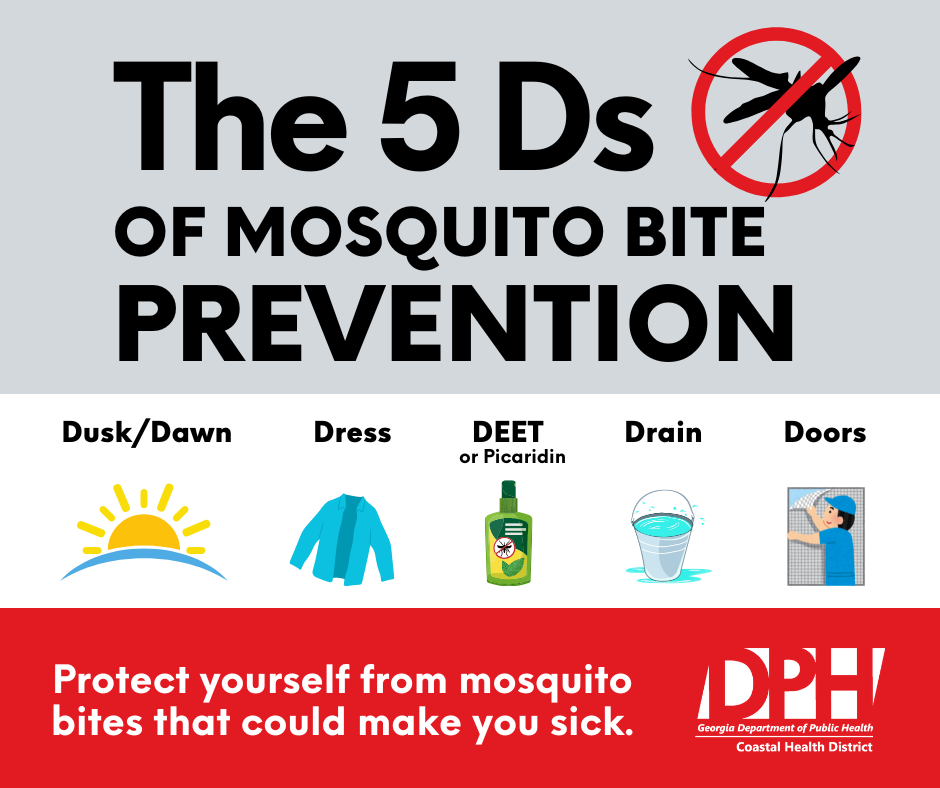
The Five Ds of mosquito bite prevention can help prevent mosquito bites and breeding:

  • Dusk/Dawn: Avoid dusk and dawn activities during the summer when mosquitoes are most active.
  • Dress: Wear loose-fitting, long-sleeved shirts and pants to reduce the amount of exposed skin.
  • DEET: Cover exposed skin with an insect repellent containing DEET or picaridin, which are the most effective repellents against mosquito bites.
  • Drain: Empty any containers holding standing water – buckets, barrels, flowerpots, tarps – because they are breeding grounds for virus-carrying mosquitoes.
  • Doors: Make sure doors and windows are in good repair and fit tightly and fix torn or damaged screens to keep mosquitoes out of the house.

West Nile Virus Detected in Mosquitoes in Coastal Georgia

When you head outside, don’t forget the bug spray – that’s the message from the Coastal Health District after three mosquito samples in Chatham County tested positive for West Nile Virus (WNV).

Chatham County Mosquito Control regularly traps mosquitoes throughout the county to test for viruses that can spread from mosquitoes to people. The information is used to direct mosquito control efforts and to warn residents to take precautions.

These are the first positive WNV tests in the Coastal Health District mosquito population this summer. Peak mosquito season typically runs from late summer through fall.

Mosquito bites are more than just an itchy nuisance. WNV is transmitted to humans by the bite of infected mosquitoes. Many people who are infected with the virus have no symptoms. Some may have mild to moderate symptoms including fever, headache, body aches, vomiting, diarrhea, or rash. Severe cases can lead to serious, sometimes fatal, illness.

There is no vaccine or cure for WNV, so prevention is key. All residents should take steps to avoid mosquito bites and eliminate standing water where mosquitoes like to breed. You can reduce your risk of infection by following the 5Ds of mosquito bite prevention:

  • Dusk/Dawn – Avoid dusk and dawn activities during the summer when mosquitoes are most active.
  • Dress – Wear loose-fitting, long-sleeved shirts and pants to reduce the amount of exposed skin.
  • DEET – Cover exposed skin with an insect repellent containing DEET, which is the most effective repellent against mosquito bites.
  • Drain – Empty containers holding standing water – buckets, barrels, flowerpots, tarps – because they are breeding grounds for virus-carrying mosquitoes.
  • Doors – Make sure doors and windows are in good repair and fit tightly and fix torn or damaged screens to keep mosquitoes out of the house.

For more information on mosquito bite prevention, visit cdc.gov/mosquitoes.

This graphic repeats information that is in the press release.

Protect Yourself and Your Family From Cyclosporiasis

The Georgia Department of Public Health (DPH) is urging Georgians to take extra precautions when purchasing, preparing, and consuming fresh fruits and vegetables to help prevent cyclosporiasis, a gastrointestinal disease. At this time, DPH is not aware of any Georgia-specific outbreaks, clusters, or potential links to the outbreak that has sickened more than a thousand people across multiple states. Investigation into common sources nationally is ongoing.

Cyclosporiasis is caused by a microscopic parasite – Cyclospora. People can become infected by consuming food or water that contains the parasite. Treated water in the U.S. does not contain Cyclospora. Although domestically acquired cases occur in Georgia every year, typically most cyclosporiasis cases in the state are associated with international travel.

The most common symptom is watery diarrhea and explosive bowel movements. Bloating, cramping, or loss of appetite can also occur. Most people with cyclosporiasis recover on their own; however, hospitalizations can occur when patients are dehydrated from diarrhea caused by the infection. The illness may last from a few days to over a month. Symptoms may seem to go away and then return one or more times. In extended cases, people are encouraged to check with their healthcare provider.

Cyclosporiasis can be prevented by following basic health hygiene practices when handling fresh fruits and vegetables. These are the measures the Georgia Department of Public Health (DPH) promotes every day.

  • Wash hands with soap and water before and after handling or preparing raw fruits and vegetables
  • Wash all fruits and vegetables thoroughly under running water before eating, cutting, or cooking
  • It is important to thoroughly wash produce even if it is labeled as pre-washed
  • Scrub firm fruits and vegetables, such as melons and cucumbers, with a clean produce brush
  • Cut away any damaged or bruised areas on fruits and vegetables before preparing and eating
  • Refrigerate cut, peeled, or cooked fruits and vegetables as soon as possible (within two hours)

For additional information about cyclosporiasis, visit the CDC website at https://www.cdc.gov/cyclosporiasis/index.html.

Click here for information about the US Food and Drug Administration’s investigation and food recall.

School Vaccination & Screening Clinics for 2026

–> Haga clic aquí para obtener información en español

Several counties in the Coastal Health District are offering special summer immunization and screening clinics to help families avoid the back to school rush. If you have a child entering:

  • Pre-K,
  • Kindergarten,
  • 7th grade, or
  • 11th grade,

they may need vaccinations or screenings for school attendance. If students do not have the required screenings and immunizations they may be unenrolled from school, so parents are encouraged to take advantage of these summer opportunities!

A list of all school clinic events is below. However, vaccines and school screenings are routinely available at all the health departments in the Coastal Health District by appointment. You do not have to wait until one of these events for screenings or immunizations.  Also, you do not have to be vaccinated in your county of residence. If a convenient appointment is not available in your county, you may call surrounding counties for additional availability.

Call your county health department for more information.


Bryan County Health Department

Back to School vaccination and screening events will be held in July at the Bryan County Health Department. Appointments are required. Many insurance plans are accepted. Low cost options are available for individuals without health insurance.

If your child is transferring from another state, please bring their immunization records to the health department several days before their appointment. This gives staff an opportunity to transfer all the information into Georgia’s immunization registry prior to the health clinic event.

Richmond Hill Clinic:

  • July 20 and 28, 8 am – 12 pm and 1 pm – 4 pm
  • Vaccines and screenings
  • 66 Captain Matthew Freeman Drive, Richmond Hill
  • Appointments required. Schedule by phone: (912) 756-2611

Pembroke Clinic:

  • July 27, 8 am – 12 pm and 1 pm – 4 pm
  • Vaccines and screenings
  • 430 Ledford Street, Pembroke
  • Appointments required. Schedule by phone: (912) 653-4331

Camden County Health Department

Back to School vaccination and screening events will be held on two dates in July at the Camden County Health Department. Appointments are strongly recommended.

  • July 9, 8 am – 10:30 am and 1 pm – 5:30 pm
  • July 14, 8 am – 10:30 am and 1 pm – 3:30 pm
  • Vaccines and screenings
  • 101 Winding Road, Kingsland
  • Appointments strongly recommended. Schedule by phone: (912) 882-8515

Chatham County Health Department

If your child is entering a Georgia school for the first time and needs an eye, ear, dental (EED) screening, the Chatham County Health Department is holding two free EED screening clinics this summer.

On these two days, you do NOT need an appointment for an EED and the usual $30 fee is waived.

  • July 23 & 30, 8am-5pm
  • School Screenings at NO COST
  • 1395 Eisenhower Drive, Savannah

For school vaccines, please call the health department at 912-356-2441 to schedule an appointment.


Effingham County Health Department

Back to School vaccination and screening events will be held BY APPOINTMENT in June and July at the Effingham County Health Department.

  • June 8 & 9
  • July 22, 23, 28, & 30
  • Vaccines and screenings
  • 802 Hwy. 119 South, Springfield
  • Appointments strongly recommended. Schedule by phone: (912) 754-6484

Glynn County Health Department

Back to School vaccination and screening services are available as a walk-in service every day the clinic is open at the Glynn County Health Department. Walk-in hours are:

  • Monday-Wednesday, 8am-4pm (closed 12-1)
  • Thursday, 8am-6pm (closed 12-1)
  • Friday, 8am-1pm
  • 2747 Fourth Street, Brunswick
  • Closed the last business day of every month for staff training
  • No appointment needed

Liberty County Health Department

Back to School vaccination and screening events will be held BY APPOINTMENT in July and August at the Liberty County Health Department.

  • July 22, 29, and August 12, 8am-4pm
  • Vaccines and screenings
  • 507 E. Oglethorpe Highway, Hinesville
  • Appointments required. Schedule online: coastalhealthdistrict.as.me/liberty-school
  • Schedule by phone: (912) 876-2173

Long County Health Department

Back to School vaccination and screening events will be held BY APPOINTMENT in June, July, and August at the Long County Health Department.

  • June 25, July 23, & August 27, 8:30 am – 11:30 am and 1 pm – 5:30 pm
  • Vaccines and screenings
  • 584 N. Macon Street, Ludowici
  • Appointments required. Schedule by phone: (912) 545-2107

McIntosh County Health Department

Back to School vaccination and screening services are available by appointment or as a walk-in service every day the clinic is open at the McIntosh County Health Department. Walk-in hours are:

  • Monday-Wednesday, 8am-4pm (closed 12-1)
  • Thursday, 8am-6pm (closed 12-1)
  • Friday, 8am-1pm
  • 1335 GA Highway 57, Townsend
  • Closed the last business day of every month for staff training
  • Walk-ins accepted or call (912) 832-5473 to schedule an appointment.

School Requirements

Students entering a Georgia school for the first time – no matter what the grade level –  must have a completed Certificate of Vision, Hearing, Dental, and Nutrition screening form. “First time” means never enrolled in a Georgia school before at any time in their lives.

In addition, children attending seventh grade and new entrants into Georgia schools in grades 8 through 12 must have received one dose of Tdap vaccine and one dose of meningococcal vaccine. (“New entrant” means any child entering any school in Georgia for the first time or entering after having been absent from a Georgia school for more than 12 months or one school year).

All students entering or transferring into 11th grade will need a meningococcal booster shot (MCV4), unless their first dose was received on or after their 16th birthday.

All health departments in Bryan, Camden, Chatham, Effingham, Glynn, Liberty, Long, and McIntosh counties offer eye, ear, dental, and nutrition screens as well as immunizations all year round. If your child needs these services and cannot attend one of these events, please call your local county health department as soon as possible to schedule an appointment during regular clinic hours.

Rabies Alerts Issued in Chatham, Liberty Counties

The Chatham and Liberty County Health Departments are both issuing rabies alerts after two wild animals tested positive for rabies.

In Chatham County, a dog discovered a bat inside a residence in the Bonaventure Road area. In Liberty County, a resident contacted the health department after noticing a raccoon behaving strangely in the Lake Georgia area of Midway. The bat and the raccoon both tested positive for rabies on June 23rd.

The residents involved in both incidents are consulting with healthcare providers about their exposure risks. Fortunately, all animals in the home in Chatham County are up to date on their rabies vaccinations.

These incidents are reminders that several species of wild animals in our area can carry rabies, including raccoons, foxes, and bats. Rabies is a potentially deadly virus that is primarily spread by infected animals. The following tips can protect you and your family from rabies:

  • Avoid contact with animals you don’t know.
  • Make sure your pets receive the proper immunizations. Dogs and cats should get rabies vaccines after 12 weeks of age, followed by a booster shot within one year and vaccination every 1-3 years depending on veterinary recommendation and vaccine used.
  • Do not handle, feed, or unintentionally attract wild animals with open garbage cans or by leaving pet food out at night.
  • Never adopt wild animals or bring them into your home. Do not try to nurse sick animals to health. Call animal services or a properly licensed animal rescue agency for assistance.
  • Teach children to never handle unfamiliar animals, wild or domestic, even if they appear friendly. “Love your own, leave other animals alone” is a good principle for children to learn.

Symptoms of rabies in animals include a change in behavior, biting, aggression, showing no fear of natural enemies (such as humans), foaming at the mouth, and paralysis. If an animal ever bites you, seek medical care immediately and contact your local animal services office and local environmental health office.

In Chatham County, you can reach Animal Services at 912-652-6575 and the Chatham County Health Department Environmental Health office at 912-356-2160. In Liberty County, you can reach Animal Services at 912-876-9191 and the Liberty County Health Department Environmental Health office at 912-368-5520.

Apply Now for the Coastal Health District Hurricane Registry

Preparing for a hurricane evacuation can be difficult for anyone, but for coastal residents with medical needs, physical disabilities, or limited transportation options, evacuation can present even greater challenges. The Coastal Health District encourages residents who may need evacuation assistance to apply now for the Hurricane Registry.

The Hurricane Registry is a confidential list of residents who may require transportation assistance during a hurricane evacuation. Coastal Georgia health departments work closely with local emergency management agencies to coordinate evacuations for registered individuals when there is a significant threat from a hurricane.

You cannot wait until a storm is approaching to apply – you must apply in advance so emergency managers can arrange for transportation assistance before a storm arrives. Applications for the Hurricane Registry are accepted all year.

You can apply for the Hurricane Registry in one of two ways:

  • Residents of Bryan, Camden, Chatham, Effingham, Glynn, Liberty, Long, and McIntosh County can call toll-free to 1-833-CHD-REGISTRY (1-833-243-7344). A representative will take some basic information and then your local health department will follow up with you to complete the application.
  • Visit our Hurricane Registry web page to download an application. Once completed, the application should be mailed or hand-delivered to your local county health department.

Examples of qualifying conditions include individuals with no transportation access and:

  • who need assistance with activities of daily living like eating, taking medication, dressing, bathing, communicating, transferring from bed to chair, and toileting.
  • who require life-saving medical support such as IV medication, tube feeding, dialysis and supplemental oxygen, and power-dependent equipment.

For more information about the Coastal Health District’s Hurricane Registry, visit our Hurricane Registry web page.

Liberty County Health Department Issues Rabies Alert

The Liberty County Health Department is alerting residents that a raccoon in Midway has tested positive for rabies. This is an important reminder to avoid contact with unfamiliar animals and keep pets up to date on rabies vaccination.

A resident of the Lake George area of Midway noticed a raccoon behaving strangely and contacted the Liberty County Health Department. The raccoon tested positive for the rabies virus on Friday, May 1. Fortunately, there was no known contact between the raccoon and any humans or pets.

Rabies is a deadly virus primarily spread through the bite or scratch of an infected animal. In coastal Georgia, rabies can circulate in wildlife such as raccoons, foxes, and bats. Residents are urged not to feed or attempt to domesticate wild animals or feral cats. Pet owners should ensure their pets stay current on rabies vaccinations.

To protect yourself and your family from rabies, the Liberty County Health Department’s Environmental Health office offers the following tips:

  • Avoid contact with animals you don’t know.
  • Make sure your pets receive the proper immunizations. Dogs and cats should get rabies vaccines after 12 weeks of age, followed by a booster shot within one year and vaccination every 1-3 years depending on veterinary recommendation.
  • Do not handle, feed, or unintentionally attract wild animals with open garbage cans or by leaving pet food out at night.
  • Never adopt wild animals or bring them into your home. Do not try to nurse sick animals to health. Call animal control or a properly licensed animal rescue agency for assistance.
  • Teach children to never handle unfamiliar animals, wild or domestic, even if they appear friendly. “Love your own, leave other animals alone” is a good principle for children to learn.

Symptoms of rabies in animals include a change in behavior, biting, aggression, showing no fear of natural enemies (such as humans), foaming at the mouth, and paralysis. If an animal ever bites you, seek medical care immediately and contact Liberty County Animal Services at 912-876-9191 and the Liberty County Health Department Environmental Health office at 912-368-5520.

Air Quality Monitoring Resources and Health Information

–> Haga clic aquí para obtener información en español.

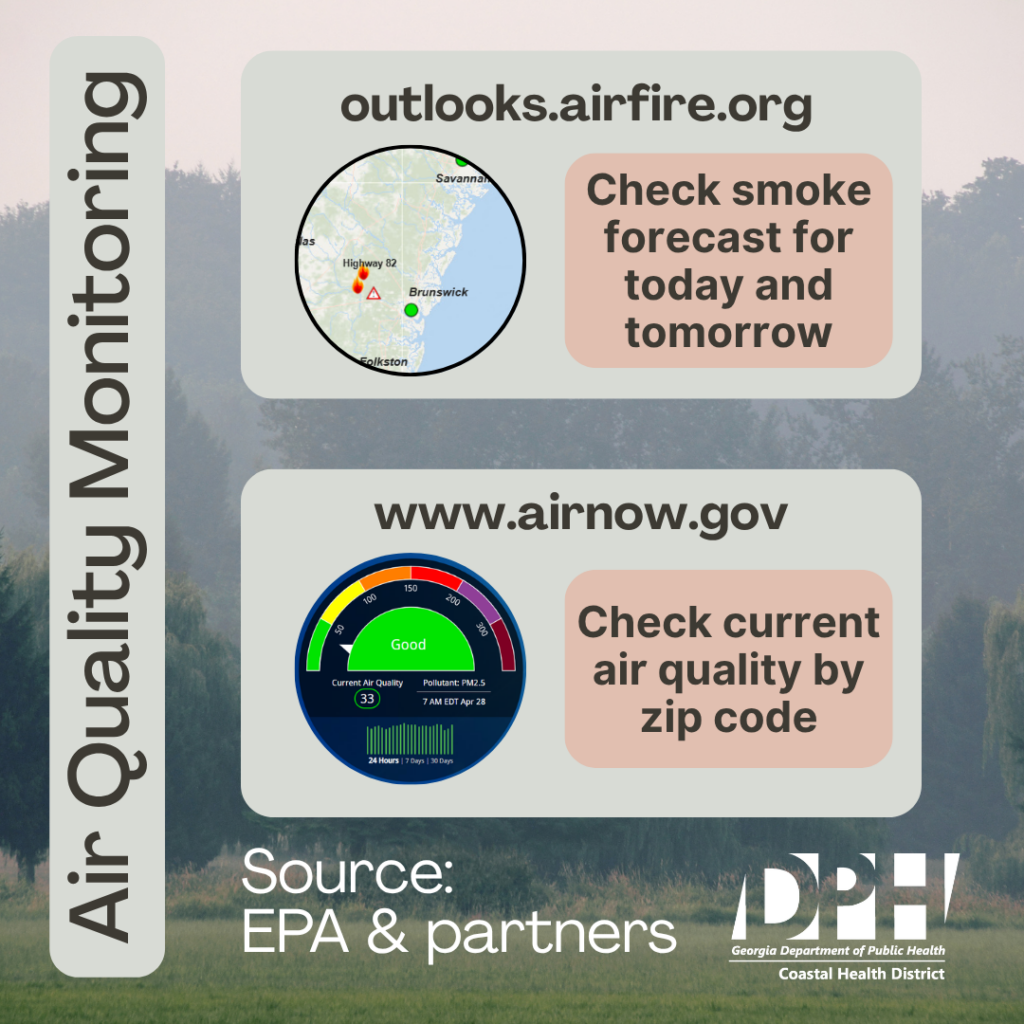
Wildfire smoke can be harmful to your health, particularly if you have asthma or other lung diseases. As wildfires continue to burn in our region, here are two federal resources for air quality information.

U.S. Interagency Wildland Fire Air Quality Response Program

  • At outlooks.airfire.org, you can click on a specific fire and see the regional smoke outlook for that day and the next.

Environmental Protection Agency & Partners

  • At www.airnow.gov, you can type in your zip code to see the current air quality index.
decorative graphic [PNG, 1,018.79 KB]

Protecting Your Health from Wildfire Smoke

The Coastal Health District is encouraging residents to take precautions when wildfire smoke is impacting air quality across the Coastal Health District.

Wildfire smoke can make anyone sick, but some people have a higher risk of health problems associated with wildfire smoke. People at increased risk include individuals with chronic conditions like asthma, Chronic Obstructive Pulmonary Disease (COPD), diabetes, chronic kidney disease, or heart disease. Pregnant women, children, and first responders are also at higher risk.

If wildfire smoke is impacting your area, you’re encouraged to:

  • Stay inside and away from the smoke.
  • Keep indoor air as clean as possible. Keep windows and doors closed. Run an air conditioner if you have one but keep the fresh air intake closed and the filter clean to prevent outdoor smoke from getting inside. You can also use fans inside the home to help stay cool.
  • Avoid activities that increase indoor pollution such as smoking or vaping, spraying aerosol products, burning candles or incense, or vacuuming unless your vacuum has a HEPA filter.
  • Keep airways moist by drinking plenty of water.
  • Follow the advice of your health care provider about medicines and your respiratory management plan if you have asthma, COPD, or any other lung or heart disease. Seek medical attention if you are having difficulty breathing or if your symptoms worsen.

Get more information about protecting your health from wildfire smoke at the website of the CDC.

Health Departments Offer Free Testing Events in April for STI Awareness Month

Health departments in the Coastal Health District are offering free testing events for sexually transmitted infections, or STIs, during STI Awareness Month in April.

STI testing is always available without an appointment during clinic hours at health departments in coastal Georgia. But during these special events, STI testing will be offered at no cost. A full list of free STI testing events is at the bottom of this page.

One in five people in the U.S. has an STI. Many infections don’t have obvious symptoms at first, but if left untreated, they can cause severe, long-term health problems and spread to partners.

STI testing is important for anyone who is sexually active, including adolescents, adults, and pregnant women.  STIs can cause serious health problems for pregnant moms and can be passed to their unborn babies.

The good news is, all STIs can be treated, and most can be cured. Routine STI testing can help individuals get treatment early, protect their health, and have open, informed conversations with partners. Testing is quick, confidential, and often easier than people expect.

In 2024, more than 2.2 million STIs were reported across the United States. Overall, rates have declined in recent years but are still much higher than STI rates of a decade ago, reinforcing the need to continue prioritizing STI prevention, testing, and treatment.

Free STI Testing Events in the Coastal Health District

Bryan County

  • April 22, 8-11am and 1-4pm, 430 Ledford St., Pembroke
    Appointments preferred but not required
  • April 14, 8-11am and 1-4pm, 66 Capt. Matthew Freeman Dr., Richmond Hill
    Appointments preferred but not required

Camden County

  • April 16, 8am-12pm and 1-5:30pm, 101 Winding Rd., Kingsland
    Appointments preferred but not required

Chatham County

  • April 13-17, 8-11am and 1-4pm, Mon. through Thurs., 8a-1p on Friday
    1395 Eisenhower Dr. & 1602 Drayton St., Savannah
    No appointment needed

Effingham County

  • April 13-17, 8-11am and 1-4pm, Mon. through Thurs., 8a-12p on Friday
    802 Hwy. 119 South, Springfield
    Appointments preferred but not required

Glynn County

  • April 16, 8am-12pm and 1-5pm, 2747 Fourth St., Brunswick
    No appointment needed

Liberty County

  • April 13-17, 8-11am and 1-4pm, Mon. through Thurs., 8a-12p on Friday
    1113 East Oglethorpe Hwy., Hinesville
    Appointments preferred but not required

Long County

  • April 20-24, 8-11am and 1-4pm, Mon. through Thurs., 8a-12p on Friday
    584 N. Macon St., Ludowici
    Appointments preferred but not required

McIntosh County

  • April 14, 8-11am and 1-4pm, 1335 GA Hwy 57, Townsend
    Appointments preferred but not required

Coastal Health District Issues Warning After Report of Fake Health Inspector in Glynn County

The Coastal Health District is warning individuals and businesses after receiving a report that an unknown person falsely claimed to be a health inspector and threatened to close a Glynn County restaurant. The restaurant manager reported the incident to the Glynn County Health Department on Monday, Feb. 10, stating that the encounter occurred over the weekend with an angry patron who made the false claim.

Because the individual did not ask for money or favors, law enforcement was not involved. However, the Coastal Health District is sharing the following information to help protect individuals and businesses from potential fraudulent encounters.

“We take incidents like this very seriously, because we take integrity and professionalism seriously,” said Environmental Health Director Brant Phelps. “This is a good opportunity to let folks know what to expect from our health inspectors and how to recognize suspicious behavior.”

County health inspectors:

  • Carry official identification cards. Businesses may ask to see the inspector’s ID and may call the county environmental health office to verify credentials.
  • Never accept money in the field. Fees for permits and other environmental health services are paid directly to the health department and are never collected in cash.

If the behavior of someone claiming to be a health inspector seems suspicious, contact the county environmental health office to verify their identity. Never pay for environmental health services in cash or directly to an individual in the field.