The Coastal Health District of Georgia serves the counties of Bryan, Camden, Chatham, Effingham, Glynn, Liberty, Long & McIntosh

Posts by District_PIO


Ya Gotta Have Heart

February is heart month. Every year, 1.5 million heart attacks or strokes happen in the United States and about 800,000 people die from heart disease in our country. Heart disease is the leading cause of death for both men and women. You can make healthy changes to lower your risk of developing heart disease. Controlling and preventing risk factors is also important for people who already have heart disease. To lower your risk:

  • Watch your weight.
  • Quit smoking and stay away from secondhand smoke.
  • Control your cholesterol and blood pressure.
  • Get active and eat healthy.
  • Participate in 30 minutes of moderate physical activity on most days of the week.
  • Eat a healthy diet that is high in fruits and vegetables and low in sodium, saturated fats, trans fat, and cholesterol.
  • Manage stress.
  • Limit the amount of alcohol you drink (no more than one drink each day for women and two for men).
  • If you have high blood pressure and are prescribed medication, take it as directed.
  • If you have a family member who has high blood pressure, you can help by taking many of the steps listed above with them. Go for walks together or cook meals with lower sodium. Make it a family affair!
  • Check your blood pressure regularly.

How much do you know about heart disease? Find out by taking this six question Heart Disease Quiz.

Let someone you love know how important it is to control and prevent heart disease by sending an E-Card.

Learn more about preventing heart disease and stroke via Million Hearts campaign.

MH_Logo_Red_Bkd


“Let’s Dance, Savannah!” Scheduled for February 6

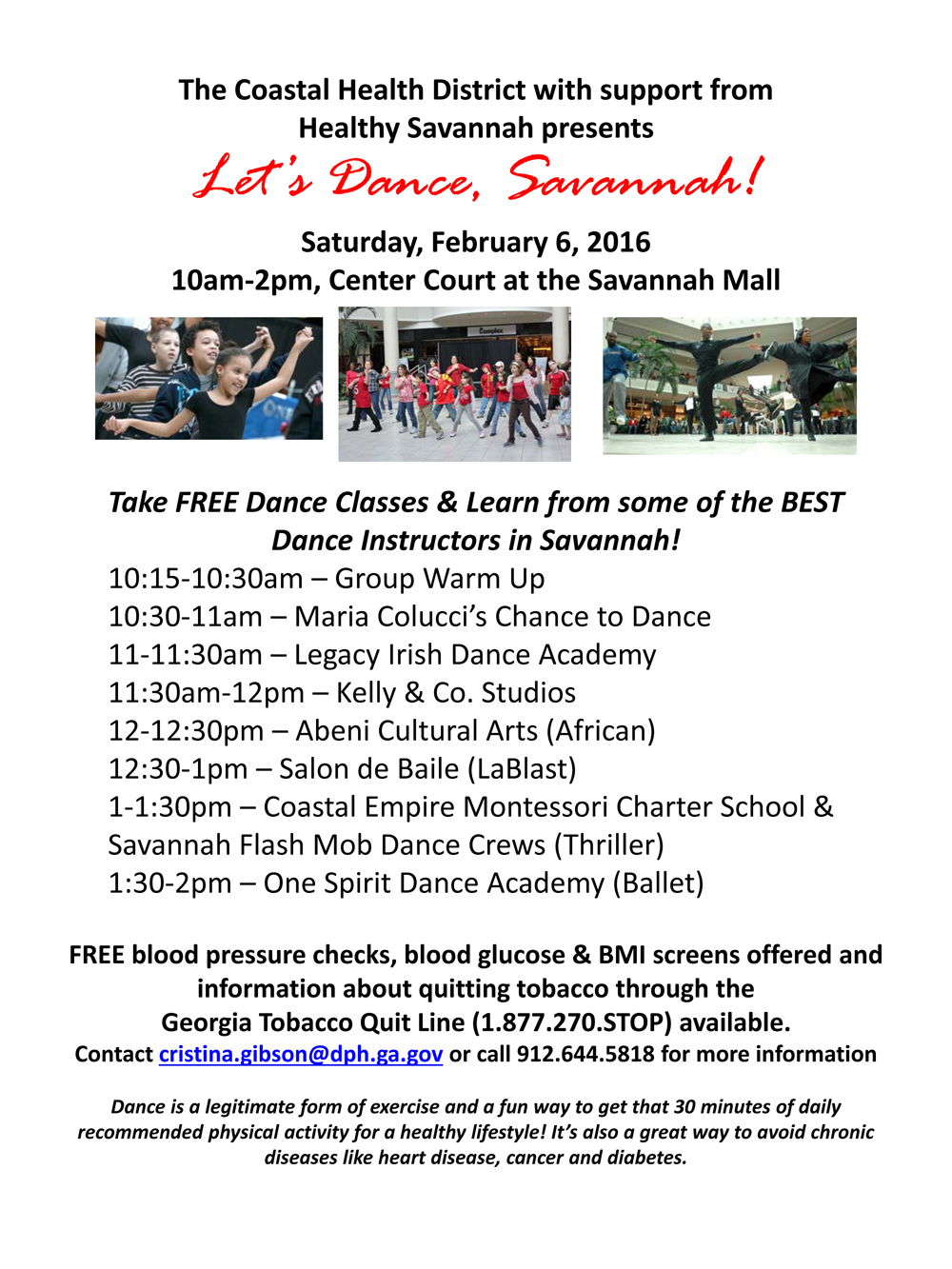
The Coastal Health District, with support from Healthy Savannah, will host “Let’s Dance, Savannah!” from 10 a.m. to 2 p.m. on Saturday, February 6, at Savannah Mall’s Center Court. The day of free dance demonstrations and classes is being offered to encourage dancing as a legitimate form of exercise and to teach people about the importance of cardiovascular health.

The event will include free dance classes, blood pressure screenings, Body Mass Index (BMI) measurements, and blood glucose testing. There will also be information on how to quit tobacco using the Georgia Tobacco Quit Line.

“Dance is truly a fun way to get in that 30 minutes of moderate exercise per day,” said Coastal Health District Chronic Disease Prevention Director, Cristina Gibson. “Dancing as a form of exercise, along with other healthy behaviors, can help keep your heart healthy.”

February is heart month and heart disease is the leading cause of death in the United States. According to the Centers for Disease Control and Prevention (CDC), 800,000 die from heart disease in the U.S. every year. Eating healthy, exercising regularly and maintaining a healthy weight, and not using tobacco can help prevent heart disease which can lead to stroke and heart attacks.

Groups scheduled to take part in the event include Maria Colucci’s Chance to Dance, Legacy Irish Dance Academy, Kelly & Co. Studios, Abeni Cultural Arts, Salon de Baile, Coastal Empire Montessori Charter School & Savannah Flash Mob Dance Crews, and One Spirit Dance Academy.

Microsoft PowerPoint - LDS Flyer [JPG, 569.00 KB]

Coastal Health District Counties Awarded Car Seat Mini-Grant: Buckle Up Right, Every Trip, Every Time

The Georgia Department of Public Health’s (DPH), Injury Prevention Program is pleased to announce that all Coastal Health District counties – Bryan, Camden, Chatham, Effingham, Glynn, Liberty, Long, and McIntosh – have been named recipients of the Child Passenger Safety Mini-Grant. The Child Passenger Safety Mini-Grant program helps county health departments and their community partners reduce the number of injuries and deaths among children in Georgia. This year’s $161,000 award will be used to support the purchase of car seats to be distributed in 137 Georgia counties. Funding for these efforts is provided by the Governor’s Office of Highway Safety (GOHS).

Since 2007, at least 283 children in Georgia who were involved in crashes were saved from serious injury or death by car seats, booster seats, and education provided through the Mini-Grant.

“Motor vehicle crashes are a leading cause of death for children and it’s up to all of us to do everything we can to protect our children on the road,” said Coastal Health District Health Director, Diane Weems, M.D. “Buckling up our children is the best way to save lives and reduce injuries.”

Throughout Georgia, DPH and county health departments work with community partners to educate parents and caregivers on how to properly install and use car seats, offer car seat inspections and provide car seats and booster seats to financially eligible families. Through the Car Seat Mini-Grant, agencies supporting more than 135 counties are working to keep Georgia’s children safe. These programs help families get their children buckled up right, every trip, every time.

DPH takes great pride in providing opportunities to enhance community outreach programs in Georgia. Through our collective efforts, we can make considerable strides in achieving our goals. For more information on the child Occupant Safety Project, please email injury.prevention@dph.ga.gov or call the office at 404-679-0500.

Additional information can be found at: www.gacarseats.com.

BRAVE III Breast Cancer Survivors Hold Successful Fundraiser

LIBERTY COUNTY, GA – Liberty County Health Department staff, along with breast cancer survivors from the BRAVE III (Be Readily Available and Very Empathetic) Project, recently raffled off a handmade quilt and raised close to $500 for the Susan G. Komen Coastal Georgia Affiliate.

The mission of the BRAVE project is to increase access to preventive breast health education, and provide screening mammograms, early diagnostic procedures, and client navigator and tracking services to African American women in rural Liberty County and Hispanic women in Long County. The BRAVE project has received grant funding from the Komen Coastal Georgia Affiliate for the past several years and as a result, more than 500 women have been screened for breast cancer and more than 300 have received screening mammograms free of charge.

“Fundraising is a way that women who have benefited from the BRAVE grant can give something back to the Komen Coastal Georgia Affiliate so other women can benefit from similar services in the future,” said Liberty County Health Department Nurse Manager, Annie Washington, R.N.

Fleming resident, Eunice Dudley, made the quilt. Coastal Health District Health Director and breast cancer survivor, Diane Weems, M.D., was the lucky winner.

“It is so fitting that Dr. Weems is the recipient of the quilt,” said Washington. “She has really done a lot to promote breast cancer education and awareness in Liberty County and is a great champion for the BRAVE project.”

Suzie Qs & Dr. Diane Weems

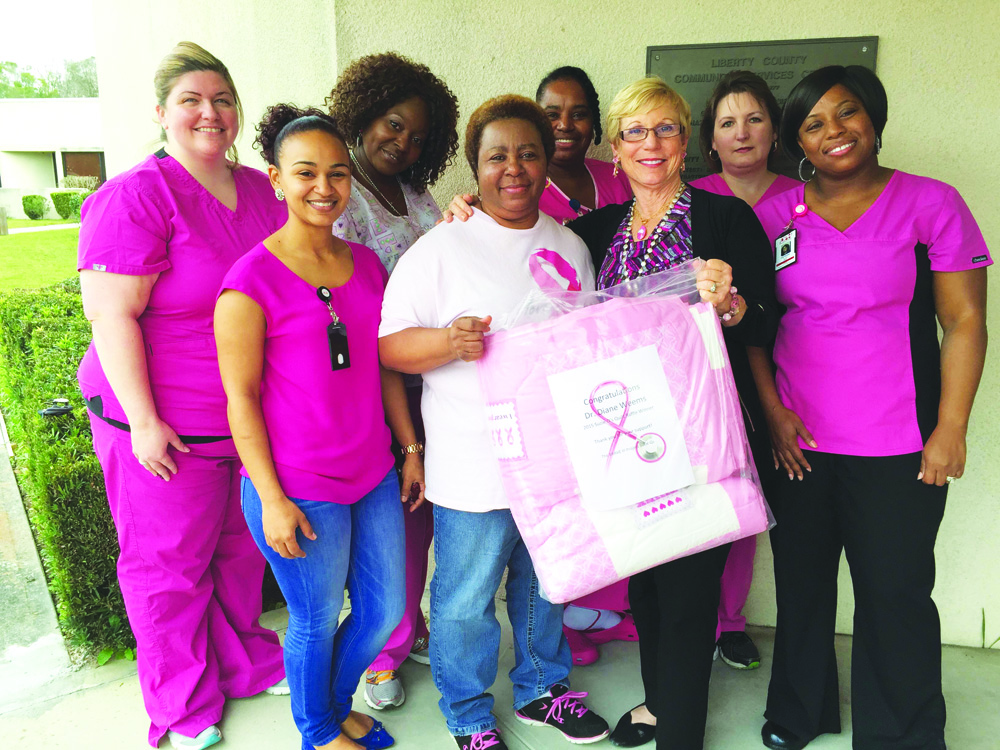
[JPG, 1.01 MB] Quilt winner, Dr. Diane Weems, and members of the Suzie Q’s breast cancer support group and BRAVE III Project. Picture IDs are below: Front row left to right: Dahiana Rivas, BRAVE Project patient navigator; Leola Lambert, R.N., cancer survivor; Dr. Diane Weems, breast cancer survivor and Health Director of the Coastal Health District. Back row left to right: Cheryl Banks, LPN; Valarie Smitherman, Public Health Technician; Linda Spellman, LPN; Stephanie Martin, R.N.; and LaTonya Turner, R.N. (Click on image for full screen view).

Beach Monitoring and Notification Program Begins Using New Thresholds to Determine Beach Water Advisories

BRUNSWICK, GA (January 5, 2016) – Effective January 1, 2016, the Beach Monitoring and Notification Program began using a new bacterial level threshold – recommended by the Environmental Protection Agency (EPA) –  in order to determine when swimming advisories should be issued. The Beach Monitoring and Notification Program is a cooperative effort between the Georgia Department of Natural Resources (GDNR) and the Georgia Department of Public Health (GDPH).

The GDNR tests the water weekly at Georgia’s coastal beaches where swimming is a popular activity. When elevated levels of bacteria are found exceeding the EPA recommended threshold, the GDPH, and more specifically the Coastal Health District, issues a swimming advisory for that beach. The new bacterial threshold value recommended by the EPA is more protective of public health. However, since Georgia’s beaches have good water quality overall, the new advisory threshold is not expected to appreciably increase the number of swimming advisories.

More information on the Beach Monitoring and Notification Program can be found on the Coastal Health District website at www.coastalhealthdistrict.org or the Georgia Department of Natural Resources Healthy Beaches website at http://www.GaHealthyBeaches.org/

THIS NEWS RELEASE WAS WRITTEN AND DISTRIBUTED BY THE
GEORGIA DEPARTMENT OF NATURAL RESOURCES COASTAL RESOURCES DIVISION.

Raccoon Tests Positive for Rabies on Wilmington Island

A dog attacked and killed a raccoon on Wilmington Island Road and the raccoon has since tested positive for rabies. The dog is up-to-date on rabies vaccinations and will be given a booster vaccine and remain under observation for 45 days.

Residents are encouraged to call the Chatham County Environmental Health division at 356-2160 or Chatham County Animal Control at 525-2408 if they see any animal exhibiting abnormal behavior. Symptoms of rabies in animals include a change in behavior, biting, aggression, showing no fear of natural enemies (such as humans), foaming at the mouth, and paralysis.

Several species of wild animals that are native to coastal Georgia – including raccoons, foxes, and bats – can carry rabies. Rabies is a potentially deadly virus that is primarily spread by infected animals. The Chatham County Health Department Environmental Health Division offers these tips to protect you and your family from rabies:

  • Avoid contact with animals you don’t know.
  • Make sure your pets receive the proper immunizations. Dogs and cats should get rabies vaccines by four months of age, followed by a booster shot one year later, and another one every year as prescribed by your veterinarian.
  • Do not handle, feed, or unintentionally attract wild animals with open garbage cans or by leaving pet food out at night.
  • Never adopt wild animals or bring them into your home. Do not try to nurse sick animals to health. Call animal control or a properly licensed animal rescue agency for assistance.
  • Teach children to never handle unfamiliar animals, wild or domestic, even if they appear friendly. “Love your own, leave other animals alone” is a good principle for children to learn.

We Are Family

Whether it’s the one you are born into or the one you create, family matters. For people living with HIV, having the support of loved ones makes a big difference in health outcomes and general well-being.

WE ARE FAMILY is a new campaign from Greater Than AIDS and the Georgia Department of Public Health to reinforce the importance of social support for people living with HIV. Produced as part of the Georgia Greater Than AIDS (Georgia>AIDS) public information partnership, the multi-platform media and community outreach campaign profiles families from across the state who have a loved one living with HIV.

Research shows people with HIV who have strong support networks are more likely to get and stay in care, which both improves health outcomes and reduces the spread of the disease.  Conversely, fear of judgement and rejection can delay a person from seeking lifesaving treatment or even knowing their status.

“Getting Georgians tested and linking HIV-positive patients with treatment is essential to reducing HIV transmission in Georgia,” said Patrick O’Neal, M.D., director of Health Protection for the Georgia Department of Public Health. “An HIV-positive person is 96 percent less-likely to pass the virus to others if they’re adhering to an appropriate treatment regimen.”

According to a new statewide survey conducted by the Kaiser Family Foundation that is being released today in conjunction with the new campaign, nearly half (46%) of Georgians say they personally know someone living with, or who has died of, HIV/AIDS.  More than one in four (28%) Black residents report having a family member affected by the disease.

Georgia has the fifth highest number of HIV/AIDS diagnoses in the country. As is the case nationally, Blacks are the most severely and disproportionately affected of all races and ethnicities, accounting for two thirds (67%) of new diagnoses in Georgia in 2013, according to the Georgia Department of Public Health.

“HIV has touched many lives, yet it’s not talked about even with those closest to us,” says Tina Hoff, Senior Vice President and Director of Health Communication and Media Partnerships at the Kaiser Family Foundation, which directs Greater Than AIDS. “Too many are getting HIV, and even dying, because of the stigma and silence.”

The large majority of Georgians surveyed say HIV “rarely,” if at all, comes up in conversations with friends, family or even intimate partners. Blacks and those with a personal connection to HIV are more likely to report talking about HIV, though most say not often.

Anchored by a series of documentary-style short videos, We  Are Family features a grandmother and her grown son, a college student and his parents, a pastor and his congregation, a recovering addict and his mother, a transgender woman and her sister, and childhood best friends. Their stories provide a powerful illustration of the difference it can make for people with HIV to have the support of family and friends.

In one profile, Masonia, a young mother who was diagnosed when she was pregnant, says of her best-friend Crystal, “she saved my life by showing me love.” In another, Abraham, a pre-med student, shares how his mother checks in regularly to make sure he’s doing okay: “She’s always asking me: ‘Did you take your medications today?’”

A statewide outdoor, transit, radio, TV and digital media campaign promotes local resources to support individuals living with HIV and their loved ones.

Community toolkits – including informational resources, posters, and other items highlighting local services – are being distributed to AIDS service and other community-based organizations across the state to support on-the-ground outreach.

For more about the campaign, informational resources, and to watch the videos, go to:  georgia.greaterthan.org

It’s Not Too Late for Flu Vaccine

It’s not too late to vaccinate – Get your flu vaccine today! After November when you see signs that advertise: “Get Your Flu Vaccine Here,” you might think, “Isn’t it too late for that?” As long as flu viruses are spreading, it’s not too late to get a vaccine to protect yourself and your loved ones.

“Flu season typically peaks between December and February but significant activity can occur as late as May,” says Dr. Dan Jernigan, Deputy Director of the Influenza Division in the National Center for Immunization and Respiratory Diseases (NCIRD) at CDC. “We are encouraging people who have not yet been vaccinated this season to get vaccinated now.”

For millions of people every season, the flu can mean a fever, cough, sore throat, runny or stuffy nose, muscle aches, fatigue, and miserable days spent in bed. However, you may not realize that each flu season, flu also causes hundreds of thousands of hospitalizations, and thousands or sometimes tens of thousands of deaths.

But there is a vaccine that can prevent flu. While how well the vaccine works can vary, the benefits from vaccination are well documented. Studies show that flu vaccination can reduce flu illnesses, doctors’ visits, missed work and school due to flu, as well as prevent flu-related hospitalizations.

This is why CDC recommends an annual flu vaccine for everyone 6 months and older. Flu vaccine is available as a shot and as a nasal spray. According to Dr. Jernigan, however, “the most important thing is that you get vaccinated, not necessarily which vaccine you get.” Talk to your doctor or other health care professional about which vaccine is best for you and your family.

Some people are at high risk for serious flu-related complications, like pneumonia, that can lead to hospitalization and even death. This includes young children, pregnant women, people 65 and older and people with certain medical conditions, like asthma, diabetes or heart disease. For those at high risk for complications, getting the flu vaccine is especially important. It’s also important to get the vaccine if you care for anyone at high risk, including babies younger than 6 months because they are too young to get the vaccine. To learn more about high risk conditions, visit http://www.cdc.gov/flu/about/disease/high_risk.htm.

Children 6 months through 8 years of age who are getting vaccinated for the first time may need two doses of flu vaccine to be fully protected. If a child has not received his/her first dose, get them vaccinated now. For children who are 6 months through 8 years of age and who have been vaccinated with one dose, parents should check with the child’s doctor or other health care professional to see if a second dose is needed. “Getting the flu vaccine is simple, and it’s the most important thing you can do to protect yourself and your family from the flu,” says Dr. Jernigan. Millions of people have safely received flu vaccines for decades.

As long as the flu is spreading, you can still benefit from a flu vaccine.  For more information about influenza or the flu vaccine, talk to your doctor or other health care professional, visit http://www.cdc.gov/flu or call CDC at 1-800-CDCINFO (800-232-4636).

Are You Ready for Colder Weather?

Temperatures in the South tend to change quickly during winter months so being prepared is key. The Centers for Disease Control and Prevention (CDC) suggests taking these steps to prepare your home to stay safe and warm during the winter months.

Winterize your home.

  • Install weather stripping, insulation, and storm windows.
  • Insulate water lines that run along exterior walls.
  • Clean out gutters and repair roof leaks.

Check your heating systems.

  • Have your heating system serviced professionally to make sure that it is clean, working properly and ventilated to the outside.
  • Inspect and clean fireplaces and chimneys.
  • Install a smoke detector. Test batteries monthly.
  • Have a safe alternate heating source and alternate fuels available.
  • Prevent carbon monoxide (CO) emergencies.
  • Install a CO detector to alert you of the presence of the deadly, odorless, colorless gas.
  • Learn symptoms of CO poisoning: headaches, nausea, and disorientation.
  • Keep grills and generators out of the house and garage. Position generators at least 20 feet from the house.

Be prepared for weather-related emergencies, including power outages.

  • Stock food that needs no cooking or refrigeration and water stored in clean containers.
  • Keep an up-to-date emergency kit, including:
    – battery-operated devices, such as a flashlight, a National Oceanic and Atmospheric Administration (NOAA) Weather Radio, and lamps;
    – extra batteries;
    – first-aid kit and extra medicine;
    – baby items; and
    – cat litter or sand for icy walkways

Your car also needs to be winterized. Make sure that you have the appropriate amount of antifreeze and that your tires are in good condition. Keep a first-aid kit in your car and get your vehicle serviced as recommended by the manufacturer.

Fox Tests Positive for Rabies; Two Human Exposures Confirmed

Two people in the Nassau Woods area of Dean Forest Road in Chatham County were exposed to a fox that has tested positive for rabies. The fox was initially seen running in the street. It then came onto private property and either bit or scratched two adults on the property. The fox was not provoked.

Residents are encouraged to call the Chatham County Environmental Health division at 356-2160 or Chatham County Animal Control at 525-2408 if they see any animal exhibiting abnormal behavior. Symptoms of rabies in animals include a change in behavior, biting, aggression, showing no fear of natural enemies (such as humans), foaming at the mouth, and paralysis.

Several species of wild animals that are native to coastal Georgia – including raccoons, foxes, and bats – can carry rabies. Rabies is a potentially deadly virus that is primarily spread by infected animals. The Chatham County Health Department Environmental Health Division offers these tips to protect you and your family from rabies:

  • Avoid contact with animals you don’t know.
  • Make sure your pets receive the proper immunizations. Dogs and cats should get rabies vaccines by four months of age, followed by a booster shot one year later, and another one every year as prescribed by your veterinarian.
  • Do not handle, feed, or unintentionally attract wild animals with open garbage cans or by leaving pet food out at night.
  • Never adopt wild animals or bring them into your home. Do not try to nurse sick animals to health. Call animal control or a properly licensed animal rescue agency for assistance.
  • Teach children to never handle unfamiliar animals, wild or domestic, even if they appear friendly. “Love your own, leave other animals alone” is a good principle for children to learn.