The Coastal Health District of Georgia serves the counties of Bryan, Camden, Chatham, Effingham, Glynn, Liberty, Long & McIntosh

Posts by CHD Communications


DPH Will Resume J&J Vaccinations in Georgia

Following a thorough safety review, the U.S. Food and Drug Administration, the CDC
and ACIP have determined that the recommended pause regarding the use of the J&J COVID
vaccine in the U.S. should be lifted.

The Georgia Department of Public Health (DPH) will again offer J&J vaccine to Georgians aged
18 and older. Details on when administration of the vaccine will begin again in Georgia will be
forthcoming, pending communication with providers.

The federal agencies advised that a warning should be added to the vaccine about the potential
for very rare, but severe blood clots associated with the J&J vaccine. In particular, women under
the age of 50 should be made of aware of the increased risk of thrombosis and
thrombocytopenia syndrome and may choose to receive another vaccine.

At the time J&J vaccine administration was paused, more than 124,000 doses of J&J vaccine
had been safely administered in Georgia. Approximately 211,000 doses are currently in
inventory statewide.

Vaccination remains one of our best tools for stopping the spread of COVID-19, along with basic
prevention measures – wearing a mask, distancing from others, avoiding large gatherings, and
washing your hands frequently

Beach Advisory Issued on Tybee Island

Updated April 22, 2021

The Chatham County Health Department has lifted the advisory for Tybee Strand Beach at the Pier, which stretches from 11th Street to 18th Street on Tybee Island.

The advisory was issued on April 20, 2021 after routine water quality tests showed a high level of enterococci bacteria which increase the risk of gastrointestinal illness in swimmers.

Subsequent water samples showed the bacteria levels had dropped below Environmental Protection Agency’s recommended limits. Therefore, the advisory has been lifted.

April 20, 2021

The Chatham County Health Department has issued a beach water advisory for Tybee Strand Beach at the Pier, which includes the beach area from Eleventh Street to Eighteenth Street on Tybee Island.

When an advisory is issued, it is only for the area specified and does not impact other beach areas on the island. There is no way of knowing if going into water that is under advisory will result in illness. However, beach water advisories are to alert the public of a possible risk of illness associated with water contact. An area under advisory does not mean the beach is closed.

Water samples are collected routinely on Georgia’s islands throughout the year. The samples are tested for enterococcus (pronounced: en·ter·o·coc·cus) bacteria which is found in warm blooded animals including humans but also birds, raccoons, deer, dolphins and other wildlife. It is difficult to determine exactly where the bacteria come from, but some sources could include animal waste, storm water runoff, or boating waste. When a beach is under advisory, it means that the level of bacteria found in the water is above the Environmental Protection Agency’s recommended standards.

The Health Department recommends you do not swim or wade in the water in the area under advisory. Fish and other seafood caught from this area should be thoroughly washed with fresh water and thoroughly cooked before eating, as should fish or seafood caught from any waters.

The area will be re-tested, and the advisory will be lifted when tests show the bacteria levels meet the Environmental Protection Agency’s recommended standards.

For more information, visit our Beach Water Testing Program page.

COVID-19 Testing in Glynn County Shifts to Curbside Service April 19

Beginning Monday, April 19th, the drive-through COVID-19 testing service at the Glynn County Health Department will shift to a curbside model. The health department will still have the capacity to test more than 400 people each week, but the change will free up more space in the parking lot and require fewer resources, like outdoor tents and tables.

“If you’ve ever used curbside service for shopping or take-out food, then this model will be very familiar,” said Adam Sanchez, Nurse Manager of the Glynn County Health Department. “Clients with appointments will pull into one of 10 designated parking spaces and call the telephone number on the sign. You can stay inside your car and we’ll come out to collect the nasal swab sample for testing. Then you’re on your way, with results in 24-36 hours.”

There is no cost for COVID-19 testing through the Glynn County Health Department. All testing is by appointment only and is offered Mondays, Wednesdays, and Fridays from 8 a.m. – 12 p.m.

Appointments can be scheduled online at covid19.dph.ga.gov or by phone at 1-912-230-9744.

Johnson & Johnson Vaccinations Paused

Following the guidance and recommendations of the Food and Drug Administration (FDA) and the Centers for Disease Control and Prevention (CDC), the Georgia Department of Public Health (DPH) is pausing J&J (Janssen) vaccinations in Georgia until further notice.

  • The JOHNSON AND JOHNSON clinics on Tuesday, April 13 and Wednesday April 14 at the Chatham County Annex will now offer Pfizer vaccine. If you have an appointment, you may still come at your regular appointment time and will receive Pfizer instead of Johnson & Johnson. You will need to return for a second dose in three weeks.
  • The JOHNSON AND JOHNSON clinic Wednesday, April 14 at the Shuman Recreation Center in Liberty will now offer Moderna vaccine. If you have an appointment, you may still come at your regular appointment time and will receive Moderna instead of Johnson & Johnson. You will need to return for a second dose in four weeks.
  • There is a JOHNSON AND JOHNSON clinic scheduled for April 24th in Camden. At this time, we do not know what vaccine will be offered – we will wait for further instruction from FDA and CDC.

The FDA and CDC are reviewing data involving six reported cases of a rare and severe type of blood clot occurring in women aged 18-48 about a week after vaccination. None of the six cases are in individuals vaccinated in Georgia.

DPH and District Health Departments are working to provide Pfizer or Moderna vaccines for individuals with previously scheduled appointments for the J&J vaccine. In some cases, this may require rescheduling, and we ask for patience while scheduling arrangements and adjustments are made.

Right now, these adverse events appear to be extremely rare, but out of an abundance of caution DPH will temporarily stop the administration of the J&J vaccine while scientists review the data around these cases. More than 124,000 doses of J&J vaccine have been safely administered in Georgia.

Individuals who have received the J&J vaccine and develop severe headache, abdominal pain leg pain or shortness of breath within three weeks after vaccination should contact their health care providers. DPH urges all health care providers to be aware of the potential for these adverse events and plan for appropriate treatment required with these types of blood clots.

Vaccination remains one of our best tools for stopping the spread of COVID-19, along with basic prevention measures – wearing a mask, distancing from others, avoiding large gatherings and frequent hand washing.

DPH will continue to monitor the situation with J&J vaccines and provide additional information as it becomes available.

More information is also available on the website of the FDA.

Beach Advisory Lifted on Jekyll Island

Updated April 15, 2021:

The Glynn County Health Department has lifted the advisory for North Beach at Dexter Lane on Jekyll Island.

The advisory was issued on April 13, 2021 after routine water quality tests showed a high level of enterococci bacteria which increase the risk of gastrointestinal illness in swimmers.

Subsequent water samples showed the bacteria levels had dropped below Environmental Protection Agency’s recommended limits. Therefore, the advisory has been lifted.


April 13, 2021:

The Glynn County Health Department has issued a beach water advisory for North Beach at Dexter Lane, which is from Tallu Fish Lane to Brice Lane on Jekyll Island.

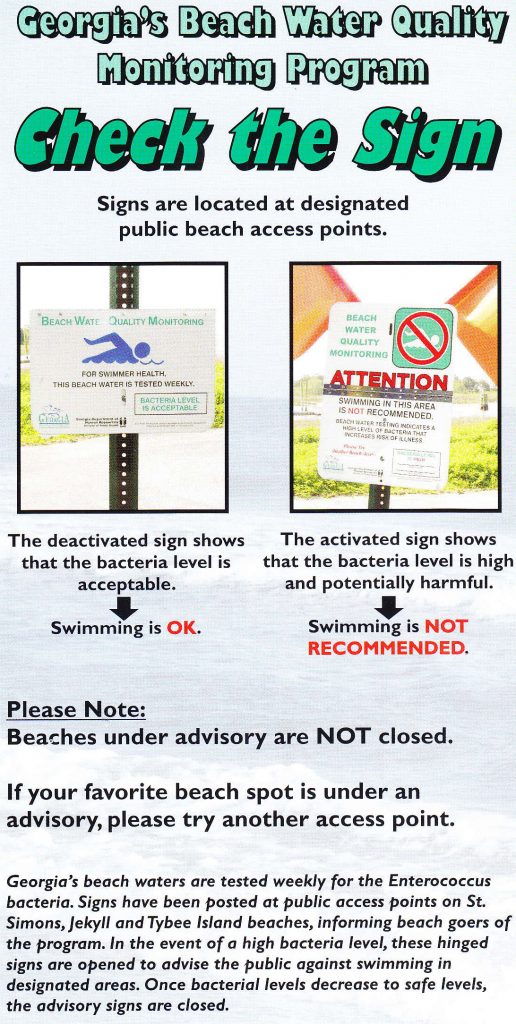
graphic showing the beach water advisory signs

The Department of Natural Resources – Coastal Resources Division tests water samples on Glynn County beaches throughout the year. The tests screen for enterococcus (pronounced: en·ter·o·coc·cus) bacteria, which are found in humans and some wildlife. The testing program is not related to the capsized motor vehicle carrier in St. Simons Sound.

When a beach is under advisory, it means the level of bacteria found in the water is above the Environmental Protection Agency’s (EPA) recommended standards. This does NOT mean the beach is closed.

The beach water advisory alerts the public of a possible risk of illness associated with water contact in the advisory area. The Health Department recommends you do not swim or wade in the water in the area under advisory. Fish and other seafood caught from this area should be thoroughly washed with fresh water and thoroughly cooked before eating, as should fish or seafood caught from any waters.

The area will be re-tested this week, and the advisory will be lifted when the bacteria levels meet the EPA’s recommended standards. For more information, visit our Beach Water Testing page.

Beach Advisory Lifted in Chatham County

Updated April 13, 2021:

The Chatham County Health Department has lifted the advisory for Tybee Strand Beach at the Pier, which stretches from 11th Street to 18th Street on Tybee Island.

The advisory was issued on April 6, 2021 after routine water quality tests showed a high level of enterococci bacteria which increase the risk of gastrointestinal illness in swimmers.

Subsequent water samples showed the bacteria levels had dropped below Environmental Protection Agency’s recommended limits. Therefore, the advisory has been lifted.


April 6, 2021:

The Chatham County Health Department has issued a beach water advisory for Tybee Strand Beach at the Pier, which includes the beach area from Eleventh Street to Eighteenth Street on Tybee Island.

When an advisory is issued, it is only for the area specified and does not impact other beach areas on the island. There is no way of knowing if going into water that is under advisory will result in illness. However, beach water advisories are to alert the public of a possible risk of illness associated with water contact. An area under advisory does not mean the beach is closed.

Water samples are collected routinely on Georgia’s islands throughout the year. The samples are tested for enterococcus (pronounced: en·ter·o·coc·cus) bacteria which is found in warm blooded animals including humans but also birds, raccoons, deer, dolphins and other wildlife. It is difficult to determine exactly where the bacteria come from, but some sources could include animal waste, storm water runoff, or boating waste. When a beach is under advisory, it means that the level of bacteria found in the water is above the Environmental Protection Agency’s recommended standards.

The Health Department recommends you do not swim or wade in the water in the area under advisory. Fish and other seafood caught from this area should be thoroughly washed with fresh water and thoroughly cooked before eating, as should fish or seafood caught from any waters.

The area will be re-tested, and the advisory will be lifted when tests show the bacteria levels meet the Environmental Protection Agency’s recommended standards.

For more information, visit our Beach Water Testing Program page.

Beach Advisory Lifted for St. Simons Island

The Glynn County Health Department has lifted the beach water advisory for North Beach at Goulds Inlet on St. Simons Island.

The advisory was issued on April 6, 2021 after routine water quality tests showed a high level of enterococci bacteria which increase the risk of gastrointestinal illness in swimmers.

Subsequent water samples taken showed that the bacteria levels had dropped below Environmental Protection Agency’s recommended limits. Therefore, the advisory has been lifted.

For more information, visit our Beach Water Testing Program page.

COVID-19 Testing at Savannah Civic Center Will Shift to Walk-up Service on Wednesdays and Thursdays

COVID-19 testing by public health at the Savannah Civic Center will shift from a drive-through model to walk-up testing two days per week.

Beginning March 31st, walk-up testing will be offered every Wednesday and Thursday. Individuals may come on foot or may park in the Civic Center parking lot and walk into the testing site. Drive-through testing will continue to be offered each Monday, Tuesday, and Friday, as well as two Saturdays per month.

Appointments for COVID-19 testing at the Civic Center are not required, but you can pre-register for a test at www.covidtestsavannah.com.

There is no out-of-pocket charge for COVID-19 testing at the Civic Center site. Health insurance will be billed for those with insurance, but insurance is not required, and no one will be charged a fee.

Summary of COVID-19 Testing Operations at Civic Center Site, 301 West Oglethorpe Ave., Savannah

  • COVID-19 Testing provided by Mako Medical in partnership with the Georgia Department of Public Health
  • No appointment needed, but pre-registration encouraged at www.covidtestsavannah.com
  • Charge: None. Insurance will be billed if available, but insurance is not required. No out-of-pocket cost.
  • Monday: Drive-through testing 8:30 a.m. – 3:30 p.m.
  • Tuesday: Drive-through testing 8:30 a.m. – 3:30 p.m.
  • Wednesday: Walk-up testing 8:30 a.m. – 3:30 p.m.
  • Thursday: Walk-up testing 8:30 a.m. – 3:30 p.m.
  • Friday: Drive-through testing 8:30 a.m. – 3:30 p.m.
  • Every first and third Saturday of each month: Drive-through testing

Raccoon Tests Positive for Rabies on St. Simons Island

A raccoon from the mid-island area of St. Simons Island in Glynn County has tested positive for rabies. The raccoon was killed by a family dog in a residential yard; the dog was up to date on its rabies vaccination and received a booster shot. There was no human exposure to the sick raccoon.

Several species of wild animals that are native to coastal Georgia – including raccoons, foxes, and bats – can carry rabies. Rabies is a potentially deadly virus that is primarily spread by infected animals. The Glynn County Health Department Environmental Health office has these tips to protect you and your family from rabies:

  • Avoid contact with animals you don’t know.
  • Make sure your pets receive the proper immunizations. Dogs and cats should get rabies vaccines after 12 weeks of age, followed by a booster shot within one year and vaccination every 1-3 years depending on veterinary recommendation and vaccine used.
  • Do not handle, feed, or unintentionally attract wild animals with open garbage cans or by leaving pet food out at night.
  • Never adopt wild animals or bring them into your home. Do not try to nurse sick animals to health. Call animal control or a properly licensed animal rescue agency for assistance.
  • Teach children to never handle unfamiliar animals, wild or domestic, even if they appear friendly. “Love your own, leave other animals alone” is a good principle for children to learn.

Symptoms of rabies in animals include a change in behavior, biting, aggression, showing no fear of natural enemies (such as humans), foaming at the mouth, and paralysis.

If an animal ever bites you, seek medical care immediately and contact Glynn County Animal Control at 912-554-7500 and the Glynn County Health Department Environmental Health office at 912-279-2940.

Beach Advisories Lifted for St. Simons Island

Updated March 24, 2021:

The Glynn County Health Department has lifted the beach water advisories on St. Simons Island.

The advisories were issued on March 23, 2021 after routine water quality tests showed a high level of enterococci bacteria which increase the risk of gastrointestinal illness in swimmers.

Subsequent water samples show the bacteria level dropped below the Environmental Protection Agency’s recommended limits. Therefore, the advisories have been lifted.


March 23, 2021:

The Glynn County Health Department has issued water quality advisories for two beach locations on St. Simons Island. 

The areas under advisory are:

  • South Beach at the Lighthouse: from 9th Street to the Pier on St. Simons Island
  • North Beach at Goulds Inlet: from Tenth Street to Driftwood Drive on St. Simons Island

The advisory is only for the area specified above and does not impact other beach areas on the island. There is no way of knowing if going into water that is under advisory will result in illness. However, beach water advisories are to alert the public of a possible risk of illness associated with water contact. An area under advisory does not mean the beach is closed.

Water samples are collected routinely on Georgia’s islands throughout the year. The samples are tested for enterococcus (pronounced: en·ter·o·coc·cus) bacteria which is found in warm blooded animals including humans but also birds, raccoons, deer, dolphins and other wildlife. It is difficult to determine exactly where the bacteria come from, but some sources could include animal waste, storm water runoff, or boating waste. When a beach is under advisory, it means that the level of bacteria found in the water is above the Environmental Protection Agency’s recommended standards.

The Health Department recommends you do not swim or wade in the water in the area under advisory. Fish and other seafood caught from this area should be thoroughly washed with fresh water and thoroughly cooked before eating, as should fish or seafood caught from any waters.

The areas will be re-tested, and the advisories will be lifted when tests show the bacteria levels meet the Environmental Protection Agency’s recommended standards.

For more information, visit our Beach Water Testing Program page.