The Coastal Health District of Georgia serves the counties of Bryan, Camden, Chatham, Effingham, Glynn, Liberty, Long & McIntosh

Posts by CHD Communications


Free Mammograms at the Chatham County Health Department March 25

Free mammograms will be available by appointment for eligible women at the Chatham County Health Department on March 25, 2025. The St. Joseph/Candler Mobile Mammography Unit will be in the parking lot of the main health department clinic at 1395 Eisenhower Drive from 8 a.m. – 3 p.m. The no-cost screenings are open to women aged 40 and older without health insurance coverage.

Space is limited – appointments are required and can be scheduled by calling the Chatham County Health Department’s Breast and Cervical Cancer Program at 912-356-2946 or 912-307-9235.

Breast cancer is the second most commonly diagnosed cancer and the second-leading cause of cancer death in women. However, many cancer deaths can be avoided through regular screening. When breast cancer is detected and treated early, the chance of survival is greatly increased.

The Breast and Cervical Cancer Program helps increase access to life-saving screenings for women who do not have health insurance coverage for mammograms and cervical cancer screenings. For more information about available services, please visit our Breast and Cervical Cancer Program page.

Cat Tests Positive for Rabies in Savannah

A feral cat in Savannah has tested positive for rabies. On February 11, the cat was discovered on Montgomery St. near the old fairgrounds at 62nd St. in Savannah. An individual was scratched on the leg while attempting to put the sick/injured cat into a carrier.

Once the cat was successfully placed into the carrier, it was brought to Chatham County Animal Services (CCAS) for treatment. The individual advised CCAS that the cat was acting “drunk.” Due to the cat’s condition, CCAS determined it was best to euthanize the cat and have it tested for rabies. The individual has been notified of the results and is starting post-rabies exposure treatment.

Rabies is a deadly virus that is primarily spread by infected animals. This is an important reminder that rabies can circulate in several species of wild animals in coastal Georgia, including raccoons, foxes, and bats. Residents are urged not to feed wild animals or attempt to domesticate feral cats, and pet owners are reminded to ensure their animals get regular rabies shots.

The Chatham County Health Department’s Environmental Health office has these tips to protect you and your family from rabies:

  • Avoid contact with animals you don’t know.
  • Make sure your pets receive the proper immunizations. Dogs and cats should get rabies vaccines after 12 weeks of age, followed by a booster shot within one year and vaccination every 1-3 years depending on veterinary recommendation and vaccine used.
  • Do not handle, feed, or unintentionally attract wild animals with open garbage cans or by leaving pet food out at night.
  • Never adopt wild animals or bring them into your home. Do not try to nurse sick animals to health. Call animal control or a properly licensed animal rescue agency for assistance.
  • Teach children to never handle unfamiliar animals, wild or domestic, even if they appear friendly. “Love your own, leave other animals alone” is a good principle for children to learn.

Symptoms of rabies in animals include a change in behavior, biting, aggression, showing no fear of natural enemies (such as humans), foaming at the mouth, and paralysis. If an animal ever bites you, seek medical care immediately and contact Chatham County Animal Services at 912- 652-6575 and the Chatham County Environmental Health office at 912-356-2160.

Raccoon Tests Positive for Rabies in Bloomingdale

A raccoon in Bloomingdale in west Chatham County has tested positive for rabies. The Chatham County Health Department’s environmental health office reminds all residents to avoid contact with wild animals and ensure pets are properly vaccinated against rabies.

A family dog encountered the sick raccoon outside a residence near the intersection of Highway 80 and Pooler Parkway on February 3. Fortunately, no humans were exposed to the raccoon, and the dog has received a rabies vaccination booster.

This incident is a reminder that several species of wild animals in our area can carry rabies, including raccoons, foxes, and bats. Rabies is a potentially deadly virus that is primarily spread by infected animals. Following these tips can protect you and your family from rabies:

  • Avoid contact with animals you don’t know.
  • Make sure your pets receive the proper immunizations. Dogs and cats should get rabies vaccines after 12 weeks of age, followed by a booster shot within one year and vaccination every 1-3 years depending on veterinary recommendation and vaccine used.
  • Do not handle, feed, or unintentionally attract wild animals with open garbage cans or by leaving pet food out at night.
  • Never adopt wild animals or bring them into your home. Do not try to nurse sick animals to health. Call animal services or a properly licensed animal rescue agency for assistance.
  • Teach children to never handle unfamiliar animals, wild or domestic, even if they appear friendly. “Love your own, leave other animals alone” is a good principle for children to learn.

Symptoms of rabies in animals include a change in behavior, biting, aggression, showing no fear of natural enemies (such as humans), foaming at the mouth, and paralysis. If an animal ever bites you, seek medical care immediately and contact Chatham County Animal Services at 912-652-6575 and the Chatham County Environmental Health office at 912-356-2160.

Free Screenings and Resources at Chatham County Health Department Heart Health Fair February 28

Treat your heart right this February and get free blood pressure screenings, blood glucose tests and more during the Chatham County Health Department’s Heart Health and Wellness Fair. The event is planned for Friday, February 28 from 10 a.m. – 1 p.m. at the clinic at 1395 Eisenhower Drive.

There is no cost for the health screenings, and no appointment is needed. The event will also feature door prizes, as well as information and education from several community vendors.

Health screenings are very important for protecting yourself from health complications such as diabetes, heart disease and heart attack. High blood pressure is often called the “silent killer” because it usually has no symptoms. The only way to know you have high blood pressure is to measure it through blood pressure screening. If your blood pressure is too high, lifestyle changes or medicine can reduce your risk for heart disease or heart attack.

Blood glucose screenings check for health concerns like pre-diabetes and diabetes. Once you know your blood glucose levels, you can make any needed adjustments to your diet, exercise, or medications to improve your health.

The Coastal Health District has several programs to help you manage blood pressure and blood glucose levels. Find out more about these programs and other local resources at the event on February 28 and on our chronic disease prevention page.

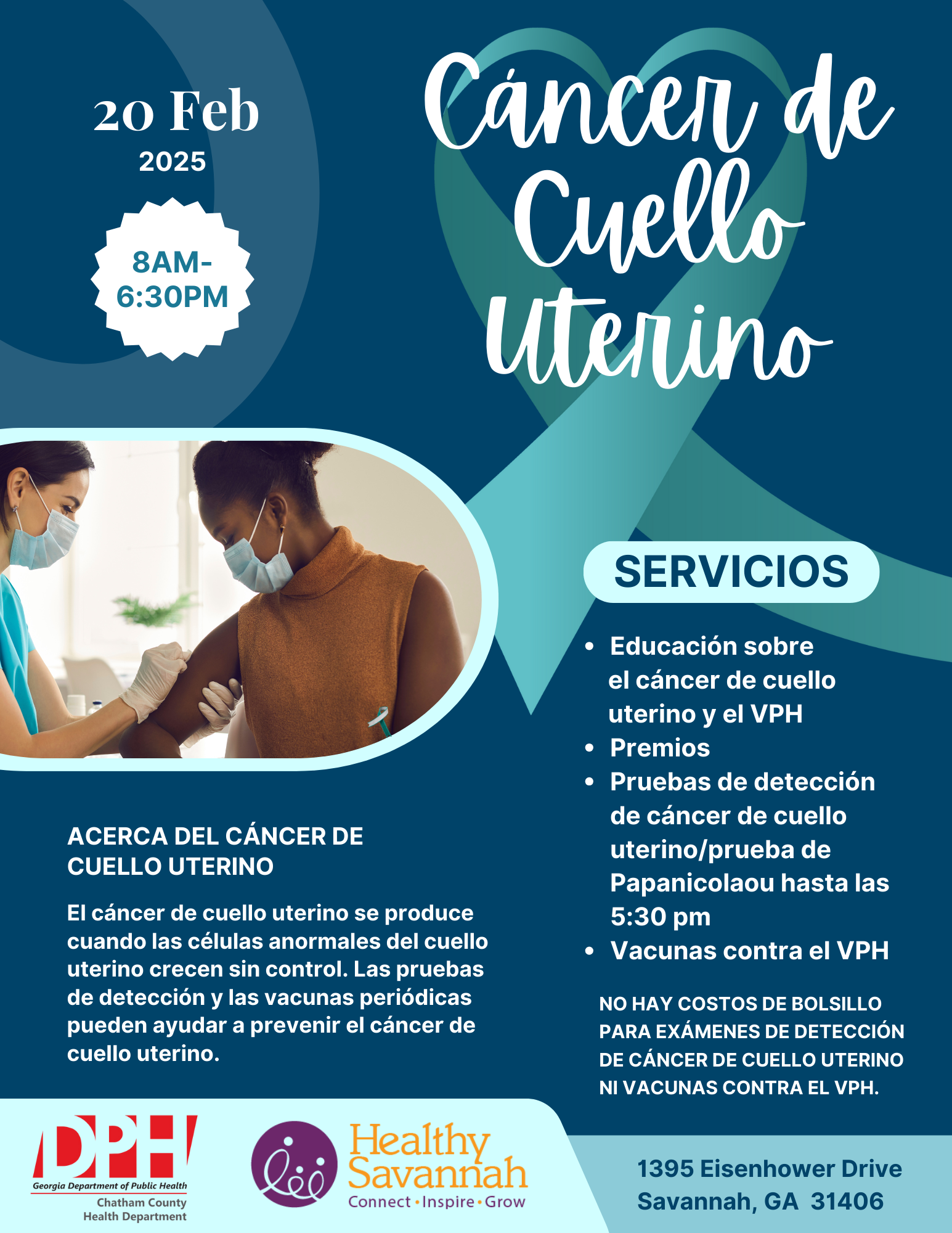
El Departamento de Salud del condado de Chatham organiza un evento de concientización sobre el cáncer de cuello uterino el 20 de febrero

El Departamento de Salud del Condado de Chatham y Healthy Savannah están organizando un evento de concientización y detección del cáncer de cuello uterino el 20 de febrero. Las mujeres que cumplan con los requisitos pueden hacerse exámenes de detección de cáncer y recibir la vacuna contra el VPH sin costo y sin necesidad de cita previa.

Casi todos los cánceres de cuello uterino se pueden prevenir, pero la vacunación y la detección temprana son fundamentales. Los exámenes de detección regulares, como las pruebas de Papanicolaou, pueden detectar lesiones precancerosas, lo que les da a las mujeres la oportunidad de comenzar el tratamiento temprano, cuando las tasas de supervivencia son más altas. Además, la vacuna contra el VPH ayuda a prevenir la infección con un virus que puede provocar cáncer de cuello uterino.

El evento de concientización sobre el cáncer de cuello uterino se llevará a cabo el jueves 20 de febrero de 8 a. m. a 6:30 p. m. en el Departamento de Salud del Condado de Chatham en 1395 Eisenhower Drive en Savannah. Este es un evento sin cita previa y no se necesitan citas. Sin embargo, cualquier persona que necesite un examen de detección de cáncer de cuello uterino debe llegar antes de las 5:30 para asegurarse de tener tiempo para ser atendida antes de que finalice la clínica.

Todas las personas mayores de 18 años deben presentar una identificación con fotografía vigente al momento del check-in. Las personas sin seguro podrán recibir servicios sin costo alguno. Las personas con seguro no tendrán que pagar de su bolsillo por las pruebas de detección de cáncer de cuello uterino o las vacunas contra el VPH; sin embargo, deben presentar su tarjeta de seguro al momento del check-in para evitar problemas o facturas de su aseguradora más adelante.

Las pruebas de detección de cáncer de cuello uterino estarán disponibles para mujeres de 21 a 64 años y las vacunas contra el VPH estarán disponibles para personas de 11 a 26 años. Cualquier persona de entre 27 y 45 años que desee recibir la vacuna contra el VPH debe hablar con un proveedor de atención médica para determinar si es adecuada para ella.

Chatham Co. Health Dept. Hosts Cervical Cancer Awareness Event Feb. 20

Haga clic aquí para obtener información en español.

The Chatham County Health Department and Healthy Savannah are hosting a cervical cancer awareness and screening event on February 20. Eligible women can get cancer screenings and HPV vaccinations at no cost, and no appointment is required.

Almost all cervical cancers are preventable, but vaccination and early detection are crucial. Regular screenings like pap smears can detect precancerous lesions, giving women a chance to begin treatment early when survival rates are highest. Additionally, a vaccination against HPV helps to prevent infection with a virus that can lead to cervical cancer.

The cervical cancer awareness event will be held Thursday, February 20 from 8 a.m. – 6:30 p.m. at the Chatham County Health Department at 1395 Eisenhower Drive in Savannah. This is a walk-in event and no appointments are needed. However, anyone needing a cervical cancer screening should arrive by 5:30 to ensure there is time to be seen before the clinic ends.

Uninsured individuals will be able to receive services at no cost. Individuals with insurance will have no out-of-pocket costs for cervical cancer screenings or HPV vaccinations; however, they should present their insurance card at check-in to avoid problems/bills from their insurer later.

The cervical cancer screenings will be available to women 21-64 years of age and HPV vaccines will be available for people age 11 to 26. Anyone age 27 to 45 wanting the HPV vaccine should talk with a health care provider to determine if it’s appropriate for them.

DPH Launches Voluntary Awareness Training to Prevent Human Trafficking

The following press release was issued by the Georgia Department of Public Health.

The Georgia Department of Public Health Office of EMS and Trauma, in partnership with Governor Brian Kemp and First Lady Marty Kemp, is launching voluntary training for EMS personnel on how to identify potential victims of human trafficking. The EMS training is in conjunction with Human Trafficking Prevention Month and provides an opportunity to raise awareness and combat this heinous crime.

As first responders, EMS personnel often have unique opportunities to encounter and assist victims of human trafficking. Their critical role makes it essential to recognize the signs, respond appropriately, and navigate the legal aspects of human trafficking. This voluntary training program is designed to empower EMS providers with the skills, tools, and knowledge they need to identify potential trafficking victims, provide effective support, and take informed action.

“EMS personnel are often the only public safety or healthcare providers to give care to victims of human trafficking,” said Kathleen E. Toomey, M.D., M.P.H. “This training offers EMS providers an opportunity to deepen their understanding of human trafficking, gain insight into relevant laws, and enhance their ability to support victims in their most vulnerable moments.”

EMS personnel can access the training at https://www.train.org/georgia/course/1126600/details.

In Georgia, more than 370 girls are trafficked each month. The average age of a human trafficking victim in Georgia is 14.8 years old. However, human trafficking affects all genders, all ages, and all social and economic groups.

“I want to thank both the team at DPH for their efforts in developing this training and all of our EMS personnel who do so much to promote the health of Georgians and help us fight human trafficking,” said Georgia First Lady Marty Kemp. “These brave first responders are in a critically important role, interacting with survivors in their most vulnerable moments. By knowing the signs and how to report them, they can go even further in their work to save lives.”

All Georgians are encouraged to take part in the First Lady’s Human Trafficking Awareness Training. The training is free and available online

To report suspected human trafficking in Georgia, call the Statewide 24-Hour Human Trafficking Hotline at 1-866-ENDHTGA (1-866-363-4842). If you have reason to believe that a victim is in imminent danger, call 911 or your local law enforcement agency to file a report. 

Working together, we can shine a light on human trafficking and make a meaningful difference in the lives of those affected.

Remember the 4 “Ps” of Winter Weather Safety as Very Cold Weather Impacts Coastal Georgia

Very cold weather is moving into the coastal Georgia area beginning Sunday, January 19, with temperatures dropping below freezing combined with a dangerous wind chill.

Remember the 4 “Ps” of winter weather safety during this cold snap.

  • People: Ensure that everyone is dressed warmly before going outdoors. If you have family, friends, or neighbors who are especially vulnerable to cold weather, please check on them to be sure they’re warm and safe.
  • Pets: Bring pets inside. If it’s too cold for you, it’s too cold for them, too.
  • Plants: Cover outdoor plants with cloth or bring them inside. Freezing temperatures can kill some plants.
  • Pipes: Let your pipes drip. Having water move through the pipes will help prevent the water from freezing. A frozen pipe can burst causing property damage.

Effingham County Health Department Brings Mobile Mammogram Unit to Rincon February 3

Free mammograms will be available for eligible women when the Effingham County Health Department brings a mobile mammogram unit to Rincon in February.

The St. Joseph/Candler Mobile Mammography Unit will be in the parking lot of the Effingham County YMCA at 1224 Patriot Drive on Monday, February 3, 2025, from 8 a.m. – 3 p.m. Women aged 40 and older without health insurance coverage can make an appointment for free mammography screening during this special event.

Appointments are required and can be scheduled by calling 912-356-2946 or 912-307-9235. The free mammograms are provided by the Coastal Health District’s Breast and Cervical Cancer Program which aims to increase access to cancer screening for women without health insurance coverage.

Breast cancer is the second most commonly diagnosed cancer and the second-leading cause of cancer death in women. However, many cancer deaths can be avoided through regular screening.

A mammogram is the best test for finding breast cancer early. It is a series of X-ray pictures of the breast that allow doctors to look for early signs of breast cancer, sometimes up to three years before it can be felt during a breast exam. When breast cancer is detected and treated early, the chance of survival is greatly increased, and many women go on to live long and healthy lives.

Boil Water Advisory Lifted for City of Pooler

December 13, 2024

The following information was posted to the City of Pooler website on Dec. 13:

Boil Water Advisory Lifted: The City of Pooler is pleased to announce that the Boil Water Advisory has been lifted for all users of the municipal water system. Following extensive flushing and thorough testing of the water supply, the results have confirmed that the water is safe for consumption.

What You Need to Know: The advisory has been lifted, and the water supply meets all safety standards. Normal water use can resume, and you no longer need to boil water for drinking, cooking, or food preparation.

For More Information: The City of Pooler is required to monitor drinking water for specific contaminants on a regular basis, and results are an indicator of whether or not drinking water meets health standards. Questions? Contact the Water Department at (912) 330-8650 or at mwilliams@pooler-ga.gov.


December 12, 2024

The City of Pooler issued a Boil Water Advisory on December 12 after the detection of E. coli bacteria at one of twenty water sample sites.

This information was posted in a press release on the City of Pooler website:

The E. coli presence is isolated to a single site, and further testing indicates that this is likely an isolated incident. However, we are issuing this advisory as a precautionary measure to protect public health. Due to the looped nature of the City’s water system, all users of the supply are being notified.

What is Being Done:

  • The Water Department is flushing the system and will continue doing so until tests confirm a negative result at the affected location.
  • Ongoing testing will ensure the water supply meets safety standards.
  • The advisory will remain in place until the water is confirmed to be safe.

To protect the public from ingesting water that could make them sick, all customers should boil any tap water that will be consumed, or use bottled water until the advisory is lifted. Please monitor the website of the City of Pooler for the current status of the Boil Water Advisory.

To properly boil tap water for use, customers should:

  1. Heat water until bubbles come quickly from the bottom of the container;
  2. Continue heating the water for one minute once it begins to boil;
  3. Remove the water from the heat source and allow it to cool before use.

During a Boil Water Advisory, the Centers for Disease Control (CDC) recommends that boiled tap water or bottled water be used for the following:

  • Drinking
  • Washing dishes
  • Brushing your teeth
  • Washing or preparing food
  • Washing your hands
  • Making ice
  • Making baby formula

The complete CDC guidance can be found at this website: cdc.gov/water-emergency.

Information for Food Service Facilities, Hotels, and Motels

All food service facilities, hotels, and motels in the advisory area MUST use boiled water or bottled water for cooking, cleaning of food contact surfaces, dishwashing, and handwashing. Additionally, use of ice makers and post-mix soda machines should be discontinued. If a facility cannot implement these measures, they should contact the Chatham County Environmental Health office for further guidance.