Air Quality Monitoring Resources and Health Information
READ MORE »

×

The Coastal Health District of Georgia serves the counties of Bryan, Camden, Chatham, Effingham, Glynn, Liberty, Long & McIntosh

Camden News


Georgia Department of Public Health’s Babies Can’t Wait Program Seeks Public Comment; Public Comment Period Until Apr.15, 2016

ATLANTA – The Georgia Department of Public Health’s (DPH) Babies Can’t Wait (BCW) program invites interested persons to participate in a 60-day public comment period for the Federal Fiscal Year (FFY) 2016 Annual State Application under Part C of the Individuals with Disabilities Education Act (IDEA) and Stakeholders, early intervention providers, parents and members of the public are encouraged to comment and may review the grant application and revised policy online or at locations throughout the state.

Comments will be accepted in four ways:

1.    Written comments will be received by mail until Apr. 15, 2016:

Babies Can’t Wait
Attn: Judy Threlkeld, Interim Part C Coordinator
2 Peachtree Street NW, Suite 11th  Floor
Atlanta, GA 30303-13422

2.    Email comments will be received until Apr. 15, 2016:

DPH-MCHDO@dph.ga.gov
(Subject line: Part C or Public Comment)

3.    Facsimile comments will be received until April 15, 2016:

State BCW Office Fax: (404-657-7307)


4.    In Person comments at a Public Hearing:

DPH invites interested persons to attend Public Hearings and present public comments. To allow an opportunity for all to be heard, comments will be limited to five minutes. (See locations listed below.)

The Babies Can’t Wait (BCW) Program is Georgia’s statewide early intervention system for infants and toddlers with special needs, age birth to three, and their families. This program enhances the capacity of families to meet the special needs of their child in order to ensure that each young child with significant developmental delays achieves his or her maximum developmental potential.

To learn more about DPH’s Babies Can’t Wait program, please call 404-657-2850 or 888-651-8224 or visit http://dph.georgia.gov/Babies-Cant-Wait.


District Date/Time Location Contact
Gainesville (2) March 7, 2016

4:00 PM – 6:00 PM

Gainesville Health District Children With Special Needs Conference Room

440 Prior Street

Gainesville, GA 30506

(770) 531-4053

Patricia (Dru) Thomas, Early Intervention Coordinator (770) 531-4053

Dru.Thomas@dph.ga.gov

Columbus (7) March 10, 2016

4:00 PM – 6:00 PM

Health and Human Services Building

2100 Comer Avenue

Columbus, GA 31902

(706) 327-0189

(800) 527-7344

Kiara Loud

Early Intervention Coordinator (706) 321-6362

Kiara.Loud@dph.ga.gov

Clayton    (3-

3)

March 17, 2016

4:00 PM – 6:00 PM

Headquarters Library

Clayton County Library System 865 Battle Creek Road Jonesboro, GA 30236

(770) 473-3850

Nicole Wilson Early Intervention Coordinator (678) 610-7252

Nicole.Wilson@dph.ga.gov

Waycross (9-2) March 17, 2016

4:00 PM – 6:00 PM

Babies Can’t Wait Office 3 West Altman Street Statesboro, GA 30458

(800) 429-6307

Tracy Weeden Early Intervention Coordinator (800) 429-6307

Tracy.Weeden@dph.ga.gov


About the Georgia Department of Public Health

The Georgia Department of Public Health (DPH) is the lead agency in preventing disease, injury and disability; promoting health and well-being; and preparing for and responding to disasters from a health perspective. In 2011, the General Assembly restored DPH to its own state agency after more than 30 years of consolidation with other departments. At the state level, DPH functions through numerous divisions, sections, programs and offices. Locally, DPH funds and collaborates with Georgia’s 159 county health departments and 18 public health districts.

Through the changes, the mission has remained constant – to protect the lives of all Georgians. Today, DPH’s main functions include: Health Promotion and Disease Prevention, Maternal and Child Health, Infectious Disease and Immunization, Environmental Health, Epidemiology, Emergency Preparedness and Response, Emergency Medical Services, Pharmacy, Nursing, Volunteer Health Care, the Office of Health Equity, Vital Records, and the State Public Health Laboratory. For more information about DPH, visit www.dph.georgia.gov.


First Travel-Related Zika Case Confirmed In Georgia

From the Georgia Department of Public Health:

ATLANTA – The Georgia Department of Public Health (DPH) is confirming the first travel-related case of Zika virus in Georgia. Testing was done by the Centers for Disease Control and Prevention. The non-pregnant individual traveled to Colombia between the end of December and the first of January and has made a full recovery. Tests are still being done on specimens from several other Georgia residents with travel history to areas where Zika virus outbreaks are ongoing.

“It is extremely important that individuals who have traveled to countries where there are on-going Zika virus outbreaks keep guard against additional mosquito bites,” said Cherie Drenzek, D.V.M, state epidemiologist for DPH. “During the first week or so of infection, Zika virus can be passed from an infected person to another mosquito through mosquito bites. An infected mosquito can then transmit the virus to other people.”

DPH cautions travelers, especially women who are pregnant, headed to countries where Zika virus transmission is ongoing: Brazil, Colombia, El Salvador, French Guiana, Guatemala, Haiti, Honduras, Martinique, Mexico, Panama, Paraguay, Suriname, Venezuela, the Commonwealth of Puerto Rico and the U.S. Virgin Islands, among others. The complete list of Zika affected countries can be found at http://wwwnc.cdc.gov/travel/page/zika-travel-information.

There are urgent concerns about Zika virus infection and pregnant women. Zika virus infections have been confirmed in infants with microcephaly and in the current outbreak in Brazil, a marked increase in the number of infants born with microcephaly has been reported. Pregnant women or women trying to get pregnant should not travel to areas where Zika virus transmission is ongoing. Pregnant women who have traveled to these areas should consult their physician immediately. Health care providers should ask all pregnant women about recent travel.

Zika virus is primarily spread to people through mosquito bites. The most common symptoms of Zika virus disease are fever, rash, joint pain, and conjunctivitis (red eyes). The illness is usually mild with symptoms lasting from several days to a week. Severe disease requiring hospitalization is uncommon. Most people infected with Zika virus never know they are sick.

Currently, there is no vaccine to prevent or medicine to treat Zika. Travelers should check CDC travel advisories for their destinations and take precautions to protect themselves from mosquitos:

  • Wear long-sleeved shirts and long pants
  • Use EPA-registered insect repellents containing DEET, picaridin, oil of lemon eucalyptus (OLE), or IR3535 (use as directed)
  • Use permethrin-treatedclothing and gear (such as boots, pants, socks, and tents)
  • Stay and sleep in screened-in or air-conditioned rooms

The number of Zika cases among travelers visiting or returning to the United States will likely increase. These imported cases could result in local spread of the virus in some areas of the country, including Georgia.


For more information about Zika virus and current travel advisories, visit dph.georgia.gov or cdc.gov/zika.


Zika Precautions Urged for Georgia Travelers: Urgent Zika Warning for Pregnant Women

From the Georgia Department of Public Health:

ATLANTA – The Georgia Department of Public Health (DPH) cautions travelers, especially women who are pregnant, headed to countries where Zika virus transmission is ongoing: Brazil, Colombia, El Salvador, French Guiana, Guatemala, Haiti, Honduras, Martinique, Mexico, Panama, Paraguay, Suriname, Venezuela, the Commonwealth of Puerto Rico and the U.S. Virgin Islands, among others. (CDC Zika Travel Information).

No locally transmitted Zika cases have been reported in Georgia or anywhere in the United States, but cases have been reported in returning travelers. The Centers for Disease Control and Prevention is currently testing specimens from several Georgia residents with travel history to the affected areas.

There are urgent concerns about Zika virus infection and pregnant women. Zika virus infections have been confirmed in infants with microcephaly and in the current outbreak in Brazil, a marked increase in the number of infants born with microcephaly has been reported. Pregnant women or women trying to get pregnant should not travel to areas where Zika virus transmission is ongoing. Pregnant women who have traveled to these areas should consult their physician immediately. Health care providers should ask all pregnant women about recent travel.

Zika virus is spread to people through mosquito bites. Zika virus is not spread human to human. The most common symptoms of Zika virus disease are fever, rash, joint pain, and conjunctivitis (red eyes). The illness is usually mild with symptoms lasting from several days to a week. Severe disease requiring hospitalization is uncommon. Most people infected with Zika virus never know they are sick.

Currently, there is no vaccine to prevent or medicine to treat Zika. Travelers should check CDC travel advisories for their destinations and take precautions to protect themselves from mosquitos:

  • Wear long-sleeved shirts and long pants
  • Use EPA-registered insect repellents containing DEET, picaridin, oil of lemon eucalyptus (OLE), or IR3535 (use as directed)
  • Use permethrin-treated clothing and gear (such as boots, pants, socks, and tents)
  • Stay and sleep in screened-in or air-conditioned rooms

The number of Zika cases among travelers visiting or returning to the United States will likely increase. These imported cases could result in local spread of the virus in some areas of the country, including Georgia.

“It is extremely important that individuals who have traveled to countries where there are on-going Zika virus outbreaks keep guard against additional mosquito bites,” said Cherie Drenzek, D.V.M, state epidemiologist for DPH. “During the first week or so of infection, Zika virus can be passed from an infected person to another mosquito through mosquito bites. An infected mosquito can then transmit the virus to other people.”

Zika virus is transmitted to people primarily through the bite of an infected Aedes species mosquito which can be found in Georgia. The mosquitos bite mostly during the daytime, they do not fly very far, and tend to live around homes. The mosquitos breed in containers so removing them or dumping out standing water at least once a week, or using larvicides such as mosquito dunks or mosquito torpedoes in water that cannot be dumped out, will reduce the number of these mosquitoes.

For more information about Zika virus and current travel advisories, visit dph.georgia.gov or cdc.gov/zika.


About the Georgia Department of Public Health

The Georgia Department of Public Health is the lead agency in preventing disease, injury and disability; promoting health and well-being; and preparing for and responding to disasters from a health perspective. In 2011, the General Assembly restored DPH to its own state agency after more than 30 years of consolidation with other departments. At the state level, DPH functions through numerous divisions, sections, programs and offices. Locally, DPH funds and collaborates with Georgia’s 159 county health departments and 18 public health districts. Through the changes, the mission has remained constant – to protect the lives of all Georgians. Today, DPH’s main functions include: Health Promotion and Disease Prevention, Maternal and Child Health, Infectious Disease and Immunization, Environmental Health, Epidemiology, Emergency Preparedness and Response, Emergency Medical Services, Pharmacy, Nursing, Volunteer Health Care, the Office of Health Equity, Vital Records, and the State Public Health Laboratory. For more information about DPH, visit www.dph.ga.gov.


Coastal Health District Counties Awarded Car Seat Mini-Grant: Buckle Up Right, Every Trip, Every Time

The Georgia Department of Public Health’s (DPH), Injury Prevention Program is pleased to announce that all Coastal Health District counties – Bryan, Camden, Chatham, Effingham, Glynn, Liberty, Long, and McIntosh – have been named recipients of the Child Passenger Safety Mini-Grant. The Child Passenger Safety Mini-Grant program helps county health departments and their community partners reduce the number of injuries and deaths among children in Georgia. This year’s $161,000 award will be used to support the purchase of car seats to be distributed in 137 Georgia counties. Funding for these efforts is provided by the Governor’s Office of Highway Safety (GOHS).

Since 2007, at least 283 children in Georgia who were involved in crashes were saved from serious injury or death by car seats, booster seats, and education provided through the Mini-Grant.

“Motor vehicle crashes are a leading cause of death for children and it’s up to all of us to do everything we can to protect our children on the road,” said Coastal Health District Health Director, Diane Weems, M.D. “Buckling up our children is the best way to save lives and reduce injuries.”

Throughout Georgia, DPH and county health departments work with community partners to educate parents and caregivers on how to properly install and use car seats, offer car seat inspections and provide car seats and booster seats to financially eligible families. Through the Car Seat Mini-Grant, agencies supporting more than 135 counties are working to keep Georgia’s children safe. These programs help families get their children buckled up right, every trip, every time.

DPH takes great pride in providing opportunities to enhance community outreach programs in Georgia. Through our collective efforts, we can make considerable strides in achieving our goals. For more information on the child Occupant Safety Project, please email injury.prevention@dph.ga.gov or call the office at 404-679-0500.

Additional information can be found at: www.gacarseats.com.

Coastal Health District HIV Director Receives Prestigious National Award

HIV Director for the Coastal Health District, Susan Alt, BSN, ACRN, has been named the HIV/AIDS Nursing Certification Board’s Certified Nurse of the Year. The HIV/AIDS Certified Nurse of the Year is a prominent national award that recognizes an AIDS Certified Registered Nurse (ACRN) who exemplifies excellence in HIV/AIDS nursing and advances the mission of the HIV/AIDS Nursing Certification Board. Alt, who has maintained certification in HIV/AIDS nursing since 1997, recently received the award at the Association of Nurses in AIDS Care (ANAC) 28th Annual Awards Ceremony in Chicago.

Alt, who has been involved in HIV nursing for more than 31 years, essentially started with Chatham County Health Department’s HIV program in 1989 when there were only 40 patients. The program now serves more than 1,300 active patients throughout the eight-county Coastal Health District and Alt has been there every step of the way.

“Susan’s leadership and guidance has been instrumental in building an HIV program that addresses all the needs of our patients,” said Coastal Health District Health Director, Diane Weems, M.D. “Her commitment to this program and the patients who are part of it has been unwavering from day one. Susan is deeply devoted to making sure that those with HIV get into care, stay in care, and get all of the resources they need to live healthy and productive lives.”

Under Alt’s leadership, the Coastal Health District was the first public health district in the state of Georgia to conduct HIV clinical trials. The District is currently engaged in 16 trials providing much needed opportunities for patients facing the most difficult obstacles. She has developed strong partnerships that have ultimately benefited the patients and community she serves.

Alt has influenced the quality of HIV care throughout Georgia through her contribution on statewide committees and workgroups including the Georgia AIDS Task Force, the Public Health Nurse Protocol Committee, the Georgia Ryan White Part B Program Quality Management Team, and the Ryan White Part B Program Leadership Group. She serves as a mentor to other Ryan White program leaders, providing technical assistance to programs throughout the state. According to the ANAC award recipient description, “Her work on the development of HIV/AIDS nursing protocols helped define HIV/AIDS nursing practice of Georgia public health nurses.”

“The most important things to Susan are preventing the spread of HIV and making sure that those living with HIV are treated not only medically but also with respect and compassion,” said Weems. “She is most deserving of this recognition and all of us at the Coastal Health District are incredibly proud of her accomplishments.”


Susan Alt ACRN Award [JPG, 271.71 KB]

World AIDS Day Events Planned for Dec. 1

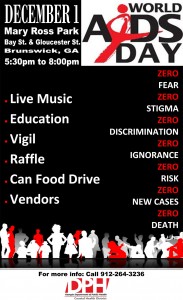
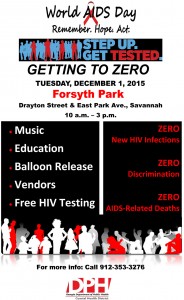
World AIDS Day is December 1 and the Coastal Health District has events planned in both Chatham and Glynn counties. The Chatham County event will be held from 10 a.m. – 3 p.m., on Tuesday, December 1, at Forsyth Park in Savannah and will include free and confidential HIV testing, vendor displays, education, music, and a balloon release. The Glynn County event will be held from 5:30 p.m. – 8 p.m., on Tuesday, December 1, at Mary Ross Park in Brunswick and will include vendor displays, education, vigil, and raffle.

The Centers for Disease Control and Prevention (CDC) estimates that 1.2 million people in the United States are living with HIV, and nearly one in eight of those are not aware that they are infected. World AIDS Day is observed every year on December 1 in an effort to raise awareness of the HIV epidemic, remember those who have died, celebrate survival, and focus on the importance of getting tested for HIV.

Volunteers are also needed to help with the HIV testing events. When you sign up to volunteer with World AIDS Day you are making a difference while helping raise awareness about HIV/AIDS in our communities.

For more information about the Chatham County event please call 912-353-3276 or e-mail Diane.DeVore@dph.ga.gov. For more information about the Glynn County event please call 912-264-3236.

Camden County Drive-Through Flu Vaccination Clinic Scheduled for October 24

The Camden County Health Department will hold a drive-through vaccination clinic from 9 a.m. to 12 p.m. on Saturday, October 24, in the North parking lot at the College of Coastal Georgia located at 8001 Lakes Boulevard in Kingsland. No appointment is necessary. Cost of the vaccine is $29 and is covered under both Medicare and Medicaid.

The Centers for Disease Control and Prevention (CDC) recommends everyone six months of age and older receive a yearly flu vaccine. The flu vaccine cannot cause the flu. Getting vaccinated is the first and best line of defense against the flu. It takes about two weeks after vaccination for the immune system to fully respond to the vaccine and provide the body protection.

On average, more than 200,000 people in the United States are hospitalized each year for illnesses associated with seasonal influenza virus infections and it is estimated that more than 36,000 Americans die each year from influenza-related illness.

The flu virus is easily spread through coughs and sneezes and by touching something with the virus on it and then touching your eyes, nose or mouth. That’s why good health habits are also important including staying home when you’re sick; avoiding close contact with people who are sick; coughing or sneezing into your elbow and not your hand; washing your hands often with soap and water; and avoid touching your eyes, nose and mouth, and cleaning and disinfecting surfaces and objects that may be contaminated with germs like the flu

For more information please call the Camden County Health Department at 912-576-3040 (Woodbine) or 912-882-8515 (St. Marys).

For more information on the flu or flu vaccine, please go to cdc.gov.

Fox Tests Positive for Rabies in Kingsland

A fox caught near the intersection of Clarks Bluff Road and Vacuna Road just inside the Kingsland city limits has tested positive for rabies. At least one dog and one cat were exposed to the fox. Camden County Environmental Health officials encourage residents to stay away from wild animals, keep an eye out for animals acting strangely, and make sure that all pets are up-to-date on rabies vaccinations.

Foxes, along with other animals that are native to coastal Georgia including raccoons and bats, can be carriers of rabies. Rabies is a potentially deadly virus that is primarily spread by infected animals. Symptoms of rabies in animals include a change in behavior, biting, aggression, showing no fear of natural enemies (such as humans), foaming at the mouth, and paralysis.

The Camden County Health Department Environmental Health division offers these tips to protect you and your family from rabies:

  • Avoid contact with animals you don’t know.
  • Make sure your pets receive the proper immunizations. Dogs and cats should get rabies vaccines by four months of age, followed by a booster shot one year later, and another one every year as prescribed by your veterinarian.
  • Do not handle, feed, or unintentionally attract wild animals with open garbage cans or by leaving pet food out at night.
  • Never adopt wild animals or bring them into your home. Do not try to nurse sick animals to health. Call animal control or a properly licensed animal rescue agency for assistance.
  • Teach children to never handle unfamiliar animals, wild or domestic, even if they appear friendly. “Love your own, leave other animals alone” is a good principle for children to learn.


If an animal ever bites you, seek medical care immediately and contact Camden County Animal Control at 912-576-7395 and the Camden County Health Department Environmental Health Division at 912-729-6012.

Parents in Camden Co. Urged to Talk to Children about Staying away from Wild Animals

A raccoon was captured on the playground at St. Marys Elementary School this week. Although the animal did not test positive for rabies, Environmental Health officials still want to emphasize how important it is to talk to children about staying away from animals they don’t know, either wild or domestic. In addition, residents are encouraged to call the Camden County Environmental Health division at 729-6012 or Camden County Animal Control at 576-7395 if they see any animal exhibiting abnormal behavior.

Rabies is a potentially deadly virus that is primarily spread by infected animals. Symptoms of rabies in animals include a change in behavior, biting, aggression, showing no fear of natural enemies (such as humans), foaming at the mouth, and paralysis.

Several species of wild animals that are native to coastal Georgia – including raccoons, foxes, and bats – can carry rabies. The Camden County Health Department Environmental Health division offers these tips to protect you and your family from rabies:

Avoid contact with animals you don’t know.
Make sure your pets receive the proper immunizations. Dogs and cats should get rabies vaccines by four months of age, followed by a booster shot one year later, and another one every year as prescribed by your veterinarian.
Do not handle, feed, or unintentionally attract wild animals with open garbage cans or by leaving pet food out at night.
Never adopt wild animals or bring them into your home. Do not try to nurse sick animals to health. Call animal control or a properly licensed animal rescue agency for assistance.
Teach children to never handle unfamiliar animals, wild or domestic, even if they appear friendly. “Love your own, leave other animals alone” is a good principle for children to learn.

Health District Officials Encourage Mosquito Precautions

Summer is under way and as more people make their way outside for summertime activities, Coastal Health District officials want to remind residents to take precautions to avoid mosquitoes. Mosquito bites are annoying but can also cause diseases such as West Nile Virus (WNV), Eastern Equine Encephalitis (EEE), and Chikungunya.

WNV is transmitted by the bite of infected mosquitoes. About 80 percent of people infected with WNV will not show any symptoms at all; however, cases can range from mild to severe. Mosquitoes that carry the West Nile Virus are more likely to bite during the evening, night, and early morning. EEE is a mosquito-borne virus that causes swelling of the brain. In horses, it is fatal 70 to 90 percent of the time. Horse and large animal owners are encouraged to vaccinate their animals against the virus and to clean out watering sources, such as buckets and troughs, every three-to-four days to prevent mosquitoes from breeding there. The most common symptoms of Chikungunya are fever and joint pain and symptoms usually begin 3–7 days after being bitten by an infected mosquito. According to the Centers for Disease Control and Prevention (CDC), reported cases of Chikungunya thus far in 2015 have occurred in travelers returning from affected areas including Puerto Rico and the U.S. Virgin Islands.

“The common thread among these illnesses is that they are transmitted through mosquito bites,” said Diane Weems, M.D., Coastal Health District Health Director. “The more precautions we take against getting bitten by mosquitoes the better our chances are of avoiding any mosquito-borne diseases.”

Mosquito Prevention

The best way to prevent mosquito-related diseases is to avoid mosquito bites. Mosquitoes breed in standing water which is why it is important to remove water-holding containers (buckets, barrels, flower pots, tarps, etc.; drill holes in tire swings so water drains out; keep children’s wading pools empty and on their sides when they’re not being used; change water frequently in pet dishes; change bird bath water at least twice a week; and avoid using saucers under outdoor potted plants.

The following tips can help lessen the risk of getting bitten by mosquitoes:

  • DRAIN all standing water.
  • Avoid DAWN and DUSK when mosquitoes are most active.
  • DRESS appropriately in long sleeves and pants.
  • DEFEND or DEET yourself against mosquitoes with an effective repellent. Repellents containing DEET, picaridin, IR3535, and oil of lemon eucalyptus and para-menthane-diol products provide long lasting protection.
  • DOORS and windows should be in good condition.