The Coastal Health District of Georgia serves the counties of Bryan, Camden, Chatham, Effingham, Glynn, Liberty, Long & McIntosh

Chatham News


DPH Confirms Measles Case in Georgia

The following press release was issued by the Georgia Department of Public Health on January 12, 2026:

The Georgia Department of Public Health (DPH) has confirmed a measles case in a baby too young to receive routine measles vaccination. The baby, who acquired the virus while traveling internationally, lives in the Coastal Health District. DPH is working to identify individuals who may have been exposed to measles through contact with the child.   

Measles is very contagious and spreads through the air when an infected person coughs or sneezes. The measles virus can stay in the air or on surfaces for up to two hours after an infected person has left the room. 

Measles symptoms typically appear 7 to 14 days after exposure, including high fever, cough, runny nose, and watery eyes. Then, a rash of tiny red spots appears. It starts at the head and spreads to the rest of the body. 

The MMR (measles, mumps, rubella) vaccine can prevent measles and rubella. The vaccine is safe and effective, and parents with questions about the vaccine or the vaccination schedule can consult their physician. The Centers for Disease Control and Prevention (CDC) recommends that children receive their first dose of MMR vaccine between 12 and 15 months of age and a second dose between 4 and 6 years of age. For babies aged 6-11 months travelling internationally, the CDC recommends a single dose of the MMR vaccine before travel, followed by two additional doses after their first birthday. 

More than 95% of the people who receive a single dose of MMR will develop immunity to all three viruses. A second dose boosts immunity, typically enhancing protection to 98%. Individuals who are vaccinated with the MMR vaccine also help protect others who are too young or medically unable to be vaccinated.

 People with measles symptoms should contact their healthcare provider immediately. DO NOT go to the doctor’s office, the hospital, or a public health clinic without first calling to let them know about your symptoms. Healthcare providers who suspect measles in a patient should notify public health immediately.

This is the first reported measles case in Georgia in 2026. There were 10 confirmed measles cases in Georgia in 2025.

For more information about measles, log on to https://dph.georgia.gov/epidemiology/acute-disease-epidemiology/vaccine-preventable-diseases/measles or https://www.cdc.gov/measles/index.html.

Free Flu Shot Events for Uninsured Children and Adults

Flu activity is high in Georgia, and if you haven’t already received your flu shot this season, it’s not too late to get vaccinated. Health departments in the Coastal Health District are offering free flu shot events for children and adults without health insurance.

Free flu shot events for individuals without health insurance coverage (while supplies last):

Bryan County

  • January 12-16 at the clinics in Pembroke and Richmond Hill
  • No appointment needed Monday-Wednesday, 8am-11am & 1pm-4pm, Thursday, 8am-11am & 1pm-6pm, and Friday, 8am-1pm.

Camden County

  • January 1-as long as supplies last
  • No appointment needed Monday-Wednesday, 8-10:30am and 1-3:30pm, Thursday from 8-10:30am and 1-5pm, and Friday from 8-10:30am.

Chatham County

  • January 1-as long as supplies last
  • Appointments are required. Call 912-356-2441 to schedule an appointment at the clinic at 1395 Eisenhower Drive, or 912-651-2587 to schedule an appointment at the midtown clinic at 1602 Drayton Street.

Effingham County

  • January 1-31
  • No appointment needed Monday-Wednesday, 8am-11am & 1pm-4pm, Thursday, 8am-11am & 1pm-6pm, and Friday, 8am-1pm.

Glynn County

  • January 1-31
  • No appointment needed Monday-Wednesday, 8am-11am & 1pm-4pm, Thursday, 8am-11am & 1pm-6pm, and Friday, 8am-1pm.

Liberty County

  • January 5-9
  • No appointment needed Monday-Wednesday, 8am-11am & 1pm-4pm, Thursday, 8am-11am & 1pm-6pm, and Friday, 8am-1pm.

Long County

  • January 1-as long as supplies last
  • Appointments are required. Call 912-545-2107 to schedule an appointment.

McIntosh County

  • January 1-as long as supplies last
  • Appointments are preferred but walk-ins are accepted. Call 912-832-5473 to schedule an appointment.

Patients with health insurance may also receive no-cost flu shots, as most insurance plans cover flu vaccine at no charge to the patient. Call the health department nearest you to confirm that your health insurance is accepted.

Everyone 6 months of age and older should get a flu vaccine every season. Vaccination is especially important for individuals at higher risk of complications from flu, such as:

  • Adults age 65 and older
  • Children under age 2
  • People who are pregnant
  • People who are obese
  • People with weakened immune systems
  • People with chronic lung conditions like asthma, COPD, and cystic fibrosis
  • People with neurologic and neurodevelopment conditions
  • People with heart disease
  • People with endocrine, blood, kidney, liver, or metabolic disorders

Flu vaccine reduces your risk of getting an influenza infection. If you do catch the flu, the vaccine can lessen the length and severity of your illness.

You can also protect yourself from the flu by avoiding people who are sick, washing your hands often, and improving air quality by bringing in fresh outside air, purifying indoor air, or gathering outdoors.

Raccoon Tests Positive for Rabies in Pooler

A raccoon in Pooler in west Chatham County has tested positive for rabies. The Chatham County Health Department’s environmental health office reminds all residents to avoid contact with wild animals and ensure pets are properly vaccinated against rabies.

On October 21st, a resident contacted Chatham County Animal Services after a raccoon attacked their family dog in a residential area near the I-16 and I-95 interchange. Animal services picked up the raccoon, which tested positive for rabies. Fortunately, the dog was up to date on its rabies vaccination and has received a booster vaccine, and no humans were exposed to the raccoon.

This incident is a reminder that several species of wild animals in our area can carry rabies, including raccoons, foxes, and bats. Rabies is a potentially deadly virus that is primarily spread by infected animals. The following tips can protect you and your family from rabies:

  • Avoid contact with animals you don’t know.
  • Make sure your pets receive the proper immunizations. Dogs and cats should get rabies vaccines after 12 weeks of age, followed by a booster shot within one year and vaccination every 1-3 years depending on veterinary recommendation and vaccine used.
  • Do not handle, feed, or unintentionally attract wild animals with open garbage cans or by leaving pet food out at night.
  • Never adopt wild animals or bring them into your home. Do not try to nurse sick animals to health. Call animal services or a properly licensed animal rescue agency for assistance.
  • Teach children to never handle unfamiliar animals, wild or domestic, even if they appear friendly. “Love your own, leave other animals alone” is a good principle for children to learn.

Symptoms of rabies in animals include a change in behavior, biting, aggression, showing no fear of natural enemies (such as humans), foaming at the mouth, and paralysis. If an animal ever bites you, seek medical care immediately and contact Chatham County Animal Services at 912-652-6575 and the Chatham County Environmental Health office at 912-356-2160.

Health Departments Begin Offering Updated COVID Vaccine

Public health departments in the Coastal Health District are now offering the updated COVID vaccine for the 2025-26 respiratory virus season. Supplies are limited in some locations as vaccine shipments continue to arrive, so call your local health department to confirm availability and schedule an appointment.

The health departments in Bryan, Camden, Chatham, Effingham, Glynn, Liberty, Long, and McIntosh Counties will offer the Pfizer brand of COVID vaccine which is approved for use in individuals 5 years of age and older.

Vaccination is particularly beneficial for adults age 65 and older and individuals of any age with health conditions that increase their risk of getting very sick from COVID infection. Risk factors include cancer, lung disease, diabetes, heart conditions, overweight and obesity, pregnancy, and more. For a list of potential risk factors for COVID-related complications, visit the website cdc.gov/covid/risk-factors.

No prescription is needed to receive a COVID vaccine. According to the latest CDC guidance, individuals may make their own informed decisions after receiving information about the COVID vaccine.

The cost of COVID vaccination is covered by most health insurance plans, and low-cost vaccination options are available for individuals without health insurance coverage.


Frequently Asked Questions & Answers

Who is eligible to receive the new COVID vaccine at the health department?

  • The health department is offering the 2025-26 vaccine by Pfizer which is approved for use in individuals 5 years of age and older.

What about children younger than 5? Can they get vaccinated?

  • The COVID vaccine by Moderna has been approved for use in children from 6 months to 4 years of age but is not available in the health departments of the Coastal Health District. Please check with your pediatrician’s office or local pharmacy to see if they have the Moderna vaccine for young children.

I thought only older individuals or those at high risk could get vaccinated.

  • The latest CDC guidance emphasizes that the benefits of vaccination are highest for those people most at risk of severe illness from COVID infection. However, individuals may make their own informed decisions after receiving information about the COVID vaccine.

Who is considered at high risk for COVID-related complications?

  • Individuals over age 65 are at highest risk of getting very sick from COVID, and more than 81% of deaths from COVID complications occur in people over age 65.
  • Certain health conditions increase a person’s risk of severe illness from COVID at any age, including cancer, lung disease, diabetes, heart conditions, overweight and obesity, pregnancy, and more.
  • For a list of potential risk factors for COVID-related complications, visit the website cdc.gov/covid/risk-factors.

Do I need a prescription to get a COVID vaccine?

  • No prescription is needed to receive a COVID vaccine. According to the latest CDC guidance, individuals may make their own informed decisions after receiving information about the COVID vaccine.

How much will the COVID vaccine cost at the health department?

  • Most health insurance plans will cover the cost of COVID vaccination, including plans through Medicaid and Medicare. The health department also has low-cost vaccination options for individuals without health insurance coverage.

My health department doesn’t have the COVID vaccine I need in stock. What can I do?

  • Most communities have several options for COVID vaccination through doctor’s offices and retail pharmacies, particularly for individuals with health insurance coverage.
  • Each of our county health departments gets a very limited supply of vaccine we can use for patients without insurance coverage each month. If your county health department does not have low-cost doses available for individuals without insurance, you may want to call around to some of the neighboring counties to see if they have the low-cost vaccine in stock. Click here for contact information for all the county health departments in the Coastal Health District.

Free Breast Cancer Screening Events Scheduled in October

Early detection saves lives, and no one should avoid or delay breast cancer screening because they don’t have health insurance. That’s why several health departments in the Coastal Health District are hosting free breast cancer screening events in October to connect women with life-saving services and raise awareness of a cancer screening program that can help.

Breast cancer screenings are provided year-round through the Breast and Cervical Cancer Program (BCCP) at no cost to women aged 40 and older without health insurance. Breast cancer is the most common cancer in women in the United States, and 1 in 8 women will get breast cancer in her lifetime. If breast cancer is found early, when it is small and has not spread, more treatment options are often available with a better outcome.

October Breast Cancer Screening Events:

Bryan County
Richmond Hill, October 21, 2025

Pembroke, October 29, 2025
Available 8a-3p, closed for lunch 12-1
The Bryan County Health Department will offer free breast and cervical cancer screenings with referrals for a free mammogram. Appointments required. Call 912-756-2611 to schedule in Richmond Hill and 912-653-4331 to schedule in Pembroke.

Camden County
October 8, 2025, 9a-2p
A mobile mammogram unit will be at the Camden County Health Department, 101 Winding Rd. in Kingsland, offering free mammograms for eligible individuals. Appointments can be scheduled in advance by calling 912-882-8515.

Chatham County
October 29, 2025, 8a-3p Event is Full
A mobile mammogram unit will be at the Midtown Clinic, 1602 Drayton Street in Savannah, offering free mammograms for eligible individuals by appointment.

Effingham County
October 2, 2025, 8a-4p

The Effingham County Health Department will offer free breast and cervical cancer screenings at the clinic at 802 US Hwy 119 S in Springfield, with referrals for a free mammogram. No appointment needed.

Glynn County
October 23, 8a-3p

A mobile mammogram unit will be at the health department at 2747 Fourth Street in Brunswick, offering free mammograms for eligible individuals. No appointment needed!

Long County
October 21, 9a-2:30p

A mobile mammogram unit will be at the IGA on US Hwy 84 in Ludowici, offering free mammograms for eligible individuals. No appointment needed!

McIntosh County
October 30, 9a-2p

A mobile mammogram unit will be at the Piggly Wiggly at 15759 US Hwy 17 in Townsend, offering free mammograms for eligible individuals. No appointment needed!

For more information about the Breast and Cervical Cancer Program, please visit coastalhealthdistirct.org/bccp.

Mosquito-Borne Eastern Equine Encephalitis Detected in Chatham County

The Coastal Health District is alerting residents of Chatham and Bryan Counties to take precautions against mosquito bites after a chicken in the area tested positive for Eastern Equine Encephalitis (EEE). Chatham County Mosquito Control routinely tests mosquitos and chickens throughout the county, checking for the presence of mosquito-borne viruses that can be transmitted to humans through mosquito bites.

Mosquito control was notified of a positive test result in a chicken on September 9. The chicken was located in the southwestern area of Chatham County, near Bryan County. Mosquito control has been spraying in the area to reduce the mosquito population and will continue to do so.

EEE is a mosquito-borne virus that causes swelling of the brain. In horses, it is fatal 70 to 90 percent of the time. Horse and large animal owners are encouraged to vaccinate their animals against the virus and to clean out watering sources, such as buckets and troughs, every three to four days to prevent mosquitoes from breeding.

Although rare in humans, EEE can be very serious. Most people infected with EEE do not show illness, but according to the Centers for Disease Control, severe cases can cause ongoing neurologic problems and death. Symptoms in severe cases of EEE include a sudden onset of headache, high fever, chills, and vomiting. There are no human vaccines to prevent or medicines to treat EEE.

You can reduce your risk of infection with EEE virus by following the 5Ds of mosquito bite prevention:

  • Dusk/Dawn – Avoid dusk and dawn activities during the summer when mosquitoes are most active.
  • Dress – Wear loose-fitting, long-sleeved shirts and pants to reduce the amount of exposed skin.
  • DEET – Cover exposed skin with an insect repellent containing the DEET or picaridin, which is the most effective repellent against mosquito bites.
  • Drain – Empty any containers holding standing water – buckets, barrels, flowerpots, tarps – because they are breeding grounds for virus-carrying mosquitoes.
  • Doors – Make sure doors and windows are in good repair and fit tightly, and fix torn or damaged screens to keep mosquitoes out of the house.   

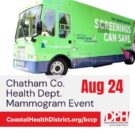
Free Mammograms October 29 at the Chatham County Health Department’s Midtown Clinic

Are you due for a mammogram but concerned about the cost? The Chatham County Health Department is now scheduling appointments for a free mammogram event. The St. Joseph’s/Candler Mobile Mammography Unit will be at the health department’s midtown clinic at 1602 Drayton Street on October 29 from 8 a.m. – 3 p.m.

Appointments are limited and must be scheduled in advance by calling the Chatham County Health Department’s Breast and Cervical Cancer Program (BCCP) at 912-356-2946 or 912-307-9235.

Breast cancer is the most common cancer in women in the United States, and 1 in 8 women will be diagnosed with breast cancer in her lifetime. If breast cancer is found early, when it is still small and has not spread, more treatment options are often available and better outcomes are more likely.

Regular mammograms are low-dose X-rays of the breast that can help detect cancer at an early stage, sometimes years before physical symptoms appear. It is recommended that women with an average breast cancer risk begin regular mammogram screenings at age 40.

The BCCP provides screenings year-round for eligible women throughout the state of Georgia. For more information about available services, please visit coastalhealthdistrict.org/bccp.

Flu Vaccine Now Available at Health Departments in Coastal Georgia

Your best protection against the flu is now available in the Coastal Health District. The health departments in Bryan, Camden, Chatham, Effingham, Glynn, Liberty, Long, and McIntosh Counties are now offering the updated 2025-2026 flu vaccine. Supplies are limited in some locations as vaccine shipments continue to arrive, so call your local health department to confirm availability and schedule an appointment.

A yearly flu vaccine is the best way to prevent serious flu-related illness for everyone age 6 months and older. Vaccination is especially important for adults aged 65 and older, children younger than 2, pregnant women, and individuals with underlying conditions like asthma and chronic lung disease.

“Even if you’re strong and healthy, you should still consider vaccination to protect the people around you,” said Dr. Bonzo Reddick, Health Director of the Coastal Health District. “Flu can make anyone feel miserable. No one wants to be sick, especially as we move closer to holiday celebrations and family gatherings.”

The cost of flu vaccination is typically covered by insurance, and health departments accept many health insurance plans. There are low-cost vaccination options for individuals without health insurance coverage. Many health departments will offer special flu vaccination events later in the fall. Information about events will be added online throughout the season at coastalhealthdistrict.org/flu.

City of Savannah Lifts Boil Water Advisory for Remaining Effected Customers

The following information was released by the City of Savannah on Sunday, August 17th:

The City of Savannah has fully lifted the boil water advisory first issued Friday evening. Tests confirmed Sunday morning that the remaining effected areas under the advisory showed no presence of coliform bacteria and the water is safe to consume.

All operations at the City’s I&D Water Treatment Plant are normal. City staff will return to routine water quality testing and monitoring protocols for the drinking water system.  

More information concerning the boil water advisory can be found at savannahga.gov/wateradvisory.

What to do after a Boil Water Advisory is lifted 

  1. Flush Your Pipes  
  • Run cold water taps for at least 5 minutes (run them longer if you live in a large building). 
  • Begin with the highest faucet in your home and work your way down to the lowest.  
  1. Flush Appliances 
  • Run and discard one cycle of water through: 
  • Refrigerator water dispensers 
  • Ice makers (discard old ice and make new ice) 
  1. Clean and Sanitize  
  • Replace water filters in: 
  • Fridge 
  • Under-sink systems 
  • Pitcher 
  • Sanitize the following:  
  • Ice bins 
  • Water coolers  
  • Coffee makers (run a cleaning cycle with clean water) 
  • Any other water-using appliances 
  1. Check and Clean Faucets  
  • Remove and clean faucet screens if needed. 
  1. Flush Toilets  
  • Flush each toilet once to clear the water lines. 
  1. Discard Stored Water  
  • Discard any stored water you collected during the advisory.  

Information for Food Service Facilities, Hotels, and Motels

The following information is from the National Restaurant Association:

Once the advisory is lifted and you’re notified the water supply is usable, take these actions to ensure the safety of your food and beverages:

  • Flush the pipes throughout your facility by running each faucet with cold water for at least 15-30 minutes.
  • Flush, clean, and sanitize appliances that use tap water, such as beverage dispensers, coffee and tea urns, ice machines, glass washers, and dishwashers. Make sure you follow the manufacturer’s instructions.
  • Run water softeners through a regeneration cycle.
  • Get your hot water tanks flushed.
  • Run your drinking fountains continuously for at least 5 minutes to flush the system.
  • Replace and sanitize water filter cartridges according to the manufacturer’s instructions.
  • Flush ice machines by following the manufacturer’s instructions. Also take the following steps: Throw out any remaining ice, flush the water line to the machine inlet, close the valve on the water line behind the machine, disconnect the water line from the machine inlet, open the valve and run 5 gallons of water through the valve, dispose of the water, and close the valve.

Environmental Health After-Hours Number for Food Service Facilities, Hotels, Motels:
912-689-4646

Raccoon Tests Positive for Rabies in Savannah

A raccoon that was picked up in Savannah and cared for by a licensed wildlife rehabilitator has tested positive for rabies. The raccoon began to exhibit abnormal behavior before it suddenly died. The rehabilitator, who is already vaccinated against rabies, is consulting their healthcare provider for post-exposure treatment recommendations. There were no other known human exposures.

Rabies is a deadly virus that is primarily spread by infected animals. This is an important reminder that rabies can circulate in several species of wild animals in coastal Georgia, including raccoons, foxes, and bats. Residents are urged not to feed wild animals or attempt to domesticate feral animals, and pet owners are reminded to ensure their animals get regular rabies shots.

The Chatham County Health Department’s Environmental Health office has these tips to protect you and your family from rabies:

  • Avoid contact with animals you don’t know.
  • Make sure your pets receive the proper immunizations. Dogs and cats should get rabies vaccines after 12 weeks of age, followed by a booster shot within one year and vaccination every 1-3 years depending on veterinary recommendation and vaccine used.
  • Do not handle, feed, or unintentionally attract wild animals with open garbage cans or by leaving pet food out at night.
  • Never adopt wild animals or bring them into your home. Do not try to nurse sick animals to health. Call animal control or a properly licensed animal rescue agency for assistance.
  • Teach children to never handle unfamiliar animals, wild or domestic, even if they appear friendly. “Love your own, leave other animals alone” is a good principle for children to learn.

Symptoms of rabies in animals include a change in behavior, biting, aggression, showing no fear of natural enemies (such as humans), foaming at the mouth, and paralysis. If an animal ever bites you, seek medical care immediately and contact Chatham County Animal Services at 912- 652-6575 and the Chatham County Environmental Health office at 912-356-2160.