The Coastal Health District of Georgia serves the counties of Bryan, Camden, Chatham, Effingham, Glynn, Liberty, Long & McIntosh

Chatham News


New Distribution Process for Monoclonal Antibody Treatment

ATLANTA – The federal government has changed the way COVID-19 monoclonal antibody treatments will be distributed in the United States, including Georgia. The decision announced Monday by the U.S. Department of Health and Human Services (HHS) is the result of supply shortages and extraordinary demand for the treatments across the country, particularly due to the rapid spread of the delta variant. Health care providers will no longer be able to order the treatments directly.

HHS will determine each state’s weekly allocation of monoclonal antibody products based on use and the number of new COVID cases. The Georgia Department of Public Health (DPH) will identify which sites in the state will receive the product and the amount each site receives. Healthcare providers must record their administration of the products in order to be eligible to receive additional shipments.

DPH will work to provide monoclonal antibody treatments quickly and equitably to as many Georgia providers as possible. The Department will also address the backlog of requests previously made to HHS, which DPH was not made aware of until yesterday.

Monoclonal antibodies are synthetic, laboratory-created antibodies. They help people at high risk for severe COVID illness, individuals who have recently tested positive (within 10 days) for the virus, or people who are close contacts of persons who have tested positive for COVID.  They do not teach a patient’s body how to create its own antibodies.

Monoclonal antibody treatments are not a replacement for COVID-19 vaccination.

“We have safe and highly effective vaccines to protect against COVID-19. It is much easier to get a vaccine than risk becoming seriously ill with life threatening complications,” said Kathleen E. Toomey, M.D., M.P.H., commissioner of the Georgia Department of Public Health. “Monoclonal antibodies are in short supply and high demand and hospital beds are full. What Georgia does have is enough vaccine for all Georgians aged 12 and over to be vaccinated.”

As of today, 53% of Georgians have received at least one dose of COVID vaccine and 46% of Georgians are fully vaccinated. COVID vaccine is available statewide and is our best tool for ending this pandemic and reducing the overwhelming strain on EMS, the healthcare system and healthcare providers. To find a COVID vaccination location, log on to https://dph.georgia.gov/covid-vaccine.

There are currently 136 locations in Georgia where monoclonal antibody treatments are being administered. https://protect-public.hhs.gov/pages/therapeutics-distribution. Patients should talk to their healthcare provider about monoclonal antibody treatments and must have a prescription or physician’s referral to receive the treatments.

Georgia Surpasses Grim COVID-19 Milestone: More Than 20,000 Lives Lost to COVID-19

ATLANTA – The number of Georgians who have died from COVID-19 now surpasses 20,000. As of 3 p.m. today, there have been 20,041 confirmed COVID deaths in Georgia since the pandemic began.

“It is tragic but not surprising that we have surpassed this grim milestone of 20,000 COVID deaths in our state,” said Kathleen E. Toomey, M.D., M.P.H., Georgia Department of Public Health commissioner. “Ninety seven percent of COVID deaths since we’ve had vaccine are in unvaccinated individuals. These deaths are preventable.”

COVID vaccines are safe and effective at protecting against COVID-19 infections. COVID vaccines also help prevent severe illness and death if an individual does get sick. The vaccines also reduce the risk of people spreading the virus that causes COVID-19.

COVID cases are surging in Georgia, driven by the delta variant. The delta variant is more transmissible than the original SARS-CoV-2 and research shows that it results in a higher rate of severe illness and hospitalization than other variants. COVID-19 is spreading fastest in areas with low vaccination rates. Currently, only 44% of Georgians are fully vaccinated.

All Georgians aged 12 and older are urged to get vaccinated, wear a mask in public settings and wash their hands frequently.

COVID vaccine is available statewide and is our best tool for ending this pandemic and reducing the overwhelming strain on EMS, the healthcare system and healthcare providers. To find a COVID vaccination location, log on to https://dph.georgia.gov/covid-vaccine.

COVID testing is recommended immediately for anyone experiencing symptoms of COVID-19. Additionally, individuals who have had a known exposure to someone with suspected or confirmed COVID-19 should be tested, even if they are fully vaccinated. People who are fully vaccinated should get tested 3-5 days after exposure. Unvaccinated individuals should quarantine and be tested immediately after being identified, and, if negative, tested again in 5–7 days after last exposure. To find testing locations, log on to https://dph.georgia.gov/covidtesting. Please do not go to hospital emergency rooms for COVID testing.

Beach Advisory Lifted for South Beach on Tybee Island

September 2, 2021

The Chatham County Health Department has lifted the beach water advisory for South Beach at Chatham Street, which is from 18th Street to the Inlet Avenue on Tybee Island.

The advisory was issued on August 31, 2021 after routine water quality tests showed a high level of enterococci bacteria which increase the risk of gastrointestinal illness in swimmers.

Subsequent water samples showed the bacteria levels had dropped below Environmental Protection Agency’s recommended limits. Therefore, the advisory has been lifted.


August 31, 2021

The Chatham County Health Department has issued a beach water advisory for South Beach at Chatham Street, from 18th Street to Inlet Avenue on Tybee Island.

When an advisory is issued, it is only for the area specified and does not impact other beach areas on the island. There is no way of knowing if going into water that is under advisory will result in illness. However, beach water advisories are to alert the public of a possible risk of illness associated with water contact. An area under advisory does not mean the beach is closed.

Water samples are collected routinely on Georgia’s islands throughout the year. The samples are tested for enterococcus (pronounced: en·ter·o·coc·cus) bacteria which is found in warm blooded animals including humans but also birds, raccoons, deer, dolphins and other wildlife. It is difficult to determine exactly where the bacteria come from, but some sources could include animal waste, storm water runoff, or boating waste. When a beach is under advisory, it means that the level of bacteria found in the water is above the Environmental Protection Agency’s recommended standards.

The Health Department recommends you do not swim or wade in the water in the area under advisory. Fish and other seafood caught from this area should be thoroughly washed with fresh water and thoroughly cooked before eating, as should fish or seafood caught from any waters.

The area will be re-tested, and the advisory will be lifted when tests show the bacteria levels meet the Environmental Protection Agency’s recommended standards.

For more information, visit our Beach Water Testing Program page.

West Nile Virus Detected in Chatham/Glynn Co. Mosquito Samples

Samples from two mosquito pools from Wilmington Island in Chatham County and one mosquito pool from downtown Brunswick in Glynn County have tested positive for West Nile Virus (WNV).

Once WNV is detected in mosquitoes it is an indication that the virus is actively circulating in local mosquito populations, regardless of the specific location of positive mosquito pools.

These are the first positive WNV mosquito samples in the Coastal Health District in 2021. Mosquito prevention measures in those areas continue.

There has been one confirmed human case of WNV this year in Georgia and none in the eight Coastal Health District counties. WNV is transmitted to humans by the bite of infected mosquitoes. Fortunately, most people infected with WNV do not feel sick. About 20% of people who are infected will have mild symptoms like a fever, headache, body aches, joint pain, vomiting, diarrhea, or rash. However, a West Nile Virus infection can be serious, and 1 out of 150 infected people develop a severe, sometimes fatal, illness.

Residents are encouraged to take precautions to prevent mosquito breeding and mosquito bites. That includes cleaning up around homes, yards, and communities and getting rid of unnecessary items outdoors that can hold water, and wearing mosquito repellant that contains at least 20-30% DEET.

Residents are always encouraged to follow the “5 Ds” of mosquito bite prevention:

  • Dusk/Dawn – Avoid dusk and dawn activities during the summer when mosquitoes are most active.
  • Dress – Wear loose-fitting, long-sleeved shirts and pants to reduce the amount of exposed skin.
  • DEET – Cover exposed skin with an insect repellent containing the DEET, which is the most effective repellent against mosquito bites.
  • Drain – Empty any outdoor containers holding standing water because they are breeding grounds for virus-carrying mosquitoes.
  • Doors – Make sure doors and windows are in good repair and fit tightly, and fix torn or damaged screens to keep mosquitoes out of the house.

Georgia Hospitals on Diversion; Georgians Asked to Reduce Strain on EMS & Emergency Departments

ATLANTA – The current surge of COVID cases throughout Georgia is stretching hospital and EMS personnel and resources to unprecedented levels. As a result, many hospitals are having to declare themselves on diversion meaning they are temporarily unable to provide normal emergency care to patients arriving by ambulance. Diversion is a term specific to ambulance transports and is a request to ambulances to transport patients to other local facilitiesif possible.

Diversion does not apply to individuals seeking emergency medical care. Individuals experiencing a medical emergency should call 9-1-1 and ask for assistance.

The statewide hospital diversion website https://georgiarcc.org is a tool intended to be used by EMS agencies across Georgia so that they may take into consideration the diversion status(es) of hospitals they may be transporting patients to.

The Georgia Coordinating Center (GCC) is a communications center for use ONLY by ambulance crews who are transporting patients to emergency departments that are located in the 13-county metro Atlanta area. The public should NOT call the GCC with questions or concerns.

To help keep hospital emergency departments open and able to treat medical emergencies, individuals seeking COVID testing should not go to hospital emergency departments. COVID-19 testing locations are available throughout Georgia and can be found on the DPH website at https://dph.georgia.gov/covidtesting. COVID vaccination is available statewide and is our best tool for ending this pandemic and reducing the overwhelming strain on EMS, the healthcare system and healthcare providers. To find a COVID vaccination location, log on to https://dph.georgia.gov/covid-vaccine. Georgians aged 12 and older are urged to get vaccinated and wear a mask in public settings where social distancing is not possible

Health Departments Offer Third Dose to Immunocompromised Individuals

On Thursday, August 19th, Health Departments in the Coastal Health District will begin offering a third dose of COVID-19 vaccine to individuals with certain immune conditions. Third doses are only recommended for immunocompromised individuals who previously received the Pfizer or Moderna vaccine.

“Studies have shown that people with compromised immune systems may not develop a strong enough immune response with just two doses, so getting a third dose will enhance that response,” said Dr. Lawton Davis, health director for the Coastal Health District. “If your immune system is compromised because of a medical condition or a medication you’re taking, this additional dose can help strengthen your body’s defense against this dangerous virus.”

Those seeking a third dose can provide documentation of their medical condition from their physician or sign a consent form attesting they have a qualifying condition. Examples of qualifying conditions include receiving an organ or stem cell transplant, undergoing treatment for cancer, having advanced HIV infection, or taking certain immune-suppressing medications.  A list of qualifying conditions can be found at coastalhealthdistrict.org/covidvaccine/.

To make an appointment for vaccination at your local county health department in the Coastal Health District, visit chdcovidvax.org or call the COVID-19 Vaccine Phone Line at 912-230-5506. Some vaccination sites allow walk-ins, but appointments are preferred at all sites and are required at the Long and McIntosh County Health Departments.

Later this fall, the Centers for Disease Control expects “booster” doses of Pfizer and Moderna’s COVID-19 vaccines to be available for residents without immune system concerns. A booster dose can create longer-lasting protection. More information on the timing and availability of booster doses will be released soon.

All counties in the eight-county Coastal Health District have vaccination rates below 50 percent. As cases continue to surge and hospitals reach and exceed their patient capacity, Davis issued an urgent plea for residents to get vaccinated.

“I know some people are still hesitant about the vaccine, but billions of doses of COVID vaccine have been given and it is saving lives. I have no agenda and no reason to be anything other than completely honest. I believe in the vaccines and the science used to create them. I was one of the first in line to get vaccinated and I will be one of first to get a third dose,” he said. “We – all of us – have the power to stop this virus, but we can’t wait any longer.”

For more information on additional doses of COVID-19 vaccine, please visit cdc.gov.

Health Departments will Soon Give Additional COVID Vaccine Dose to Immunocompromised Individuals

From the Georgia Department of Public Health:

Following the FDA’s authorization of an additional COVID vaccine dose for immunocompromised individuals, the CDC’s Advisory Committee on Immunization Practices (ACIP) is now recommending that certain patients with weakened immune systems receive an additional dose of the Pfizer-BioNTech or Moderna vaccine. The recommendation does not include J&J vaccine recipients at this time.

The Georgia Department of Public Health (DPH) is awaiting guidance from the CDC that clearly defines what conditions make an individual eligible for an additional dose of vaccine. Once those conditions are known, DPH will establish statewide protocols for health departments administering additional doses of COVID vaccine. Until then, DPH will hold off on administering third doses.

Patients seeking additional doses of vaccine should contact their healthcare provider for guidance and recommendations.

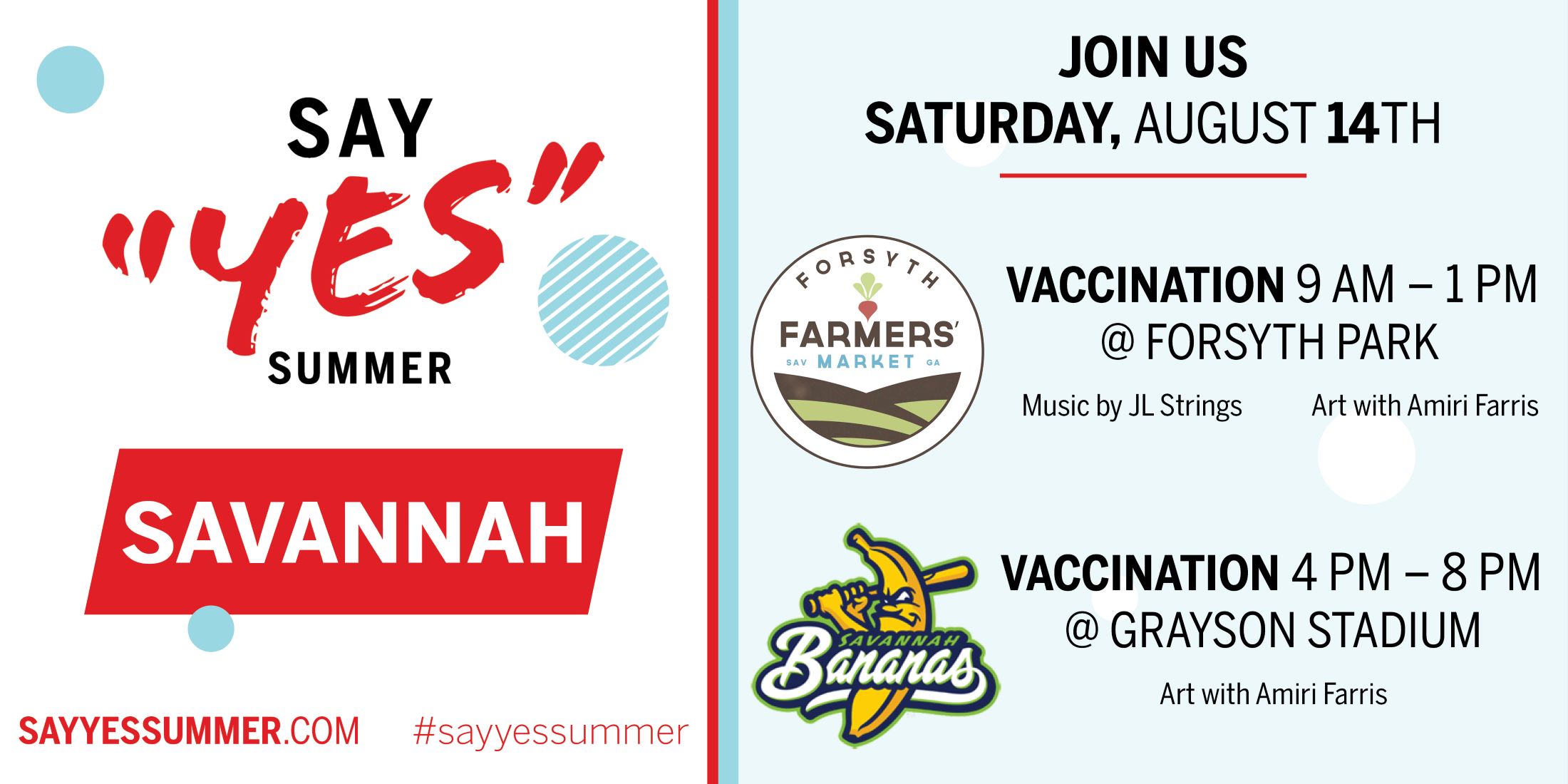
Say “Yes” Summer Vaccination Events Scheduled in Savannah August 14

In an urgent effort to increase vaccinations and stop the spread of COVID-19, the Coastal Health District and Georgia Department of Public Health (DPH) are hosting two unique vaccination events on Saturday, August 14th in Savannah. The Say “YES” Summer events will offer walk-up vaccinations that are free and do not require appointments, insurance, or identification. Participants can also enjoy incentives, entertainment, and art at these pop-up events.

The first event will be held Saturday from 9 a.m. to 1 p.m. at the Forsyth Farmers Market in Forsyth Park where the first 50 people to be vaccinated will receive a credit to use at the market. Then, from 4 to 8 p.m., vaccinations will be offered at Grayson Stadium during the Savannah Bananas game, where the first 50 recipients will be given free Bananas merchandise.

Say “YES” Summer events are designed to attract attention in popular public places and will be held in several Georgia cities. The events will include live installations by local artists and art organizations, offering education, conversation, and on-site vaccination. This national-to-local collaboration is between DPH, local artists and art organizations, the Centers for Disease Control and Prevention (CDC), David J. Sencer CDC Museum, South Arts, Home Depot, and Community Organized Relief Effort (CORE).

As part of all pop-up events, DPH will unveil a participatory art installation, the “I Said ‘YES’ to COVID-19 Vaccine Because…” community mural, for residents to write their own reasons for receiving a COVID-19 vaccine and inspire others to do the same. CORE and health district vaccination teams will operate on-site mobile vaccination clinics to provide educational materials and vaccinations.

DPH and the Coastal Health District believe the collaboration between the Georgia arts and science communities will both inspire and inform Georgians of the importance of COVID-19 vaccines for all aspects of life.

For more details and updates, please visit SayYesSummer.com. For information about other vaccination events by public health in our area, visit chdcovidvax.org.

[JPG, 217.60 KB]

Beach Water Advisories Lifted on Tybee, Jekyll Islands

Update: August 5, 2021

The Chatham County Health Department has lifted the beach water advisory for Polk St. Beach, which extends from the north end of island to the north jetty on Tybee Island. The Glynn County Health Department has lifted the beach water advisory for South Beach at the 4-H Camp, which is from the south water tower to Macy Lane on Jekyll Island.

The advisories were issued August 3, 2021 after routine water quality tests showed a high level of enterococci bacteria which increase the risk of gastrointestinal illness in swimmers.

Subsequent water samples show the bacteria level has dropped below the Environmental Protection Agency’s recommended limits. Therefore, the advisories have been lifted.

For more information about beach water advisories, go to www.coastalhealthdistrict.org and click on the Environmental Health tab at the top of the page.

August 3, 2021

The Chatham and Glynn County Health Departments have issued beach water advisories on Tybee and Jekyll Islands.

A beach water advisory is in effect for Polk St. Beach, which extends from the north end of island to the north jetty on Tybee Island.

A beach water advisory is also in effect for South Beach at the 4-H Camp, which is from the south water tower to Macy Lane on Jekyll Island.

When an advisory is issued, it is only for the area specified and does not impact other beach areas on the island. There is no way of knowing if going into water that is under advisory will result in illness. However, beach water advisories are to alert the public of a possible risk of illness associated with water contact. An area under advisory does not mean the beach is closed.

Water samples are collected routinely on Georgia’s islands throughout the year. The samples are tested for enterococcus (pronounced: en·ter·o·coc·cus) bacteria which is found in warm blooded animals including humans but also birds, raccoons, deer, dolphins and other wildlife. It is difficult to determine exactly where the bacteria come from, but some sources could include animal waste, storm water runoff, or boating waste. When a beach is under advisory, it means that the level of bacteria found in the water is above the Environmental Protection Agency’s recommended standards.

The Health Department recommends you do not swim or wade in the water in the area under advisory. Fish and other seafood caught from this area should be thoroughly washed with fresh water and thoroughly cooked before eating, as should fish or seafood caught from any waters.

The area will be re-tested, and the advisory will be lifted when tests show the bacteria levels meet the Environmental Protection Agency’s recommended standards.

For more information, visit our Beach Water Testing Program page.

“We’re tired.” Nurses Plead With Community to Get Vaccinated

The following press release was issued from the South Georgia Health System, with hospital campuses in Glynn and Camden Counites.

BRUNSWICK, Georgia: August 4, 2021 –

With the number of positive COVID-19 patients increasing every day at its Brunswick and Camden Campus hospitals, Southeast Georgia Health System nurses and physicians are pleading with the community to get vaccinated.

“We’re tired, and we’re at our wits’ end,” says Jan Jones, R.N., BSN, director, Patient Care Services, Southeast Georgia Health System. “As soon as a patient is discharged from our critical care unit, or worse, is deceased, there’s another patient to put in that bed. It’s like a revolving door that we can’t stop.”

Similar to most hospitals across the nation, Southeast Georgia Health System is reporting a sharp rise in COVID-19 hospitalized patients. Health System leadership attributes the increase to the more contagious delta variant, low vaccination rates and relaxed safety measures.

“This summer we were starting to feel some relief with our COVID-19 patient census hovering between four to eight patients in early July,” says Michael D. Scherneck, president and CEO, Southeast Georgia Health System. “People began to relax. They stopped wearing masks and social distancing. Even though the CDC recommended that unvaccinated people continue to wear masks, you rarely saw anyone wearing one. Yet, as of today, our community’s vaccination rate is less than 40%, and we need to reach 70% to achieve herd immunity.”

Due to the increased patient volumes and growing positivity rates in the community, the Health System has reinstated visitor restrictions, limiting patients to one visitor per day.

“We regret having to limit visitors, and we realize the impact it has on our patients and their families. But our primary concern is the health and well-being of our team members and patients. We must protect them from possible exposure,” says Scherneck.

The Health System is also postponing some elective surgeries, particularly those that require an overnight stay.

“With such a high census of COVID-19 patients, we’ve had to convert regular patient rooms into coronavirus rooms,” says Alan K. Brown, M.D., chief medical officer. “More importantly, we need the nursing staff to be available to care for COVID-19 patients.”

Brown adds, “We had hoped the vaccine would bring us the relief we all so desperately need, especially our nurses. It’s very hard and disheartening for our health care teams to be going through this again. People need to get their vaccine. While it’s true that there’s still a chance of contracting the virus after being vaccinated, the vaccine reduces the risk of becoming seriously ill and being hospitalized. The vaccine has been proven to be safe and effective and it’s free. There’s no reason to delay getting a vaccine.”

Jones agrees, “This surge isn’t like the ones we experienced last year. The delta variant is much more contagious and it’s impacting much younger patients, even those who don’t have chronic health issues. It’s so sad when we have to put a 20 or 30 year old on a ventilator. We just need people to realize that this virus doesn’t discriminate. You can be young and healthy and still end up hospitalized in a critical care bed. Please get the vaccine to protect yourself and others.”

The Health System offers free COVID-19 vaccines to everyone age 12 and older at its Brunswick and Camden campuses; dates and addresses are listed on the Health System’s website at sghs.org/covid19-vaccine. Individuals with questions about COVID-19 symptoms can call the Health System’s free screening hotline at 912-466-7222.