Other ways to prevent the spread of respiratory illnesses include:
Cover your mouth and nose with a tissue when you cough or sneeze. Throw used tissues in the trash. If you don’t have a tissue, cough or sneeze into your elbow, not your hands.
The following press release was issued by the Georgia Department of Public Health.
The Georgia Department of Public Health Office of EMS and Trauma, in partnership with Governor Brian Kemp and First Lady Marty Kemp, is launching voluntary training for EMS personnel on how to identify potential victims of human trafficking. The EMS training is in conjunction with Human Trafficking Prevention Month and provides an opportunity to raise awareness and combat this heinous crime.
As first responders, EMS personnel often have unique opportunities to encounter and assist victims of human trafficking. Their critical role makes it essential to recognize the signs, respond appropriately, and navigate the legal aspects of human trafficking. This voluntary training program is designed to empower EMS providers with the skills, tools, and knowledge they need to identify potential trafficking victims, provide effective support, and take informed action.
“EMS personnel are often the only public safety or healthcare providers to give care to victims of human trafficking,” said Kathleen E. Toomey, M.D., M.P.H. “This training offers EMS providers an opportunity to deepen their understanding of human trafficking, gain insight into relevant laws, and enhance their ability to support victims in their most vulnerable moments.”
In Georgia, more than 370 girls are trafficked each month. The average age of a human trafficking victim in Georgia is 14.8 years old. However, human trafficking affects all genders, all ages, and all social and economic groups.
“I want to thank both the team at DPH for their efforts in developing this training and all of our EMS personnel who do so much to promote the health of Georgians and help us fight human trafficking,” said Georgia First Lady Marty Kemp. “These brave first responders are in a critically important role, interacting with survivors in their most vulnerable moments. By knowing the signs and how to report them, they can go even further in their work to save lives.”
To report suspected human trafficking in Georgia, call the Statewide 24-Hour Human Trafficking Hotline at 1-866-ENDHTGA (1-866-363-4842). If you have reason to believe that a victim is in imminent danger, call 911 or your local law enforcement agency to file a report.
Working together, we can shine a light on human trafficking and make a meaningful difference in the lives of those affected.
Very cold weather is moving into the coastal Georgia area beginning Sunday, January 19, with temperatures dropping below freezing combined with a dangerous wind chill.
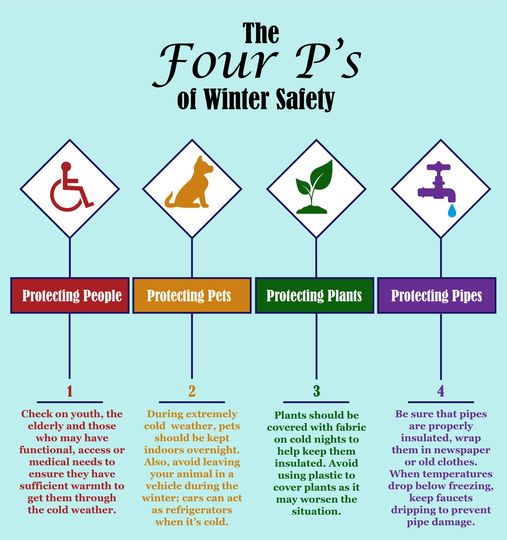
Remember the 4 “Ps” of winter weather safety during this cold snap.
People: Ensure that everyone is dressed warmly before going outdoors. If you have family, friends, or neighbors who are especially vulnerable to cold weather, please check on them to be sure they’re warm and safe.
Pets: Bring pets inside. If it’s too cold for you, it’s too cold for them, too.
Plants: Cover outdoor plants with cloth or bring them inside. Freezing temperatures can kill some plants.
Pipes: Let your pipes drip. Having water move through the pipes will help prevent the water from freezing. A frozen pipe can burst causing property damage.
As loved ones gather around the table for Thanksgiving this week, the Coastal Health District offers tips and reminders for ensuring a safe and healthy holiday feast. From preparing food, to serving, to storing leftovers, there are important food safety rules that can prevent you from ingesting bacteria that can make you sick.
Avoid Cross-Contamination
If turkey is on the menu, keep the raw turkey and its juices separate from foods that won’t be cooked.
Remember to fully clean and sanitize surfaces that come in contact with the uncooked meat and juices so bacteria from the turkey doesn’t cross-contaminate other food or surfaces.
Avoid touching ready-to-eat food with bare hands – this includes food you’ve already cooked, or food that doesn’t have to be cooked. Be sure to use serving utensils or gloves so you don’t unknowingly contaminate the food with germs from your hands.
Proper Temperature
Whether you’re frying or roasting your turkey, the key is to make sure the meat reaches a safe minimum temperature.
A food thermometer can help you ensure the turkey is hot enough to effectively kill bacteria. The turkey needs to reach a temperature of at least 165 degrees in the thickest part of the breast, the innermost part of the thigh, and the innermost part of the wing.
Leftovers: The Two Hour Rule
Once the food has been served, remember the two-hour rule. Perishable food should not sit at room temperature longer than two hours or harmful bacteria can develop. Refrigerate or freeze leftovers within two hours of serving.
If you have leftover turkey, it’s a good idea to carve the bird into smaller pieces and place them into small, shallow containers so the meat can cool more evenly and quickly.
When reheating the leftovers, only heat the amount you actually plan to eat at that time. For example, reheating an entire casserole dish and then cooling it back down multiple times isn’t a safe choice.
Leftovers can be kept safely in the refrigerator for 3-4 days and the freezer for 2-6 months.
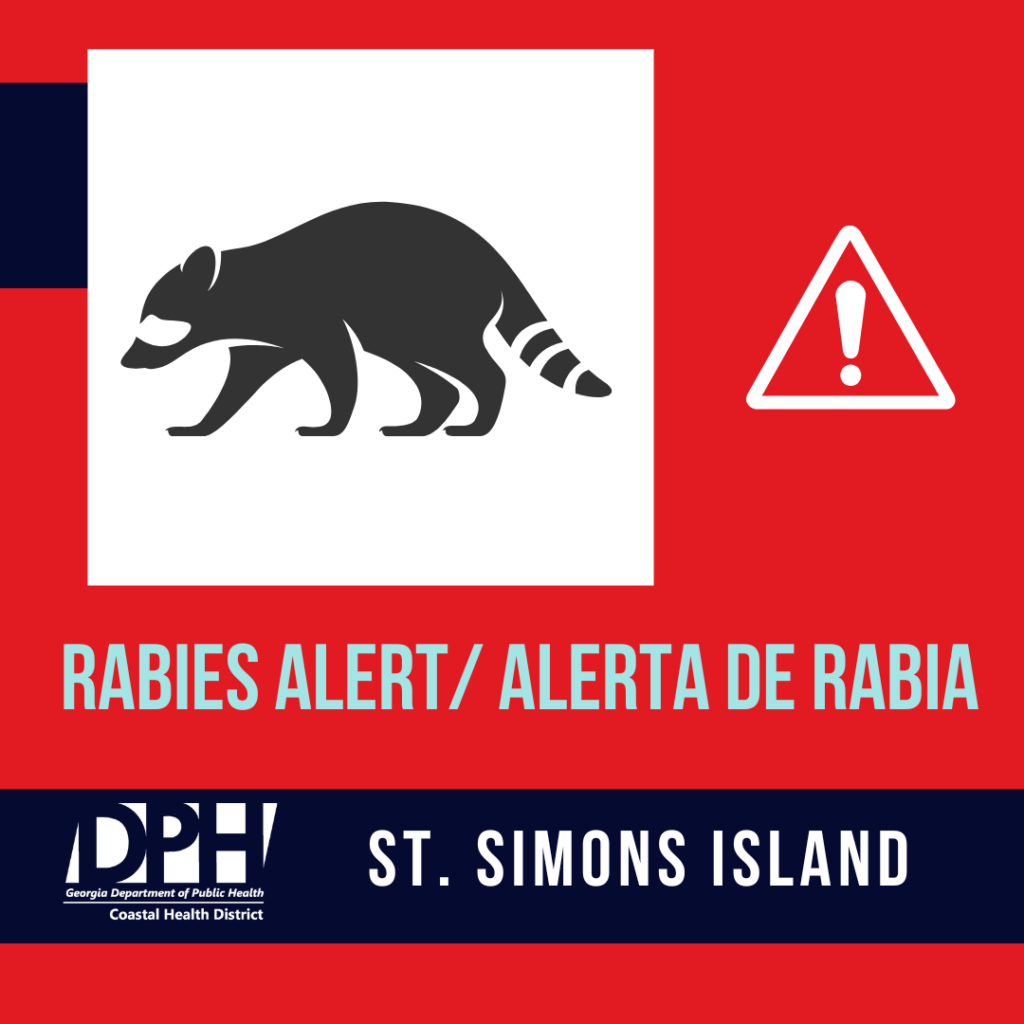
The Glynn County Health Department is alerting residents that a raccoon from St. Simons Island has tested positive for rabies. On November 20th, the raccoon attacked a feral cat in an area near Frederica Road and Harrington Road. No humans were exposed to the rabid raccoon.
Rabies is a deadly virus that is primarily spread by infected animals. This is an important reminder that rabies can circulate in several species of wild animals in coastal Georgia, including raccoons, foxes, and bats. Residents are urged not to feed wild animals or attempt to domesticate feral cats, and pet owners are reminded to ensure their animals get regular rabies shots.
The Glynn County Health Department’s Environmental Health office has these tips to protect you and your family from rabies:
Avoid contact with animals you don’t know.
Make sure your pets receive the proper immunizations. Dogs and cats should get rabies vaccines after 12 weeks of age, followed by a booster shot within one year and vaccination every 1-3 years depending on veterinary recommendation and vaccine used.
Do not handle, feed, or unintentionally attract wild animals with open garbage cans or by leaving pet food out at night.
Never adopt wild animals or bring them into your home. Do not try to nurse sick animals to health. Call animal control or a properly licensed animal rescue agency for assistance.
Teach children to never handle unfamiliar animals, wild or domestic, even if they appear friendly. “Love your own, leave other animals alone” is a good principle for children to learn.
Symptoms of rabies in animals include a change in behavior, biting, aggression, showing no fear of natural enemies (such as humans), foaming at the mouth, and paralysis. If an animal ever bites you, seek medical care immediately and contact Glynn County Animal Control at 912-554-7500 and the Glynn County Health Department Environmental Health office at 912-279-2940.
Due to the potential for severe weather associated with Hurricane Milton, all Camden and Glynn County clinics and offices will be closed on Thursday, October 10. Anyone with an appointment previously scheduled during the closure will be contacted to reschedule. Both counties are expected to reopen on Friday, October 11 at the regularly scheduled times.
The Coastal Health District urges residents to be prepared as Hurricane Milton approaches. They should:
Have a three-day supply of non-perishable foods.
Have one gallon of water per person per day.
Have a three-day supply of prescription medications.
Turn the refrigerator to the coldest setting.
Charge phones and electronics.
Hurricane Milton is expected to bring tropical storm-force winds, significant rainfall with potential coastal flooding, storm surge, flash flooding, and rip currents. Flooding of coastal streets and roadways is also possible. Just six inches of moving water can knock a person down, and one foot of moving water can sweep a vehicle away. We urge everyone to “Turn Around. Don’t Drown.” Learn more about flood safety at ready.gov/floods.
Several health departments in the Coastal Health District are hosting breast cancer screening events in October as part of Breast Cancer Awareness Month.
Breast cancer is the second most commonly diagnosed cancer and the second-leading cause of cancer death in women. However, many cancer deaths can be avoided through regular screening. When breast cancer is detected and treated early, the chance of survival is greatly increased.
Read below for information about a screening event near you.
Bryan County Health Department – Pembroke Clinic
October 24th, 8 a.m. – 4 p.m.
At the health department, 430 Ledford Street in Pembroke
Clinical breast exams, cervical cancer screenings, referral for mammogram at a later date
Appointments are encouraged but not required and can be scheduled by calling the health department at 912-653-4331.
All breast health services, including mammograms, are free for women aged 40 and older without health insurance. Cervical cancer screenings are free to women aged 21-64 without health insurance.
Camden County Health Department
October 17th, 8:30 a.m. – 2 p.m.
At the health department, 905 Dilworth Street in St. Marys
Clinical breast exams, cervical cancer screenings, mobile mammogram unit
Appointments are limited and can be scheduled by calling the health department at 912-882-8515.
All breast health services, including mammograms, are free for women aged 40 and older without health insurance. Cervical cancer screenings are free to women aged 21-64 without health insurance.
Women with health insurance are also welcome to schedule an appointment, and health insurance will be billed for the services.
Chatham County Health Department
October 29th
At the health department’s Midtown clinic, 1602 Drayton Street in Savannah
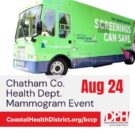
Mobile mammogram unit
By appointment only – schedule by calling 912-356-2946
Mammograms are free for women aged 40 and older without health insurance.
Effingham County Health Department
October 22nd, 8 a.m. – 4 p.m.
At the health department, 802 Hwy 119 South in Springfield
Clinical breast exams, cervical cancer screenings, referral for mammogram at a later date
Appointments are encouraged but not required and can be scheduled by calling the health department at 912-754-6484.
All breast health services, including mammograms, are free for women aged 40 and older without health insurance. Cervical cancer screenings are free to women aged 21-64 without health insurance.
Free blood pressure and blood glucose screenings will also be available, and all participants will receive goody bags and light refreshments.
Glynn County Health Department
October 21st, 8 a.m. – 3 p.m.
At the health department, 2747 Fourth Street in Brunswick
Mobile mammogram unit
No appointment needed – walk-ins are welcome
Mammograms are free for women aged 40 and older without health insurance. Women with health insurance are also welcome, and health insurance will be billed for the services.
Liberty County Health Department
October 22nd, 8 a.m. – 4 p.m.
At the health department, 1113 E. Oglethorpe Hwy. in Hinesville
Clinical breast exams, cervical cancer screenings, referral for a same-day mammogram at Diversity Healthcare
Appointments are strongly recommended and can be scheduled by calling the health department at 912-876-2173.
All breast health services, including mammograms, are free for women aged 40 and older without health insurance. Cervical cancer screenings are free to women aged 21-64 without health insurance.
No-cost COVID and flu vaccines will also be available, and all participants will receive giveaways.
Long County Health Department
October 15th, 11 a.m. – 2 p.m.
In the IGA parking lot on Hwy 84 in Ludowici
Mobile mammogram unit
No appointment needed – walk-ins are welcome
Mammograms are free for women aged 40 and older without health insurance. Women with health insurance are also welcome, and health insurance will be billed for the services.
McIntosh County Health Department
October 28th, 9 a.m. – 2 p.m.
Coastal Market at 5214 Highway 17 in Darien
Mobile mammogram unit
No appointment needed – walk-ins are welcome
Mammograms are free for women aged 40 and older without health insurance. Women with health insurance are also welcome, and health insurance will be billed for the services.
Generators are commonly used as a backup power source during a prolonged power outage, but they can also be dangerous – even deadly – if not used correctly. The Coastal Health District is reminding all residents to ONLY use generators outdoors, at least 20 feet away from doors and windows, directing the generator’s exhaust away from the home, and ALWAYS have working carbon monoxide detectors in the home.
Portable back-up generators produce the poison gas carbon monoxide (CO). CO is an odorless, colorless gas that kills without warning. It claims the lives of hundreds of people every year and makes thousands more ill.
Follow these steps to keep your family safe.
Portable Generators:
Never use a generator inside your home or garage, even if doors and windows are open.
Only use generators outside, more than 20 feet away from your home, doors, and windows.
Carbon Monoxide Detectors:
Install battery-operated or battery back-up CO detectors near every sleeping area in your home.
Check CO detectors regularly to be sure they are functioning properly.
The most common symptoms of CO poisoning are headache, dizziness, sleepiness, upset stomach, vomiting, chest pain, and confusion. CO symptoms are often described as “flu-like.”
If you or someone you’re with has symptoms of carbon monoxide poisoning, get into fresh air immediately and call 911 for emergency medical help.
There is a risk of long-term, permanent heart and brain damage even if a person survives carbon monoxide poisoning, which is why prevention is the most important step.
Due to the potential for severe weather associated with Hurricane Milton, all Camden and Glynn County clinics and offices will be closed on Thursday, October 10. Both counties are expected to reopen on Friday, October 11 at the regularly scheduled times.
Boil Water Advisories
[PNG, 179.35 KB]
Various private water service companies have issued boil water advisories for several communities across the state, including customers in the Coastal Health District.
Once power is off, the refrigerator keeps food at safely cold temperatures for 4 hours. A full freezer will keep the temperature for approximately 48 hours (24 hours if it is half full) if the door remains closed.
If your power is off longer, your food is not safe to eat and should be discarded.
If you own or operate a food service establishment and your facility experienced flooding or an extended power outage, you must close the facility and contact your local Environmental Health office prior to reopening.
Never use a generator inside your home or garage, even if doors and windows are open. Only use generators outside, more than 20 feet away from your home, doors and windows.
Install battery-operated or battery backup carbon monoxide detectors near every sleeping area in your home.
Keep in mind that floodwater often carries germs. If you touch it, be sure to wash your hands with soap and water. If you don’t have soap or water, use alcohol-based wipes or sanitizer.
Do not allow children to play in any free-flowing, run-off, or floodwater. This water can be contaminated with bacteria or chemicals. Floodwater often carries organisms that can cause infections if they get into cuts or scrapes.
Floodwater can also displace insects and reptiles which can be dangerous to people.
Is Your Tetanus Vaccination Up to Date?
[JPG, 42.88 KB]
If you’re cleaning up after floodwater or assisting with the recovery, it’s important to be up-to-date on your tetanus vaccine. Tetanus bacteria is found naturally in soil. If you wade through flood water, you could encounter sharp objects and sustain an injury that allows the tetanus bacteria to enter your body. Although tetanus infection is rare, it can be very serious or even fatal.
The best way to prevent infection is to be vaccinated prior to exposure, which is why all adults should receive tetanus booster shots every 10 years. However, tetanus vaccination is still effective if given within 48 hours after an injury.
Avoid contact with flood waters if you have an open wound. Keep open wounds as clean as possible by washing well with soap and clean water and covering with a waterproof bandage to reduce chance of infection.
You may need a tetanus vaccine if:
It has been more than 10 years since your last tetanus vaccination.
You have a puncture wound and it has been more than 5 years since your last tetanus vaccination.
You have a wound that has come in contact with floodwater and it has been more than 5 years since your last tetanus vaccination.
If you’re not sure if you need a tetanus vaccine, contact your local county health department or your regular healthcare provider.
The cost of tetanus vaccination is covered by most health insurance plans. If you do not have insurance coverage for this vaccine, no-cost options may be available at the health departments of the Coastal Health District.
[JPG, 649.97 KB]
Emergency Wound Care After a Disaster
Flood waters and standing waters pose various risks, including infectious diseases, chemical hazards and injuries. Prompt first aid can help heal small wounds and prevent infection.
The Coastal Health District urges private well owners to take precautions and disinfect any well that flooded during recent severe weather.
When a well is flooded, the water can become contaminated with bacteria that could cause waterborne illness. Disinfection of a flooded private well cannot begin until the water covering the affected well has receded.
Standing water can bring mosquitoes that carry disease. To avoid mosquito bites when outdoors, use insect repellent with DEET or Picaridin, IR3535, or Oil of Lemon Eucalyptus. Follow label directions.
Wear long sleeves, pants and socks when you’re outside.
Be sure to drain water from any containers in your yard to eliminate breeding locations for mosquitoes and prevent the spread of illness. Tip out standing water in flowerpots, planters, children’s toys, wading pools and buckets.
Mold Cleanup After a Flood
[JPG, 26.34 KB]
Mold will grow where there is moisture, so if your home flooded, you may begin to find mold in your house. The Centers for Disease Control recommends that you clean up and dry out your home fully and quickly (within 24–48 hours) after a flood to reduce the growth of mold. Remove or replace carpets and upholstery that have been soaked and cannot be dried right away.


 [JPG, 45.75 KB]
 [JPG, 751.43 KB]
 [PNG, 72.82 KB]
 [PNG, 744.03 KB]
 [PNG, 84.73 KB]
 [PNG, 179.35 KB]
 [JPG, 48.98 KB]
 [JPG, 240.35 KB]
 [JPG, 71.04 KB]
 [JPG, 50.79 KB]
 [JPG, 42.88 KB]
 [JPG, 649.97 KB]
 [JPG, 39.73 KB]
 [JPG, 73.66 KB]
 [JPG, 26.34 KB]