Air Quality Monitoring Resources and Health Information
READ MORE »

×

The Coastal Health District of Georgia serves the counties of Bryan, Camden, Chatham, Effingham, Glynn, Liberty, Long & McIntosh

Glynn News


Health Officials Encourage Wildfire Smoke Precautions

Smoke from wildfires burning in South Georgia is making its way into some coastal counties and as a result, Coastal Health District officials are encouraging residents to take precautions. For healthy people, smoke from wildfires that contains particles from burning trees and shrubs can irritate your eyes and respiratory system. However, smoke can worsen chronic health problems such as lung disease, asthma, and allergies. People with existing respiratory conditions, young children and elderly people are especially susceptible to health effects from this smoke.

It’s important to limit your exposure to the smoke and take precautions to protect your health and the health of your family.

  • Stay inside and away from the smoke.
  • Keep indoor air as clean as possible. Keep windows and doors closed. Run an air conditioner if you have one, but keep the fresh-air intake closed and the filter clean to prevent outdoor smoke from getting inside.
  • Avoid activities that increase indoor pollution. Vacuuming stirs up particles already inside your home, contributing to indoor pollution. Smoking also puts even more pollution into the air.
  • Keep airways moist by drinking plenty of water.
  • Do not rely on dust masks for protection. Paper “comfort” or “dust” masks commonly found at hardware stores are designed to trap large particles, such as sawdust. These masks will not protect your lungs from the small particles found in wildfire smoke.
  • Follow the advice of your doctor or other health care provider about medicines and about your respiratory management plan if you have asthma or another lung disease.

Seek medical attention if you are having difficulty breathing or if your symptoms worsen.
CDC: Georgia’s Early Childhood Vaccination Rates Among Nation’s Highest

ATLANTA – Georgia is leading the country with above average early childhood vaccinations with 75.6 percent of children 19-35 months old protected, compared to national averages of 72.2 percent for the 7-vaccine series. However, health officials here say statewide immunization statistics show that more can be done to stop vaccine-preventable disease outbreaks in Georgia.

As recent disease outbreaks demonstrate, immunizing infants and young children remains a critical component of protecting vulnerable infants against potentially deadly diseases.

So far in 2017, the Centers for Disease Control and Prevention has reported more than 1,200 cases of mumps across the U.S. Other recent outbreaks include a pertussis outbreak in 2012 that infected more than 48,000 people, and a measles outbreak that started at Disneyland and impacted 188 people in 2015. Each of these diseases is preventable by vaccines.

During National Infant Immunization Week, April 22-29, the Georgia Department of Public Health and the Georgia Chapter of the American Academy of Pediatrics urge parents to check with their pediatrician to ensure their child is up-to-date on vaccinations.

“Immunizations are the best way to protect infants and children from childhood diseases, like whooping cough and measles that can be life-threatening at young ages,” said Brenda Fitzgerald, M.D., commissioner of the Georgia Department of Public Health. “It is critical for parents to talk to their child’s doctor to ensure they are up-to-date on immunizations, because no child should have to suffer a vaccine-preventable illness.”

The American Academy of Pediatrics encourages parents to become aware of vaccination rates in their community. The AAP offers an interactive map (https://immunizations.aap.org/) that highlights vaccination rates in each state for recommended childhood vaccines, including vaccines that protect against measles, mumps, pertussis, polio and influenza. It also offers state-by-state information about community immunity thresholds, which is the level at which disease outbreaks are prevented.

“High immunization rates in the community provide a buffer of protection that makes it harder for diseases to break through,” said Georgia Chapter AAP President Ben Spitalnick, M.D., Savannah. “Vaccines protect children from diseases, and they also keep communities healthy by protecting infants who are too young to be vaccinated, or those who have compromised immune systems.”

The Georgia Department of Public Health and the Georgia Chapter of the American Academy of Pediatrics encourage everyone – in observance of National Infant Immunization Week – to protect the little ones who cannot yet protect themselves. Please contact your pediatrician or your local public health department to ensure your infant is up-to-date on vaccinations. For more information contact the Georgia Department of Public Health http://dph.georgia.gov/immunization-section or http://www.gaaap.org/immunizations/.


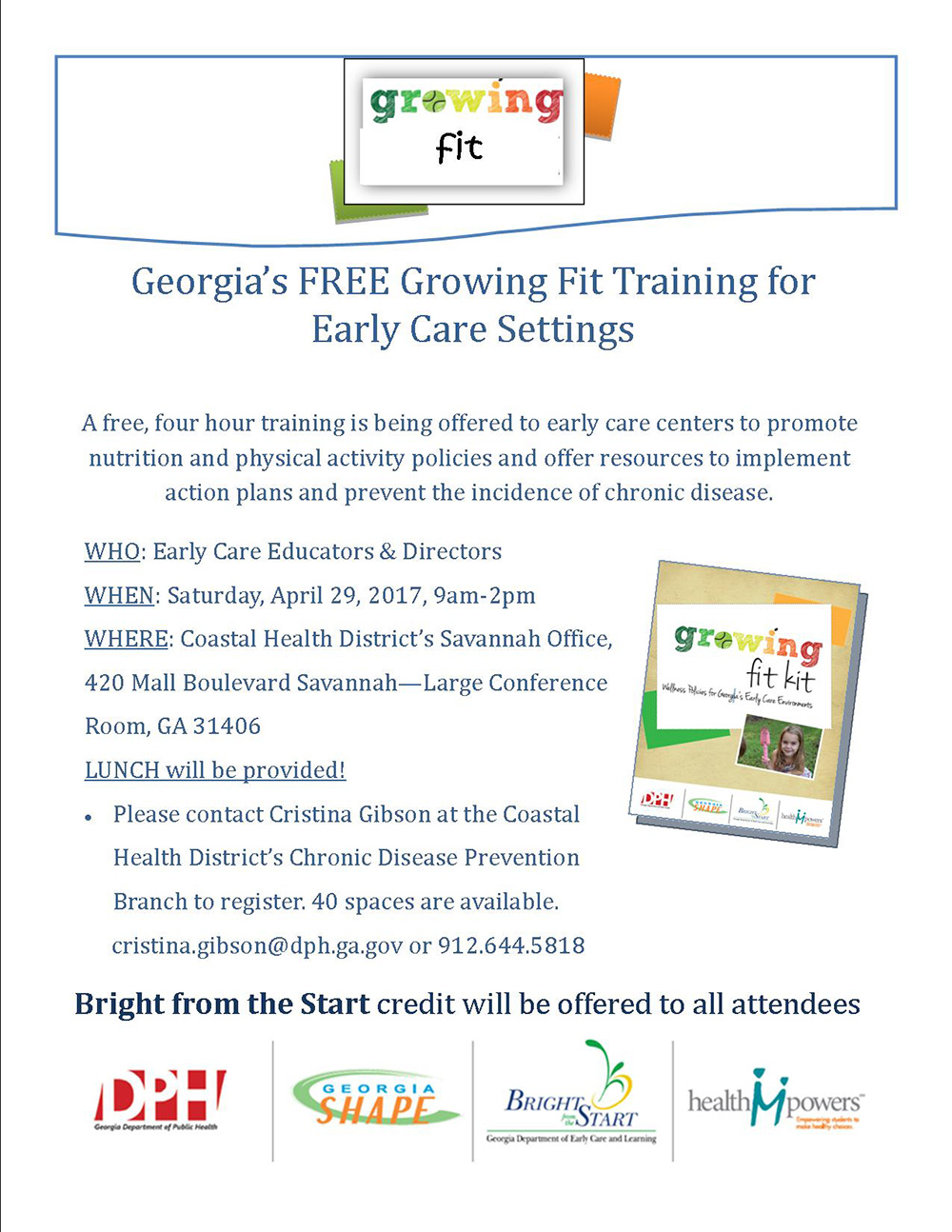
Free “Growing Fit” Training Offered for Early Care Centers

Physical activity and nutrition are essential for children to develop healthy lifestyles that will help reduce the risk of chronic disease later in life. To that end, the Georgia Department of Public Health, Georgia Shape, HealthMPowers, Inc. and Bright from the Start: Georgia Department of Early Care and Learning have developed Growing Fit Kit: Wellness Policies for Georgia’s Early Care Environment. A free training on the kit will be offered to staff from early care centers from 9 a.m. to 2 p.m. on Saturday, April 29, at the Coastal Health District office located at 420 Mall Blvd. in Savannah.

Training will center around a tool kit which provides a step-by-step process to guide early care educators in the development and/or improvement of nutrition and physical activity policies and practices.  It also contains an explanation of the importance of a wellness policy, a self-assessment tool to evaluate current policies and practices, success stories from other early care settings, healthy eating and physical activity resources, and a planning document with suggestions and examples for writing the policy.

This educational learning experience is a Bright from the Start: Georgia Department of Early Care and Learning approved CEU course allowing participants to earn required training units while strengthening their wellness policy efforts to create healthy environments for students to learn and teachers to work. This training also helps move centers toward achievement of Quality Rated standards set by the Department of Early Care and Learning.

To register for either training session, please contact Cristina Gibson at 912-644-5818 or email cristina.gibson@dph.ga.gov.

[JPG, 344.33 KB]

Georgia Health Officials Warn of Potential Phone Scam

ATLANTA – The Georgia Department of Public Health (DPH) is receiving complaints from residents of Georgia and residents of other states about suspicious phone calls. Many of the calls appear to come from a Georgia DPH phone number.

“Right now, we do not know the real reason for the calls or what the caller is truly looking for,” said Rick Keheley, DPH’s inspector general. “We do know the calls are not coming from the Georgia Department of Public Health.”

DPH encourages residents to be extremely cautious when participating in health-related telephone surveys.

DPH does occasionally use telephone surveys to gain information on health trends and it is important to understand the difference. DPH:

  • Will never ask for religious information
  • Will never ask for credit card information
  • Will never try to sell goods or services
  • Will always provide call back or contact information for verification

Residents with questions or those wishing to report a suspicious call should contact DPH’s Office of Inspector General at (404) 656-4409 or reportdphfraud@dhr.state.ga.us


About the Georgia Department of Public Health

The Georgia Department of Public Health (DPH) is the lead agency in preventing disease, injury and disability; promoting health and well-being; and preparing for and responding to disasters from a health perspective. For more information about DPH, visit www.dph.ga.gov.

National Black HIV/AIDS Testing Events Scheduled Feb. 7

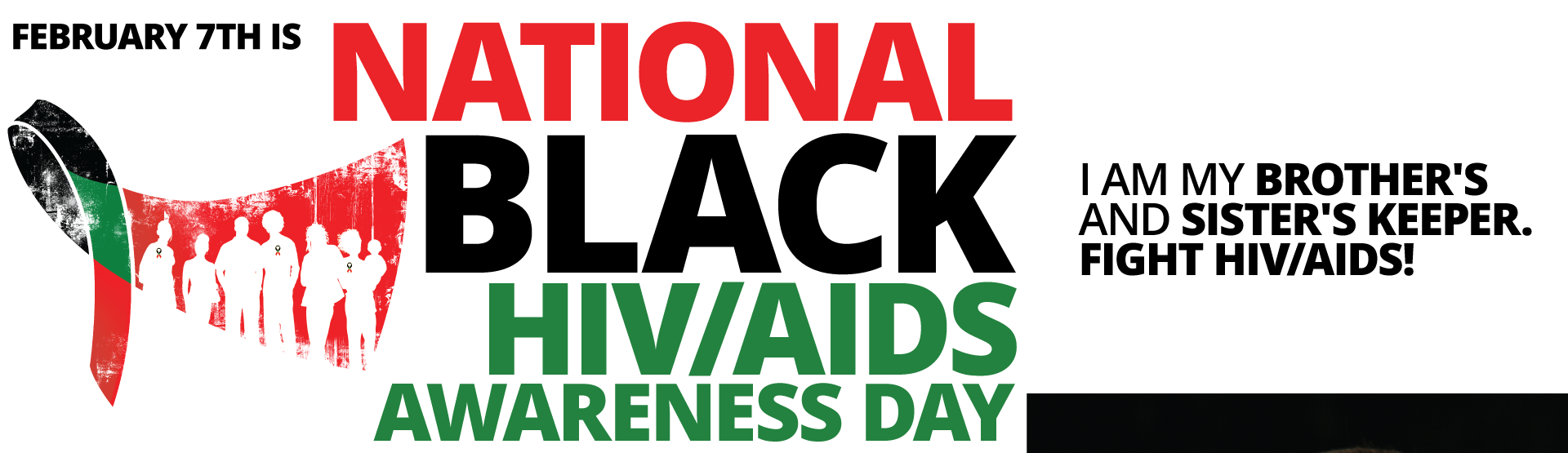
Tuesday, February 7, will mark the 16th observance of National Black HIV/AIDS Awareness Day (NBHAAD) and the Coastal Health District will recognize the day by holding HIV testing events throughout the eight-county public health district. The Coastal Health District Prevention Program will offer free and rapid confidential HIV testing from 9 a.m. to 3 p.m. on Tuesday, February 7 at health departments in Bryan, Camden, Chatham, Effingham, Glynn, Liberty, Long, and McIntosh counties. No appointment necessary.

The NBHAAD 2017 theme is “I am my Brother’s and Sister’s Keeper: Fight HIV/AIDS.” NBHAAD is directed, planned, and organized by a group known as the Strategic Leadership Committee, a coalition that partners with the Centers for Disease Control and Prevention (CDC) to mobilize communities in an effort to address local epidemics and influence the course of HIV in African American communities across the country.

The Coastal Health District has close to 1,400 active cases of HIV and Georgia ranks 5th highest in the nation for the total number of new diagnosis of HIV. The Coastal Health District encourages the community to use this observance to promote HIV prevention practices and reduce the stigma surrounding the disease.

Go to www.nationalblackaidsday.org to learn more about NBHAAD. To locate services for a free HIV test or to access treatment, visit Georgia Department of Public Health’s CAPUS (Care and Prevention in the U.S.) Care Portal at www.gacapus.com or call the Georgia AIDS/STD Infoline at 1-800-551-2728.

For more information on the testing events, please call Diane DeVore at 912- 644-5828 or email Diane.Devore@dph.ga.gov.

[PNG, 190.42 KB]

Coastal Health District Counties Awarded Car Seat Mini Grants

Health departments in Bryan, Chatham, Effingham, Glynn, Liberty, and McIntosh counties have been awarded the 2017 Car Seat Mini Grant by the Georgia Department of Public Health, Injury Prevention Program. Through the Mini Grant, the health departments will work together with other local partners and to provide car seats and education to financially eligible families. This program is funded by the Governor’s Office of Highway Safety to help ensure Georgia’s children are safe while riding in motor vehicles.

Since 2007, the education, car seats, and booster seats provided through the Mini Grant prevented serious injury or death and saved more than 300 of Georgia’s children who were involved in crashes. According to the National Highway Traffic Safety Administration, car seats reduce fatal injuries by 71 percent among infants and by 54 percent among children ages 1 to 4 years in passenger cars. Car seats offer the best protection for children in the event of a crash and they are most effective when installed and used correctly. Nearly three out of every four car seats are not used properly, placing children at unnecessary risk. Through this program, parents and caregivers are educated on how to properly install and use car seats.

Through the Car Seat Mini Grant, agencies supporting more than 130 counties are working to keep Georgia’s children safe. These programs help families get their children buckled up right, every trip, every time.

For more information about the car seat program, please contact your local health department. Contact information for Coastal Health District health departments can be found HERE. If you would like information regarding other counties involved in the program, please contact the Georgia Department of Public Health’s Child Occupant Safety Project via email at injury@dph.ga.gov or by calling (404-679-0500).


Raccoon Tests Positive for Rabies on St. Simons

A raccoon on Poplar Avenue on St. Simons Island has tested positive for rabies after coming into contact with a family dog. The dog is up-to-date on its rabies vaccination.

Several species of wild animals that are native to coastal Georgia – including raccoons, foxes, and bats – can carry rabies. Rabies is a potentially deadly virus that is primarily spread by infected animals. The Glynn County Health Department Environmental Health office offers these tips to protect you and your family from rabies:

  • Avoid contact with animals you don’t know.
  • Make sure your pets receive the proper immunizations. Dogs and cats should get rabies vaccines by four months of age, followed by a booster shot one year later, and another one every year as prescribed by your veterinarian.
  • Do not handle, feed, or unintentionally attract wild animals with open garbage cans or by leaving pet food out at night.
  • Never adopt wild animals or bring them into your home. Do not try to nurse sick animals to health. Call animal control or a properly licensed animal rescue agency for assistance.
  • Teach children to never handle unfamiliar animals, wild or domestic, even if they appear friendly. “Love your own, leave other animals alone” is a good principle for children to learn.

Symptoms of rabies in animals include a change in behavior, biting, aggression, showing no fear of natural enemies (such as humans), foaming at the mouth, and paralysis.

If an animal ever bites you, seek medical care immediately and contact Glynn County Animal Control at 912-554-7500 and the Glynn County Health Department Environmental Health Division at 279-2940.

E-Cigarette Use Among Youth: A Public Health Threat Know the Risks and How to Get Help to Quit Tobacco and Nicotine

ATLANTA – The Georgia Department of Public Health (DPH) is urging caution about the use and exposure of children and youth to electronic nicotine delivery systems, including electronic cigarettes. The U.S. Surgeon General issued a report this week on the dangers of electronic nicotine delivery systems saying “nicotine-containing products are unsafe for youth.”

Electronic nicotine delivery systems are known by a variety of names, including “vapes,” “e-cigarettes,” “pens” and “e-hookahs.” They come in thousands of flavors and colors. Parents, teachers, coaches, counselors and other youth leaders should be aware of the dangers of these products and that they can be made to look like pens and other small objects that can be hidden in plain sight.

It is against the law in Georgia to sell or distribute any electronic cigarette to a person who is under the age of 18. As of October 2014, it is against state policy to use these products on any University System of Georgia property. Federal law also prohibits sales of e-cigarettes to minors, restricts sales in vending machines, and requires these products to have a nicotine warning label.

Nicotine is a neurotoxin that can damage the developing adolescent brain by causing permanent changes and contributing to mental health problems and mood disorders as well as other health problems. In addition to nicotine, the aerosol from electronic nicotine delivery products may include formaldehyde, propylene glycol, lead and other toxic chemicals.

Use of electronic nicotine delivery systems or devices, particularly by youth, is associated with other tobacco use.

“We know youth and young adults are trying these unsafe products in increasing numbers. This is an emerging public health crisis that threatens the health of our youth and our progress in reducing dependence on tobacco statewide” said Jean O’Connor, JD, DrPH, director of Chronic Disease Prevention for DPH.

The emissions from e-cigarettes have not been proven to be safe for anyone. Along with the dangers to the developing youth brain, nicotine is a highly addictive chemical for people of all ages that causes hardening of the arteries, which is associated with heart attack and stroke. Pregnant women or women who may become pregnant should especially avoid using or being exposed to nicotine. It can impact fetal development, affecting the brain, nerves and circulatory systems.

Electronic cigarettes and similar electronic nicotine delivery devices have not been approved by the U.S. Food and Drug Administration as tobacco cessation devices. The only current safe and effective tools to quit nicotine and tobacco products are approved nicotine replacement therapy products, which contain controlled doses of nicotine.

Most people who want to quit tobacco or nicotine need help to end their addiction. Anyone, including teenagers, who needs help quitting tobacco or nicotine, should talk with their doctor. Help quitting tobacco is covered by Georgia Medicaid and other health plans. Or, they can contact the Georgia Tobacco Quitline for free, confidential support:

English: 1-877-270-STOP (877-270-7867)
Spanish: 1-877-2NO-FUME (877-266-3863)
Hearing Impaired: 1-877-777-6534

The Quitline is available 24/7. It is never too late to quit.

For more information visit dph.ga.gov/tobacco or email chronic.disease@dph.ga.gov

Smoke From Wildfires Spreads In Georgia; DPH Urges Precautions to Protect Health

Shifting winds are pushing smoke from several fires burning in North Georgia and parts of Tennessee into the state, including the metro Atlanta area. The Georgia Department of Public Health is urging people, especially individuals with chronic heart and lung diseases, to protect themselves from smoke from wildfires.

For healthy people, smoke from wildfires that contains particles from burning trees and shrubs can irritate your eyes and respiratory system. However, smoke can worsen chronic health problems such as lung disease, asthma, allergies and increased risk of heart attacks and stroke. People with existing respiratory conditions, young children and elderly people are especially susceptible to health effects from this smoke.

“We especially urge parents and caregivers to pay careful attention to children and older adults and seek medical care if needed,” said Jean O’Connor, director of Chronic Disease Prevention at the Georgia Department of Public Health. “Older adults are more susceptible to smoke because of their increased risk of heart and lung problems. Children’s airways are still developing and they breathe more air per pound of body weight than adults.”

Smoke can irritate the eyes and airways, causing coughing, a scratchy throat, irritated sinuses, headaches, stinging eyes or a runny nose. People with heart disease might experience chest pain, palpitations, shortness of breath or fatigue. People with lung disease may not be able to breathe as deeply or as vigorously as usual, and they may experience symptoms such as coughing, phlegm, chest discomfort, wheezing and shortness of breath.

It’s important to limit your exposure to smoke and there are precautions you can take:

  • Use common sense. If it looks and smells smoky outside limit outdoor activities; yard work, exercise, children playing.
  • Pay attention to local air quality reports and news coverage related to smoke.
  • Keep indoor air as clean as possible if you are advised to stay indoors. Keep windows and doors closed. Run an air conditioner if you have one, but keep the fresh-air intake closed and the filter clean to prevent outdoor smoke from getting inside.
  • Avoid activities that increase indoor pollution. Burning candles, fireplaces, or gas stoves can increase indoor pollution. Vacuuming stirs up particles already inside your home, contributing to indoor pollution. Smoking also puts even more pollution into the air. 
  • Do not rely on dust masks for protection. Paper “comfort” or “dust” masks commonly found at hardware stores are designed to trap large particles, such as sawdust. These masks will not protect your lungs from the small particles found in wildfire smoke. 
  • Follow the advice of your doctor or other health care provider about medicines and about your respiratory management plan if you have asthma or another lung disease.

For more information about smoke and health go to www.cdc.gov/features/wildfires/.

Smoke from Burning Debris Can Trigger Respiratory Issues

Smoke created from residents burning debris generally does not pose a health hazard but it may worsen symptoms for people who have pre-existing respiratory conditions such as respiratory allergies, asthma and chronic obstructive pulmonary disease (COPD).

The best protection for these individuals is to avoid areas where burning is taking place or stay indoors. If that is not possible, parents or caregivers of persons with respiratory conditions should monitor the individual carefully; ensure all medication is taken as directed; and, seek medical attention immediately if the In addition:

  • Make sure to keep windows and doors shut.
  • Use the recycle or re-circulate mode on the air conditioner in your home or car.
  • Asthmatics should follow their asthma management plan.
  • Contact your doctor if you have symptoms such as chest pain, chest tightness, shortness of breath, or severe fatigue. This is important not only for people with chronic lung or heart disease, but also for individuals who have not been previously diagnosed with such illnesses. Smoke can “unmask” or produce symptoms of such diseases.