Air Quality Monitoring Resources and Health Information
READ MORE »

×

The Coastal Health District of Georgia serves the counties of Bryan, Camden, Chatham, Effingham, Glynn, Liberty, Long & McIntosh

Long News


DPH Urges Safety Precautions After Irma

Keep Yourself and Your Loved Ones Safe By Following Basic Safety Tips

ATLANTA – Hurricane/tropical storm Irma is no longer a threat but recovering from the storm will take weeks, and even longer in some parts of the state. The Georgia Department of Public Health (DPH) is urging Georgians to use extreme caution particularly in the next few days as residents return to their homes, power is restored and damage assessments are made. The storm may be over, but that doesn’t mean the danger is.

Be careful near damaged buildings

  • Do not return to your home until you are told it is safe to do so.
  • Return during daylight hours, when it is easier to avoid hazards, particularly if the electricity is off.
  • Do not enter your home if you are unsure of structural integrity.
  • Leave immediately if you hear shifting or unusual noises.
  • If you smell gas or suspect a leak, notify emergency authorities or the gas company immediately and leave the area.

Stay away from power lines

  • Stay clear of fallen power lines – be particularly careful of power lines that may be hidden in fallen trees and branches.
  • Watch out for power lines dangling overhead.
  • Report downed power lines to emergency authorities or the power company immediately.

Avoid floodwater

  • Always follow warnings about flooded roads.
  • Don’t drive through floodwater – it may be deeper than you think.
  • Keep in mind that floodwater often carries germs. If you touch it, be sure to wash your hands with soap and water. If you don’t have soap or water, use alcohol-based wipes or sanitizer.

Prevent Carbon Monoxide Poisoning

  • Never use a generator inside your home or garage, even if doors and windows are open.
  • Only use generators outside, more than 20 feet away from your home, doors and windows.
  • Install battery-operated or battery backup CO detectors near every sleeping area in your home.

Identify and throw away food that may not be safe to eat

  • When in doubt, throw it out.
  • Throw away food that has an unusual odor, color or texture.
  • Throw away perishable foods (including meat, poultry, fish, eggs and leftovers) in your refrigerator when the power has been off for four hours or more.
  • Thawed food that contains ice crystals can be refrozen or cooked. Freezers, if left unopened and full, will keep food safe for 48 hours (24 hours if half full).
  • Throw away canned foods that are bulging, opened or damaged.

Check water quality

  • Listen and follow all drinking water advisories and use bottled water when in doubt.
  • Do not drink water from private wells that have/may have been flooded.
  • Disinfect all private wells that may have been flooded before drinking water.

Protect yourself from animals and pests

  • Floods can bring mosquitoes that carry disease – use insect repellent with DEET or Picaridin, IR3535, and some oil of lemon eucalyptus. Follow label directions.
  • Wear long sleeves, pants and socks when you’re outside.
  • Stay away from wild or stray animals after a storm – call 911 or your local public health department to report them.

Prevent mold

  • Protect yourself by wearing gloves, masks and goggles.
  • Remove and discard items that cannot be washed and disinfected (such as mattresses, carpeting, carpet padding, rugs, upholstered furniture, cosmetics, stuffed animals, baby toys, pillows, foam-rubber items, books, wall coverings and paper products) within 24-48 hours.
  • Remove and discard drywall and insulation that has been contaminated with sewage or floodwaters within 24-48 hours.
  • Ventilate by opening all doors and windows.
  • Thoroughly clean all hard surfaces (such as flooring, concrete, molding, wood and metal furniture, countertops, appliances, sinks and other plumbing fixtures) with hot water and laundry or dish detergent.


For more information go to:

https://www.cdc.gov/disasters/hurricanes/hurricane_irma.html

https://www.foodsafety.gov/keep/charts/refridg_food.html

https://www.epa.gov/sites/production/files/2015-05/documents/epa816f05021.pdf [PDF]

https://www.cdc.gov/mold/images/mold_infographic.jpg [JPG]

http://www.gema.ga.gov/Pages/default.aspx

https://dph.georgia.gov/


About the Georgia Department of Public Health

The Georgia Department of Public Health (DPH) is the lead agency in preventing disease, injury and disability; promoting health and well-being; and preparing for and responding to disasters from a health perspective. For more information visit: www.dph.georgia.gov
Swimming in the Ocean Not Advised Under Current Conditions

The Coastal Health District and Georgia Department of Natural Resources, Coastal Resources Division, advise against swimming or wading in the ocean due to the possibility of hazards including rip currents, elevated bacteria levels, and debris in the water.

Testing for elevated levels of enterococcus (pronounced: en·ter·o·coc·cus), bacteria which is found in warm blooded animals including humans but also birds, raccoons, deer, dolphins and other wildlife, is currently suspended/temporarily unavailable. Testing will resume as soon as possible.

For more information about beach water testing, click HERE.

West Nile Virus Infections Increase in Georgia; Georgians Urged to Protect Themselves from Mosquito Bites

From the Georgia Department of Public Health
August 31, 2017

ATLANTA – The Georgia Department of Public Health (DPH) has confirmed nearly 20 human cases of West Nile virus so far this year, including at least three deaths. Georgians are urged to protect themselves from mosquito bites, especially when they are outside this Labor Day weekend.

“Georgians can reduce the number of mosquitoes around their homes and yards by getting rid of standing water,” said Chris Rustin, Ph.D., DPH director of Environmental Health. “Standing water is a breeding ground for mosquitoes that may be infected with West Nile virus and other mosquito-borne diseases.”

Tip ‘n Toss all containers that can collect water – flowerpots, buckets, pool covers, pet water dishes, discarded tires, and birdbaths – anything that holds water and gives mosquitoes a place to thrive. Mosquitoes that carry West Nile virus look for stagnant water to breed in, so be sure gutters and eaves are clear of leaves and debris.

The most effective way to protect against WNV infection and all mosquito-borne diseases, including Zika, is to prevent mosquito bites. Observe the “Five D’s of Prevention” during your outdoor activities this holiday weekend:

  • Dusk/Dawn – Mosquitoes carrying WNV usually bite at dusk and dawn, so avoid or limit outdoor activity at these times.
  • Dress – Wear loose-fitting, long sleeved shirts and pants to reduce the amount of exposed skin.
  • DEET – Cover exposed skin with an insect repellent containing DEET, which is the most effective repellent against mosquito bites.
  • Drain – Empty any containers holding standing water because they are excellent breeding grounds for virus-carrying mosquitoes.
  • Doors – Make sure doors and windows are in good repair and fit tightly, and fix torn or damaged screens to keep mosquitoes out of the house.

Symptoms of WNV include headache, fever, neck discomfort, muscle and joint aches, swollen lymph nodes, and a rash – that usually develop three to 15 days after being bitten by an infected mosquito. The elderly, those with compromised immune systems, or those with other underlying medical conditions are at greater risk for complications from the disease.

Anyone with questions about WNV or Zika should speak to their healthcare provider or call their local county health department, environmental health office. More information about mosquito-borne illnesses and mosquito repellents can be found by clicking mosquito-borne illness.


About the Georgia Department of Public Health

The Georgia Department of Public Health (DPH) is the lead agency in preventing disease, injury and disability; promoting health and well-being; and preparing for and responding to disasters from a health perspective. DPH’s main functions include: Health Promotion and Disease Prevention, Maternal and Child Health, Infectious Disease and Immunization, Environmental Health, Epidemiology, Emergency Preparedness and Response, Emergency Medical Services, Pharmacy, Nursing, Volunteer Health Care, the Office of Health Equity, Vital Records, and the State Public Health Laboratory. For more information visit: www.dph.georgia.gov.

Solar Eclipse Safety Tips

On Monday, August 21, Georgia will be among 14 states to experience a total eclipse of the sun. The Georgia Department of Public Health reminds those who will watch the solar eclipse that it’s never safe to look directly at the sun, or eye damage may occur.

Viewing the solar eclipse should be done through “eclipse glasses” that meet the ISO 12312-2 international safety standard. See the American Astronomical Society (AAS) Reputable Vendors of Solar Filters & Viewers for a list of dealers of eclipse glasses.

Retinal damage to eyes may occur while attempting to stare at the sun. Solar retinopathy is a result of too much ultraviolet light flooding the retina. Never look directly at the sun without proper protection – using ISO 12312-2 lenses. If you damage your eyes trying to view the solar eclipse, please contact your healthcare provider.

NASA’s additional recommendations for safe eclipse viewing are:

  • Stand still, and put on your eclipse glasses before looking up at the eclipse. Turn away to remove your eclipse glasses — do not remove them while looking at the sun.
  • Do not look at the eclipse through a camera, a telescope or binoculars while using your eclipse glasses — the sun will damage the filter and your eyes.
  • Always inspect your eclipse glasses before use; if scratched or damaged, do not use.
  • Supervise children viewing the eclipse.
  • Remove your eclipse glasses only when the moon completely covers the sun and it gets dark. Then, as soon as the sun begins to reappear, put your eclipse glasses back on.

The last time the U.S. saw a total eclipse was 1979. During this year’s eclipse, the moon will fully block the sun for two minutes and 40 seconds. Only the northeast corner of Georgia will experience this; the rest of the state will see a partial eclipse. The moon will pass between the Earth and the sun, blocking all or part of the sun, for up to three hours.

Learn more about safely viewing the solar eclipse at: https://eclipse2017.nasa.gov/safety.

World Breastfeeding Week Events Scheduled August 4 and 5

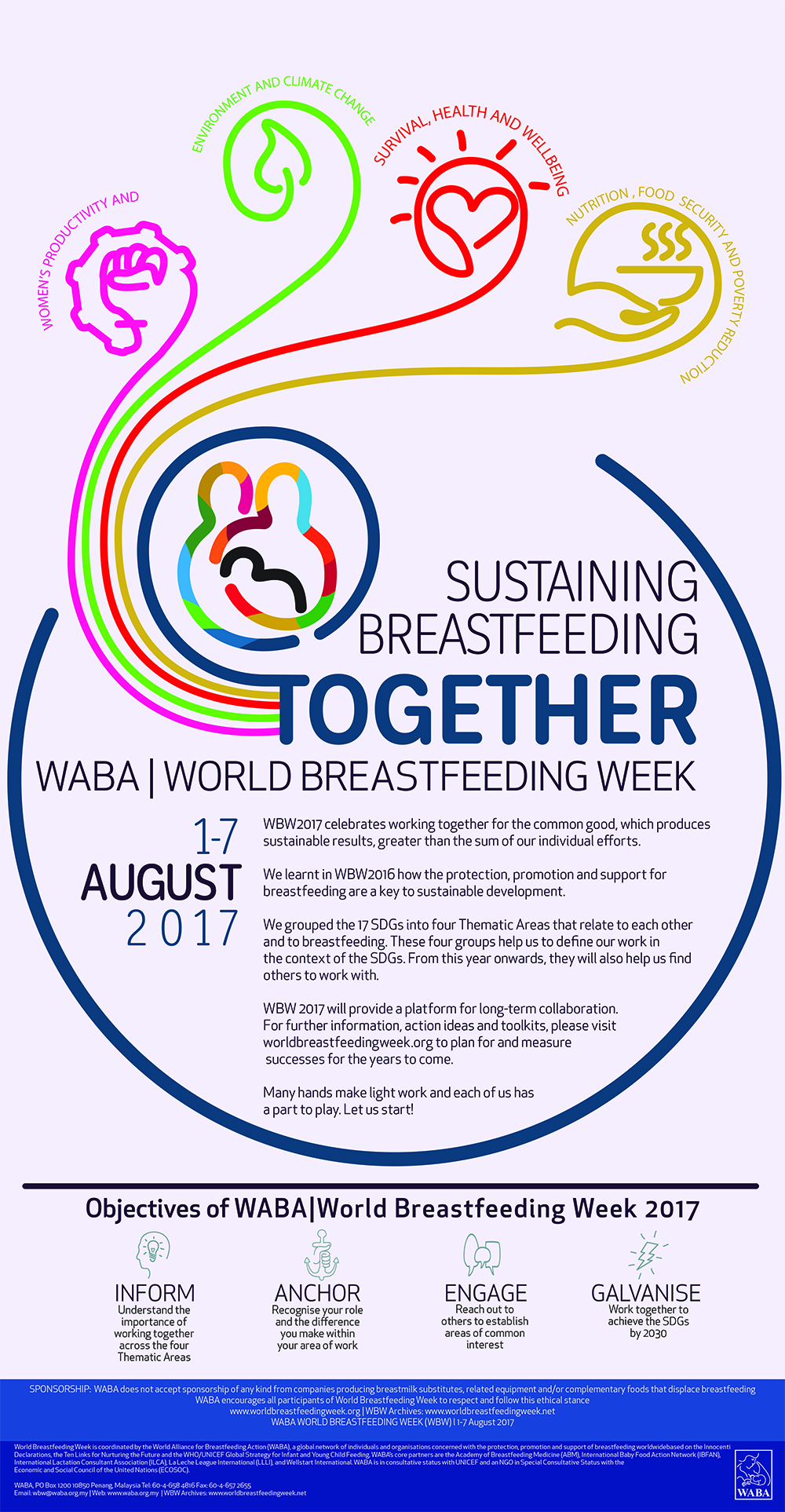
The Coastal Health District Women, Infants, and Children’s (WIC) nutrition program will hold two World Breastfeeding Week celebrations in early August. The first event will take place from 4 p.m. to 6 p.m. on Friday, August 4 at Jekyll Island Square on Newcastle Street in Brunswick and the second event will take place from 8 a.m. to 11 a.m. on Saturday, August 5, at the Forsyth Farmers’ Market in Savannah. The celebrations will include public walks, prize giveaways, and information on the benefits of breastfeeding. All events are free and family friendly.

Those who register for the events by going to www.coastalhealthdistrict.org/bf will receive a free T-shirt while supplies last.

World Breastfeeding Week is celebrated during the first week in August every year in more than 170 countries to encourage breastfeeding and improve the health of babies around the world.  This year’s theme is “Sustaining breastfeeding together” and is focused on working together for the common good. The key to best breastfeeding practices is continued day-to-day support for breastfeeding mothers within their home and community. The Coastal Health District is committed to helping mothers breastfeed their babies because breastfeeding is so important for good health. Breast milk is easy to digest, with just the right amount of fat, sugar, water, and protein for a baby’s growth and development. Breastfed babies usually get sick less often, because breast milk contains antibodies that can protect infants from bacterial and viral infections.

For more information on the objectives of World Breastfeeding Week 2017, click HERE.

For more information on the scheduled Coastal Health District events, contact Monica Lightfoot at Monica.Lightfoot@dph.ga.gov.

[JPG, 2.02 MB]

Georgia Department of Public Health commissioner named head of Atlanta-based CDC


July 7, 2017 – from the office of Georgia Governor Nathan Deal:

Gov. Nathan Deal today announced the appointment of Dr. J. Patrick O’Neal, current director of Health Protection for the Georgia Department of Public Health (DPH), as interim commissioner of DPH, effective immediately. The vacancy was created by the appointment of Dr. Brenda Fitzgerald, current commissioner of DPH, as director of the Centers for Disease Control and Prevention (CDC) by President Donald Trump.

“I am immensely proud of my friend and colleague Dr. Brenda Fitzgerald, and I am grateful to her for her tireless work to promote the health and well-being of Georgia’s citizens,” said Deal. “She has been an asset to the State of Georgia and I know she will bring the same determination and persistence to her new role of CDC director, working for the good of the entire country. I want to thank President Trump for naming one of our own to this prominent role and I am confident Dr. O’Neal will be able to successfully pick up where Brenda left off at DPH.”

“I am humbled by the challenges that lie ahead, yet I am confident that the successes we’ve had in Georgia will provide me with a foundation for guiding the work of the CDC,” said Fitzgerald. “The progress we’ve made in Georgia around early brain development, childhood obesity and creating a model for addressing the Ebola epidemic would not have been possible without the full support of Governor Deal and a dedicated public health staff.”


Brenda Fitzgerald, M.D. [JPG, 4.91 KB]

Fitzgerald formerly served as the commissioner of DPH and as State Health Officer. She is a board-certified Obstetrician-Gynecologist and practiced medicine for more than three decades before coming to Public Health in 2011. As Commissioner, Fitzgerald oversaw various state public health programs including Health Promotion and Disease Prevention, Health Protection, Georgia WIC, Office of Pharmacy, Nursing, Volunteer Health Care and Vital Records. She also directed the state’s 18 public health districts. She earned a bachelor’s degree in Microbiology from Georgia State University and a medical degree from the Emory University School of Medicine. As a Major in the United States Air Force, Fitzgerald served at the Wurtsmith Air Force Strategic Air Command Base in Michigan and at the Andrews Air Force Base in Washington, D.C.


J. Patrick O’Neal, M.D. [JPG, 4.65 KB]

O’Neal serves as the Director of Health Protection for DPH, overseeing more than a dozen public health programs including Epidemiology, Infectious Disease and Immunization, Emergency Preparedness and the Georgia Public Health Lab. He is also the medical director for the Office of EMS and Trauma. O’Neal previously practiced emergency medicine for 29 years at DeKalb Medical Center and also served as the regional medical director for EMS throughout the Metro Atlanta area. He earned a bachelor’s degree from Davidson College and a medical degree from the Tulane University School of Medicine. Following medical school, O’Neal entered the United States Air Force for training in flight medicine and later served as a flight surgeon in Vietnam.


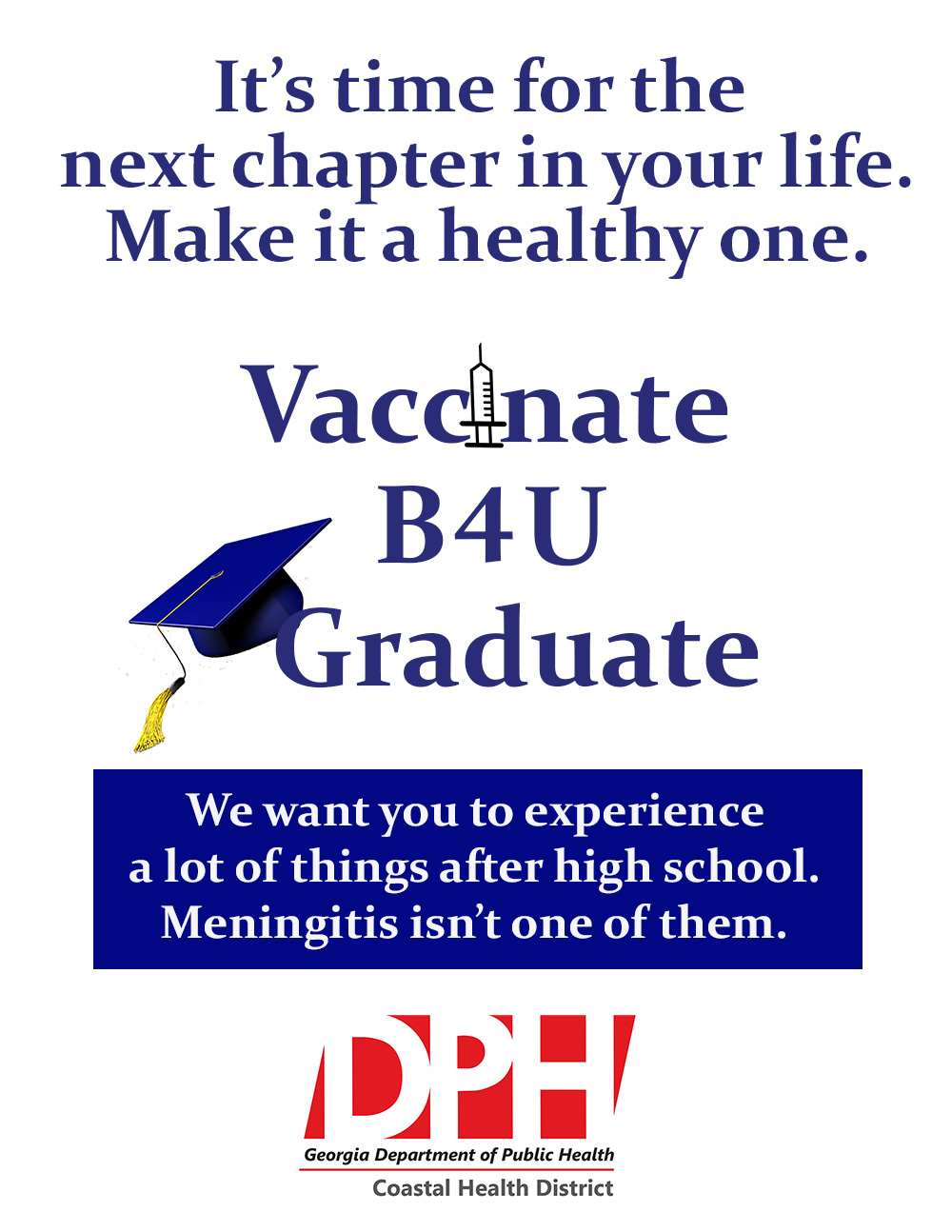
Health Department Officials Urge Students to “Vaccinate B4U Graduate”

As students begin looking ahead to graduation and starting a new and exciting chapter in life, it’s a good time to remind both students and their parents about the important role that immunizations play in that chapter. Health department officials in Bryan, Camden, Chatham, Effingham, Glynn, Liberty, Long, and McIntosh counties want to encourage soon-to-be high school graduates to get vaccinated against meningococcal disease which causes meningitis.

Meningococcal disease is not common; however, when it is contracted it can be dangerous. The bacteria that causes meningococcal disease is spread by exchanging respiratory and throat secretions (saliva or spit) during close (for example, coughing or kissing) or lengthy contact, especially if living in the same household or dorm. There are different kinds of meningitis. Bacterial meningitis can be very serious and can even cause permanent disabilities and death. Viral meningitis is the most common type of meningitis and is usually less serious but can still cause illness.

“We encourage parents of students getting ready to graduate – especially those going off to college – to make sure their children have received the meningococcal vaccine and that all vaccinations are up-to-date,” said Coastal Health District Immunization Coordinator, Paige Lightsey, R.N. “This is an exciting time for our students and we want to do everything we can to make sure that they are protected from meningitis as they start on their new adventure.”

When children are 11 or 12 years old they should receive one dose of the vaccine followed by a booster at age 16. Parents can check with the health department or their healthcare provider to get immunization records for their children or schedule a time to get the meningococcal vaccine.

For more information on meningitis or the meningococcal vaccine, please to cdc.gov/meningitis.
[JPG, 282.12 KB]

School Health Summit Planned for May 31; School Officials Encouraged to Attend

 The Coastal Health District Chronic Disease Prevention Program will host a School Health Summit from 9 a.m. to 3 p.m. on Wednesday, May 31, at the Liberty County Schools Performing Arts Center located at 2140 E. Oglethorpe Hwy. in Hinesville.

The free one-day training is being offered to school administrators, teachers, nutrition directors, and principals to develop and execute nutrition and physical activity policies and to offer resources to help prevent the incidence of chronic disease in children.

“Obesity continues to be a real problem in children of all ages and unhealthy habits developed early translate into unhealthy habits later in life,” said Coastal Health District Chronic Disease Prevention Director, Cristina Gibson. “The Summit is a way for school leaders to learn about tools that can help promote better health in students and how to go about using those tools.”

Those interested in attending the training can register by calling Gibson at 912-644-5818 or by emailing cristina.gibson@dph.ga.gov.

The 2017 School Health Summit is sponsored by the Georgia Department of Public Health, healthMpowers, Georgia SHAPE, and the Coastal Health District.

CDC: Georgia’s Early Childhood Vaccination Rates Among Nation’s Highest

ATLANTA – Georgia is leading the country with above average early childhood vaccinations with 75.6 percent of children 19-35 months old protected, compared to national averages of 72.2 percent for the 7-vaccine series. However, health officials here say statewide immunization statistics show that more can be done to stop vaccine-preventable disease outbreaks in Georgia.

As recent disease outbreaks demonstrate, immunizing infants and young children remains a critical component of protecting vulnerable infants against potentially deadly diseases.

So far in 2017, the Centers for Disease Control and Prevention has reported more than 1,200 cases of mumps across the U.S. Other recent outbreaks include a pertussis outbreak in 2012 that infected more than 48,000 people, and a measles outbreak that started at Disneyland and impacted 188 people in 2015. Each of these diseases is preventable by vaccines.

During National Infant Immunization Week, April 22-29, the Georgia Department of Public Health and the Georgia Chapter of the American Academy of Pediatrics urge parents to check with their pediatrician to ensure their child is up-to-date on vaccinations.

“Immunizations are the best way to protect infants and children from childhood diseases, like whooping cough and measles that can be life-threatening at young ages,” said Brenda Fitzgerald, M.D., commissioner of the Georgia Department of Public Health. “It is critical for parents to talk to their child’s doctor to ensure they are up-to-date on immunizations, because no child should have to suffer a vaccine-preventable illness.”

The American Academy of Pediatrics encourages parents to become aware of vaccination rates in their community. The AAP offers an interactive map (https://immunizations.aap.org/) that highlights vaccination rates in each state for recommended childhood vaccines, including vaccines that protect against measles, mumps, pertussis, polio and influenza. It also offers state-by-state information about community immunity thresholds, which is the level at which disease outbreaks are prevented.

“High immunization rates in the community provide a buffer of protection that makes it harder for diseases to break through,” said Georgia Chapter AAP President Ben Spitalnick, M.D., Savannah. “Vaccines protect children from diseases, and they also keep communities healthy by protecting infants who are too young to be vaccinated, or those who have compromised immune systems.”

The Georgia Department of Public Health and the Georgia Chapter of the American Academy of Pediatrics encourage everyone – in observance of National Infant Immunization Week – to protect the little ones who cannot yet protect themselves. Please contact your pediatrician or your local public health department to ensure your infant is up-to-date on vaccinations. For more information contact the Georgia Department of Public Health http://dph.georgia.gov/immunization-section or http://www.gaaap.org/immunizations/.


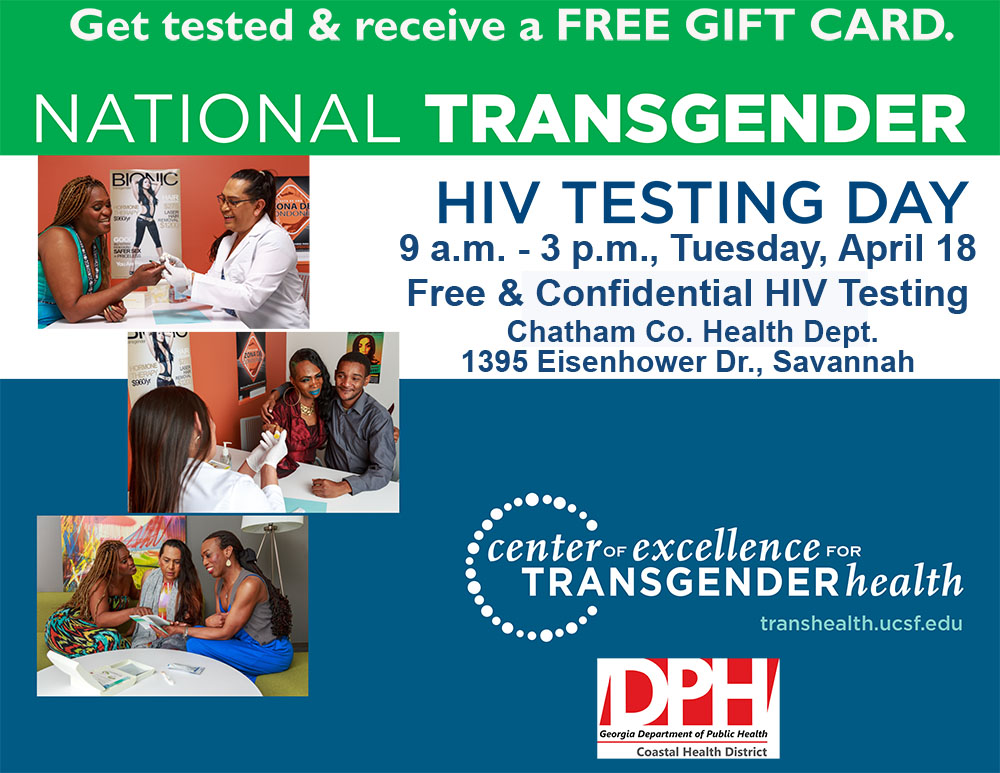
National Transgender HIV Testing Day Event Scheduled for April 18

The Coastal Health District Prevention Program will offer free and confidential HIV testing event in observance of National Transgender HIV Testing Day from
9 a.m. to 3 p.m. on Tuesday, April 18, at the Chatham County Health Department located at 1395 Eisenhower Drive in Savannah.

National Transgender HIV Testing Day (NTHTD) is a day to recognize the importance of routine HIV testing, status awareness, and continued focus on HIV prevention and treatment efforts among transgender and gender non-binary people. In observance of this day, the Coastal Health District will offer free, rapid confidential testing. No appointment is necessary. Anyone who gets tested at the event will receive a gift card.

[JPG, 225.17 KB]