Air Quality Monitoring Resources and Health Information
READ MORE »

×

The Coastal Health District of Georgia serves the counties of Bryan, Camden, Chatham, Effingham, Glynn, Liberty, Long & McIntosh

McIntosh News


DPH Awaits CDC Confirmation of Positive COVID-19 Test in Floyd County

ATLANTA – The Georgia Department of Public Health (DPH) is awaiting confirmatory testing on a positive test for COVID-19 in a Georgia patient in Floyd County. The initial testing was completed by the Georgia Public Health Laboratory on March 5.

Per testing protocols established by the Centers for Disease Control and Prevention (CDC), the test results were sent to the CDC for confirmation. Testing at most state laboratories, including Georgia, is just underway; and due to previous flaws in the test components sent to state laboratories, the CDC requires all presumptive positives for COVID-19 be sent to them for verification at this time. We expect to have results from the CDC in the coming days.

“The Centers for Disease Control and Prevention has not confirmed initial test results for this patient. The Georgia Department of Public Health has requested expedited processing for an official determination,” said Governor Kemp. “To prevent the spread of incomplete or inaccurate information, we encourage Georgians to rely on guidance from the CDC, the DPH, and my office. We will continue to provide regular updates to keep the public informed and ensure the health and safety of families across our state.”

DPH is working to identify any contacts who may have been exposed while the individuals were infectious. People who are identified as having been exposed will be contacted directly by a DPH epidemiologist and monitored for fever and respiratory symptoms.

The risk of COVID-19 to the general public remains low at this time. All Georgians should follow basic prevention measures for any respiratory illness, including:

  • Wash your hands often with soap and warm water for at least 20 seconds. If soap and water are not available, use an alcohol-based hand sanitizer.
  • Avoid touching your eyes, nose and mouth with unwashed hands.
  • Avoid close contact with people who are sick.
  • Stay home when you are sick.
  • Cover your cough or sneeze with a tissue, then throw the tissue in the trash.
  • Clean and disinfect frequently touched objects and surfaces.

If you have recently traveled to areas where there are ongoing outbreaks of COVID-19 and develop fever with cough and shortness of breath within 14 days of your travel, or if you have had contact with someone who is suspected to have COVID-19, stay home and call your health care provider or local health department right away. Be sure to call before going to a doctor’s office, emergency room, or urgent care center and tell them about your recent travel and your symptoms.

Gov. Kemp, Officials Confirm Two Cases of COVID-19 in Georgia

There are currently no confirmed cases of COVID-19 in the Coastal Health District.

From the Georgia Department of Public Health:

This evening, Governor Brian Kemp, Georgia Department of Public Health (DPH) Commissioner Kathleen Toomey, M.D., and state officials confirmed Georgia’s first cases of Coronavirus Disease 2019 (COVID-19) involving two residents of Fulton County who live in the same household. One recently returned from Italy. Both have mild symptoms; they are isolated at home with other relatives to keep the illness from spreading.

DPH is working to identify any contacts who may have been exposed while the individuals were infectious. People who are identified as having been exposed will be contacted directly by a DPH epidemiologist and monitored for fever and respiratory symptoms.

Earlier this evening, Governor Kemp spoke with Vice President Mike Pence about the two confirmed cases. The Governor’s Coronavirus Task Force was briefed via conference call at roughly 9:30 p.m. At 10 p.m., Governor Kemp held a press conference at the Georgia State

Capitol with Dr. Toomey, State Epidemiologist Cherie Drenzek, Adjutant General Tom Carden, Georgia Department of Emergency Management and Homeland Security Director Homer Bryson, and Insurance and Safety Fire Commissioner John King.

“Our team has been working around the clock to prepare for any scenario. Already, state health officials have established contact with these individuals to gather more information, monitor their condition, and determine any exposure,” said Governor Kemp. “They are confident that our efforts to prepare for this moment have enabled us to manage these cases appropriately and minimize any risks moving forward. We remain in constant communication with our partners at all levels of government, and we will continue to update members of the public as information becomes available.”

“We knew that Georgia would likely have confirmed cases of COVID-19, and we planned for it. The immediate risk of COVID-19 to the general public, however, remains low at this time,” said Kathleen E. Toomey, M.D., M.P.H, DPH commissioner. “I cannot emphasize enough the need for all Georgians to follow the simple precautions that DPH always urges to prevent the spread of respiratory viruses.”

COVID-19 spreads through the air when an infected person coughs or sneezes. Symptoms appear within two to 14 days after exposure and include fever, cough, runny nose, and difficulty breathing. Those considered at risk for contracting the virus are individuals with travel to areas where there are ongoing outbreaks of COVID-19 or individuals in close contact with a person infected with COVID-19.

Best Practices

  • Wash your hands often with soap and warm water for at least 20 seconds. If soap and water are not available, use an alcohol-based hand sanitizer.
  • Avoid touching your eyes, nose, and mouth with unwashed hands.
  • Avoid close contact with people who are sick.
  • Stay home when you are sick.
  • Cover your cough or sneeze with a tissue, then throw the tissue in the trash.
  • Clean and disinfect frequently touched objects and surfaces.

The flu is still widespread and active throughout the state, so if you have not already gotten a flu shot, it is not too late. While the flu shot will not protect against COVID-19, it will prevent serious complications that require hospitalization and prevent overburdening the health care system in the event of a COVID-19 outbreak.

If you have recently traveled to areas where there are ongoing outbreaks of COVID-19 and develop fever with cough and shortness of breath within 14 days of your travel, or if you have had contact with someone who is suspected to have COVID-19, stay home and call your health care provider or local health department right away. Be sure to call before going to a doctor’s office, emergency room, or urgent care center and tell them about your recent travel and your symptoms.


For more information and resources about COVID-19, visit our COVID-19 Planning and Response Pages.

DPH Preparations for Potential Spread of COVID-19

ATLANTA – The Georgia Department of Public Health (DPH) is working closely with the CDC, and state partners to prepare for a potential outbreak of COVID-19 in the U.S., including Georgia. The goal is to quickly identify cases of COVID-19 and take the appropriate public health action to reduce its spread and protect the general public. It is important to note that at this time, the overall risk of COVID-19 to the general public remains low.

“We urge Georgians to prepare for hurricanes or flooding or take measures to prevent flu, so preparing for an outbreak of COVID-19 is no different,” said Kathleen E. Toomey, M.D., M.P.H., DPH commissioner. “DPH is working to make sure our health systems, first responders and county health departments have the resources they need to respond to a COVID-19 outbreak.”

DPH already has a detailed pandemic flu plan that was developed in partnership with the Georgia Emergency Management Agency, the Georgia Department of Education and other state agencies, and will be adapted for a COVID-19 outbreak in the state. DPH has responded to other serious disease outbreaks, including Ebola and Zika virus and each instance has provided new insight and guidance and highlighted the need to be as prepared as we can be.

DPH Emergency Preparedness and Response (EPR) is providing CDC information and guidance about COVID-19 to all health care and hospital facilities throughout Georgia, and holding weekly calls with the entire public health and hospital/health care community to update information and answer questions.

DPH epidemiologists are on-call 24/7 to help health care providers evaluate individuals presenting with symptoms of COVID-19 to ensure that possible cases are managed safely, support laboratory testing and implement recommendations from the CDC. In the event of COVID-19 in Georgia, epidemiologists would also be monitoring outbreaks and recommending control strategies, including guidance regarding testing and isolation.

Should it become necessary, DPH may recommend appropriate community mitigation measures for affected communities, such as temporary closure of child care facilities and schools/colleges and universities, school and workplace social distancing measures, and postponement or cancellation of mass gatherings. Additionally, businesses should consider ways to implement strategies to reduce the impact of a potential COVID-19 outbreak on their workforce, including teleworking and cross-training employees on essential job functions.

The same measures that are urged to prevent the spread of any respiratory virus are increasingly important for all Georgians:

  • Wash your hands often with soap and water for at least 20 seconds. If soap and water are not available, use an alcohol-based hand sanitizer.
  • Avoid touching your eyes, nose and mouth with unwashed hands.
  • Avoid close contact with people who are sick.
  • Stay home when you are sick.
  • Cough or sneeze into your elbow or use a tissue to cover it, then throw the tissue in the trash.
  • Clean and disinfect frequently touched objects and surfaces.
  • The best prevention against the flu is vaccination. Flu is still widespread and active in Georgia – it’s not too late to get a flu shot.

Passenger screening at Hartsfield Jackson Atlanta International Airport is ongoing. This is to identify people coming from China who may have been exposed to and are at risk of developing COVID-19, and to provide appropriate assessment and monitoring to protect the general public.

COVID-19 is rapidly evolving and guidance is subject to change. The preparations currently underway in Georgia are based on the best scientific information we have from the CDC. DPH will continue to monitor the COVID-19 situation, and work with state partners and health care communities to incorporate the most up to date guidance in our planning and preparation efforts.

DPH will continue to update Georgians through our website https://dph.georgia.gov/novelcoronavirus, our Facebook page and our Twitter account. It is important to remember that the most accurate and timely information regarding this outbreak is available through DPH or the CDC’s website https://www.cdc.gov/coronavirus/2019-ncov/index.html.

Travelers Returning to Georgia from China Self-Monitoring for Novel Coronavirus (COVID-19) Symptoms

The following press release was issued by the Georgia Department of Public Health on February 11, 2020:

Under the supervision of the Georgia Department of Public Health (DPH), about 200 individuals who have recently returned from China are self-monitoring for symptoms of COVID-19 (novel coronavirus). These travelers arrived in the U.S. from mainland China outside Hubei Province with no known high-risk exposure. These individuals are asymptomatic (no symptoms) and are self-isolating at home.

DPH receives a list every day from Customs and Border Protection (CBP) with the names of Georgia travelers coming from China. DPH epidemiologists contact the individuals by phone to establish a plan for self-monitoring and provide instructions on how to contact DPH before seeking health care if they develop fever, cough or shortness of breath. There are no Georgia travelers who have returned from Wuhan or Hubei Province requiring quarantine.

To slow the potential spread of COVID-19 to the United States, on January 31, President Trump issued a federal proclamation that included a travel ban for non-U.S. citizens entering the country from China and funneling flights from China to one of 11 airports in the U.S., including Atlanta Hartsfield Jackson International Airport.

In addition, the proclamation requires mandatory 14-day quarantine for returning travelers who have been in the Hubei Province (high risk) and 14 days of supervised self-monitoring for returning travelers from anywhere else in China (medium risk).

The CDC says the overall risk of coronavirus to the general public is low, but the best way to prevent infection of any respiratory virus is:

  • Wash your hands often with soap and water for at least 20 seconds. If soap and water are not available, use an alcohol-based hand sanitizer.
  • Avoid touching your eyes, nose and mouth with unwashed hands.
  • Avoid close contact with people who are sick.
  • Stay home when you are sick.
  • Cough or sneeze into your elbow or use a tissue to cover it, then throw the tissue in the trash.
  • Clean and disinfect frequently touched objects and surfaces.

Flu is still widespread and active in Georgia. The best prevention against the flu is vaccination – it’s not too late to get a flu shot.

For More Information

Free HIV Testing Events in February

The Coastal Health District HIV Prevention Program will hold free HIV testing events at  several locations throughout the month of February in observance of National Black HIV/AIDS Awareness Day (NBHAAD). Although the events are being held to bring awareness to HIV/AIDS education, testing, and treatment among black communities, these testing events – and all HIV testing events offered in the Coastal Health District – are open to the public.

The following events have been scheduled:

Thursday, February 6
12:30 p.m. – 4:30 p.m.
Georgia Southern University, Armstrong Campus, Savannah

*Friday, February 7
11 a.m. – 7 p.m.
Walgreens, 2270 U.S. Hwy. 17, Richmond Hill
* (The first 25 people to be tested at the event in Richmond Hill will receive gift cards).

Saturday, February 8
12 p.m. – 7 p.m.
Savannah Civic Center (Black Heritage Festival)

Monday, February 10
12:30 p.m. – 4:30 p.m.
Georgia Southern University, Liberty Campus, Hinesville

Wednesday, February 12 and February 19
Time TBD
Savannah State University

Thursday, February 13
11 a.m. – 3 p.m.
College of Coastal Georgia, Brunswick

According to the Centers for Disease Control and Prevention (CDC), blacks/African Americans accounted for 43 percent of all HIV diagnoses in the United States in 2017. Currently, there are around 1.2 million people in the United States are living with HIV, and one in eight people don’t know they have it. Getting tested and getting those who are HIV positive into treatment right away is vital in stopping the HIV epidemic.

As a reminder, HIV testing is always free at all health departments in Bryan, Camden, Chatham, Effingham, Glynn, Liberty, Long, and McIntosh counties and available Monday through Friday during regular health department hours of operation.

Georgia Counties Share Car Seat Mini Grant

ATLANTA – The Georgia Department of Public Health’s (DPH), Injury Prevention Program, Child Occupant Safety Project, is pleased to announce the 2019 recipients of the Child Passenger Safety MiniGrant. The Child Passenger Safety MiniGrant program helps county health departments and their community partners reduce the number of injuries and deaths among children in Georgia. This year’s $166,000 award will be used to support the purchase of car seats to be distributed in over 107 Georgia counties.  Funding for these efforts is provided by the Governor’s Office of Highway Safety (GOHS).

And it works! Since 2007, the education, car seats and booster seats provided through the Mini Grant prevented serious injury or death and has saved over 375 of Georgia’s children who were involved in crashes.

“Motor vehicle crashes are a leading cause of death for children and it’s up to all of us to do everything we can to protect our children on the road,” said Kathleen E. Toomey, Commissioner of the Georgia Department of Public Health. “Buckling up our children is the best way to save lives and reduce injuries.”

Throughout Georgia, DPH and county health departments work with community partners to educate parents and caregivers on how to properly install and use car seats, offer car seat inspections and provide car seats and booster seats to financially eligible families. Through the Car Seat Mini-Grant, agencies supporting more than 143 counties are working to keep Georgia’s children safe.  These programs help families get their children buckled up right, every trip, every time.

DPH takes great pride in providing opportunities to enhance community outreach programs in Georgia. Through our collective efforts, we can make considerable strides in achieving our goals. For more information on the child Occupant Safety Project, please email injury@dph.ga.gov or call the office at 404-463-1487.

2020 County Mini Grant Awardees:

Appling, Atkinson, Bacon, Banks, Barrow, Ben Hill, Berrien, Bibb, Brooks, Bryan, Bulloch, Burke, Butts, Camden, Carroll, Charlton, Chatham, Chattahoochee, Cherokee, Clarke, Clay, Clayton, Cobb, Coffee, Colquitt, Columbia, Cook, Crawford, Crisp, Dade, Dawson, DeKalb, Dougherty, Douglas, Early, Echols, Elbert, Fannin, Fayette, Forsyth, Franklin, Fulton, Gilmer, Glynn, Gordon, Greene, Habersham, Haralson, Harris, Hart, Henry, Houston, Irvin, Jasper, Jeff Davis, Jones, Lamar, Lanier, Laurens, Lee, Liberty, Lincoln, Long, Lowndes, Macon, Marion, McDuffie, McIntosh, Meriwether, Morgan, Murray, Muscogee, Newton, Oconee, Paulding, Pickens, Pike, Polk, Quitman, Randolph, Richmond, Rockdale, Schley, Spalding, Stephens, Stewart, Sumter, Taliaferro, Tattnall, Telfair, Terrell, Thomas, Tift, Troup, Twiggs, Union, Upson, Walton, Ware, Warren, Washington, Webster, White, Whitfield, Wilcox, Wilkinson, Worth.

DPH Identifies First Death From Vaping-Associated Illness

September 25, 2019

Atlanta -The Georgia Department of Public Health (DPH) has identified the state’s first death from a vaping-associated illness. The patient had a history of heavy nicotine vaping, but no reported history of vaping THC. DPH has identified nine cases, including the death, of vaping-associated illness in Georgia, and other possible cases are being reviewed. All patients were hospitalized and developed pneumonia with no known infectious cause. Cases range in age from 18 to 68 years (median age 26 years), 78% are male.

The Centers for Disease Control and Prevention (CDC) is working with states to investigate more than 500 cases of vaping-associated illness. No specific e-cigarette device or substance has been linked to all cases. Most patients have reported a history of using vaping products containing THC. Many patients have reported using THC and nicotine. Some have reported the use of e-cigarette products containing only nicotine.

Governor Brian P. Kemp and DPH Commissioner Kathleen E. Toomey, M.D., M.P.H. urge individuals to follow the CDC recommendation that individuals not use e-cigarettes or other vaping devices while this investigation is ongoing. Without knowing the specific cause of the vaping-associated illness, discontinuing use of e-cigarettes and vaping devices is the best prevention against becoming ill.

E-cigarettes and other vaping devices are not safe for youth, young adults, pregnant women or adults who do not currently use tobacco products. People who use e-cigarette products should not buy vaping products off the street and should not modify or add any substances to e-cigarette products.

Symptoms of vaping-associated illness, which worsen over time, include cough, shortness of breath, fatigue, chest pain, nausea, vomiting and diarrhea. People with a history of vaping who are experiencing breathing problems or any of these symptoms should seek medical care.

For more information about e-cigarettes and vaping, visit https://www.cdc.gov/tobacco/basic_information/e-cigarettes/severe-lung-disease.html#latest-outbreak-information.

Free Mammograms for Women Who Meet Eligibility Criteria

[JPG, 1.72 MB]In observance of National Breast Cancer Awareness Month, several health departments in the Coastal Health District will host free mammogram screening events in October in observance of National Breast Cancer Awareness Month. Mammograms will be offered at no cost to women who meet certain annual income guidelines and are 40-64 years of age without insurance.

Events will take place in the following counties:

Camden County
Wednesday, October 9
9 a.m. – 1 p.m.
Lowe’s 1410 Boone Ave., Kingsland
For more information, call the Camden County Health Department at 912-576-3040 (Woodbine) or 912-882-8515 (St. Marys)

Long County
Tuesday, October 15
8:30 a.m. – 2 p.m.
IGA, U.S. Hwy. 84, Ludowici
For more information, call the Long County Health Department at  912-545-2107.

Glynn County
Monday, October 28
9 a.m. – 2:30 p.m.
Sparrow’s Nest, 2911 Altama Avenue, Brunswick
For more information, call the Glynn County Health Department at 912-264-3961.

McIntosh County
Tuesday, October 29
8:30 a.m. – 3 p.m.
Piggly Wiggly, 15759 U.S. 17, Eulonia
For more information, call the McIntosh County Health Department at 912-832-5473.

Chatham County
Tuesday, October 29
8:30 a.m. – 3 p.m.
Chatham County Health Department, 1602 Drayton St., Savannah
For more information, call  356-2946.

Although these events are taking place during National Breast Cancer Awareness Month, mammography services are available through the Breast and Cervical Cancer Program all year long for women who meet eligibility criteria.

Beach Water Advisory Lifted for Tybee Island

Updated September 19, 2019

The Chatham County Health Department has lifted the advisory for Tybee Strand Beach at the Pier, which stretches from 11th Street to 18th Street on Tybee Island.

The advisory was issued on September 17, 2019 after routine water quality tests showed a high level of enterococci bacteria which increase the risk of gastrointestinal illness in swimmers.

Subsequent water samples showed the bacteria levels had dropped below Environmental Protection Agency’s recommended limits. Therefore, the advisory has been lifted.


September 17, 2019

The Chatham County Health Department has issued a water quality advisory for Tybee Strand Beach at the Pier, which stretches from 11th Street to 18th Street on Tybee Island.

This advisory is only for the area specified above and does not impact any other beaches on the island. There is no way of knowing if going into water that is under advisory will result in illness; however, this beach water advisory is to alert the public of a possible risk of illness associated with water contact. An area under advisory does not mean the beach is closed.
Water samples are collected weekly on Tybee Island, and are tested for enterococcus (pronounced: en·ter·o·coc·cus) bacteria which is found in warm blooded animals including humans but also birds, raccoons, deer, dolphins and other wildlife.

It is difficult to determine exactly where the bacteria come from, but some sources could include animal waste, storm water runoff, or boating waste. When a beach is under advisory, it means that the level of bacteria found in the water is above the Environmental Protection Agency’s recommended standards. The Chatham County Health Department recommends you do not swim or wade in the water in the area under advisory.

Fish and other seafood caught from this area should be thoroughly washed with fresh water and thoroughly cooked before eating as should fish or seafood caught from any waters. The area will be re-tested, and the advisory will be lifted when tests show the bacteria levels meet the Environmental Protection Agency’s recommended standards.

Beach Advisory Updated for Jekyll & St. Simons

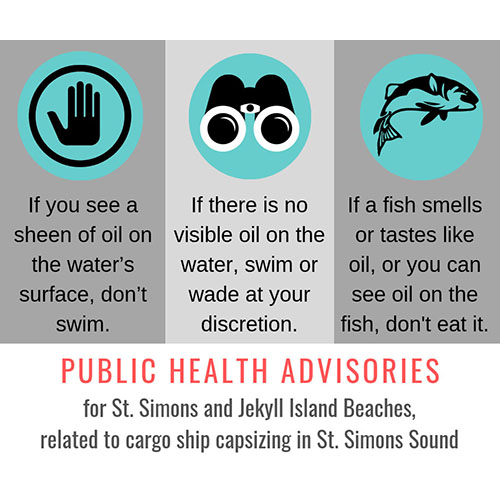
If you’re planning to swim or wade at the beach on St. Simons or Jekyll Islands, the Coastal Health District has some precautionary advice: check the water for any signs of oil, and use your best judgement before swimming.

The Coastal Health District issued a general swimming advisory Sunday, asking visitors to stay out of the water after a cargo ship capsized in the St. Simons Sound. Today, the swimming advisory has been modified, and swimmers are asked to be aware and use discretion. Although oil has not been seen on the ocean-facing beaches of St. Simons or Jekyll Islands, beach visitors are urged to visually check the water before deciding to swim. A similar advisory also applies to fish consumption.

  • If you see a sheen of oil on the water’s surface, don’t swim. Contact with oil could cause skin and eye irritation.
  • If there is no visible oil on the water, then swim or wade at your discretion. Stay alert for changing conditions.
  • If a fish smells or tastes like oil, or you can see oil on the fish, do not eat it.

Officials at the incident command center are working to plug the ship’s vent stacks to prevent any additional release of oil, and absorbent booms are soaking up most of the oil immediately around the vessel. Booms have also been placed at the entrance of nearby creeks to protect local oyster beds. Agencies will continue to monitor the beaches and marshes for signs of oil contamination.

Some of the agencies involved in monitoring any ongoing environmental impacts are the Coastal Resources Division of the Department of Natural Resources, the National Oceanic and Atmospheric Administration, the U.S. Coast Guard, and private contractors. If you see oil on the beach, contact the U.S. Coast Guard National Response Center at 1-800-424-8802 to make a report.