Air Quality Monitoring Resources and Health Information
READ MORE »

×

The Coastal Health District of Georgia serves the counties of Bryan, Camden, Chatham, Effingham, Glynn, Liberty, Long & McIntosh

McIntosh News


Solar Eclipse Safety Tips

On Monday, August 21, Georgia will be among 14 states to experience a total eclipse of the sun. The Georgia Department of Public Health reminds those who will watch the solar eclipse that it’s never safe to look directly at the sun, or eye damage may occur.

Viewing the solar eclipse should be done through “eclipse glasses” that meet the ISO 12312-2 international safety standard. See the American Astronomical Society (AAS) Reputable Vendors of Solar Filters & Viewers for a list of dealers of eclipse glasses.

Retinal damage to eyes may occur while attempting to stare at the sun. Solar retinopathy is a result of too much ultraviolet light flooding the retina. Never look directly at the sun without proper protection – using ISO 12312-2 lenses. If you damage your eyes trying to view the solar eclipse, please contact your healthcare provider.

NASA’s additional recommendations for safe eclipse viewing are:

  • Stand still, and put on your eclipse glasses before looking up at the eclipse. Turn away to remove your eclipse glasses — do not remove them while looking at the sun.
  • Do not look at the eclipse through a camera, a telescope or binoculars while using your eclipse glasses — the sun will damage the filter and your eyes.
  • Always inspect your eclipse glasses before use; if scratched or damaged, do not use.
  • Supervise children viewing the eclipse.
  • Remove your eclipse glasses only when the moon completely covers the sun and it gets dark. Then, as soon as the sun begins to reappear, put your eclipse glasses back on.

The last time the U.S. saw a total eclipse was 1979. During this year’s eclipse, the moon will fully block the sun for two minutes and 40 seconds. Only the northeast corner of Georgia will experience this; the rest of the state will see a partial eclipse. The moon will pass between the Earth and the sun, blocking all or part of the sun, for up to three hours.

Learn more about safely viewing the solar eclipse at: https://eclipse2017.nasa.gov/safety.
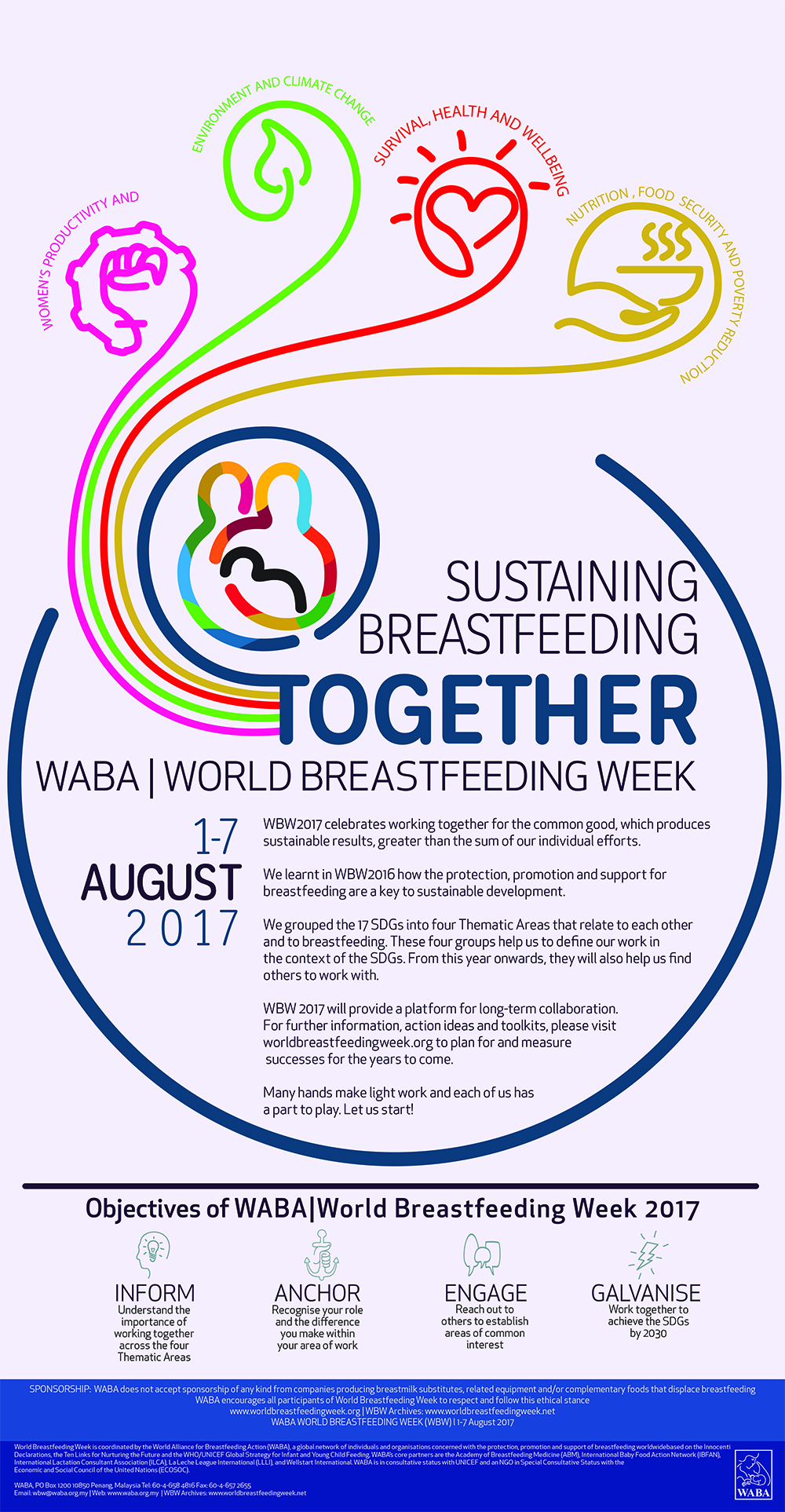
World Breastfeeding Week Events Scheduled August 4 and 5

The Coastal Health District Women, Infants, and Children’s (WIC) nutrition program will hold two World Breastfeeding Week celebrations in early August. The first event will take place from 4 p.m. to 6 p.m. on Friday, August 4 at Jekyll Island Square on Newcastle Street in Brunswick and the second event will take place from 8 a.m. to 11 a.m. on Saturday, August 5, at the Forsyth Farmers’ Market in Savannah. The celebrations will include public walks, prize giveaways, and information on the benefits of breastfeeding. All events are free and family friendly.

Those who register for the events by going to www.coastalhealthdistrict.org/bf will receive a free T-shirt while supplies last.

World Breastfeeding Week is celebrated during the first week in August every year in more than 170 countries to encourage breastfeeding and improve the health of babies around the world.  This year’s theme is “Sustaining breastfeeding together” and is focused on working together for the common good. The key to best breastfeeding practices is continued day-to-day support for breastfeeding mothers within their home and community. The Coastal Health District is committed to helping mothers breastfeed their babies because breastfeeding is so important for good health. Breast milk is easy to digest, with just the right amount of fat, sugar, water, and protein for a baby’s growth and development. Breastfed babies usually get sick less often, because breast milk contains antibodies that can protect infants from bacterial and viral infections.

For more information on the objectives of World Breastfeeding Week 2017, click HERE.

For more information on the scheduled Coastal Health District events, contact Monica Lightfoot at Monica.Lightfoot@dph.ga.gov.

[JPG, 2.02 MB]

Georgia Department of Public Health commissioner named head of Atlanta-based CDC


July 7, 2017 – from the office of Georgia Governor Nathan Deal:

Gov. Nathan Deal today announced the appointment of Dr. J. Patrick O’Neal, current director of Health Protection for the Georgia Department of Public Health (DPH), as interim commissioner of DPH, effective immediately. The vacancy was created by the appointment of Dr. Brenda Fitzgerald, current commissioner of DPH, as director of the Centers for Disease Control and Prevention (CDC) by President Donald Trump.

“I am immensely proud of my friend and colleague Dr. Brenda Fitzgerald, and I am grateful to her for her tireless work to promote the health and well-being of Georgia’s citizens,” said Deal. “She has been an asset to the State of Georgia and I know she will bring the same determination and persistence to her new role of CDC director, working for the good of the entire country. I want to thank President Trump for naming one of our own to this prominent role and I am confident Dr. O’Neal will be able to successfully pick up where Brenda left off at DPH.”

“I am humbled by the challenges that lie ahead, yet I am confident that the successes we’ve had in Georgia will provide me with a foundation for guiding the work of the CDC,” said Fitzgerald. “The progress we’ve made in Georgia around early brain development, childhood obesity and creating a model for addressing the Ebola epidemic would not have been possible without the full support of Governor Deal and a dedicated public health staff.”


Brenda Fitzgerald, M.D. [JPG, 4.91 KB]

Fitzgerald formerly served as the commissioner of DPH and as State Health Officer. She is a board-certified Obstetrician-Gynecologist and practiced medicine for more than three decades before coming to Public Health in 2011. As Commissioner, Fitzgerald oversaw various state public health programs including Health Promotion and Disease Prevention, Health Protection, Georgia WIC, Office of Pharmacy, Nursing, Volunteer Health Care and Vital Records. She also directed the state’s 18 public health districts. She earned a bachelor’s degree in Microbiology from Georgia State University and a medical degree from the Emory University School of Medicine. As a Major in the United States Air Force, Fitzgerald served at the Wurtsmith Air Force Strategic Air Command Base in Michigan and at the Andrews Air Force Base in Washington, D.C.


J. Patrick O’Neal, M.D. [JPG, 4.65 KB]

O’Neal serves as the Director of Health Protection for DPH, overseeing more than a dozen public health programs including Epidemiology, Infectious Disease and Immunization, Emergency Preparedness and the Georgia Public Health Lab. He is also the medical director for the Office of EMS and Trauma. O’Neal previously practiced emergency medicine for 29 years at DeKalb Medical Center and also served as the regional medical director for EMS throughout the Metro Atlanta area. He earned a bachelor’s degree from Davidson College and a medical degree from the Tulane University School of Medicine. Following medical school, O’Neal entered the United States Air Force for training in flight medicine and later served as a flight surgeon in Vietnam.


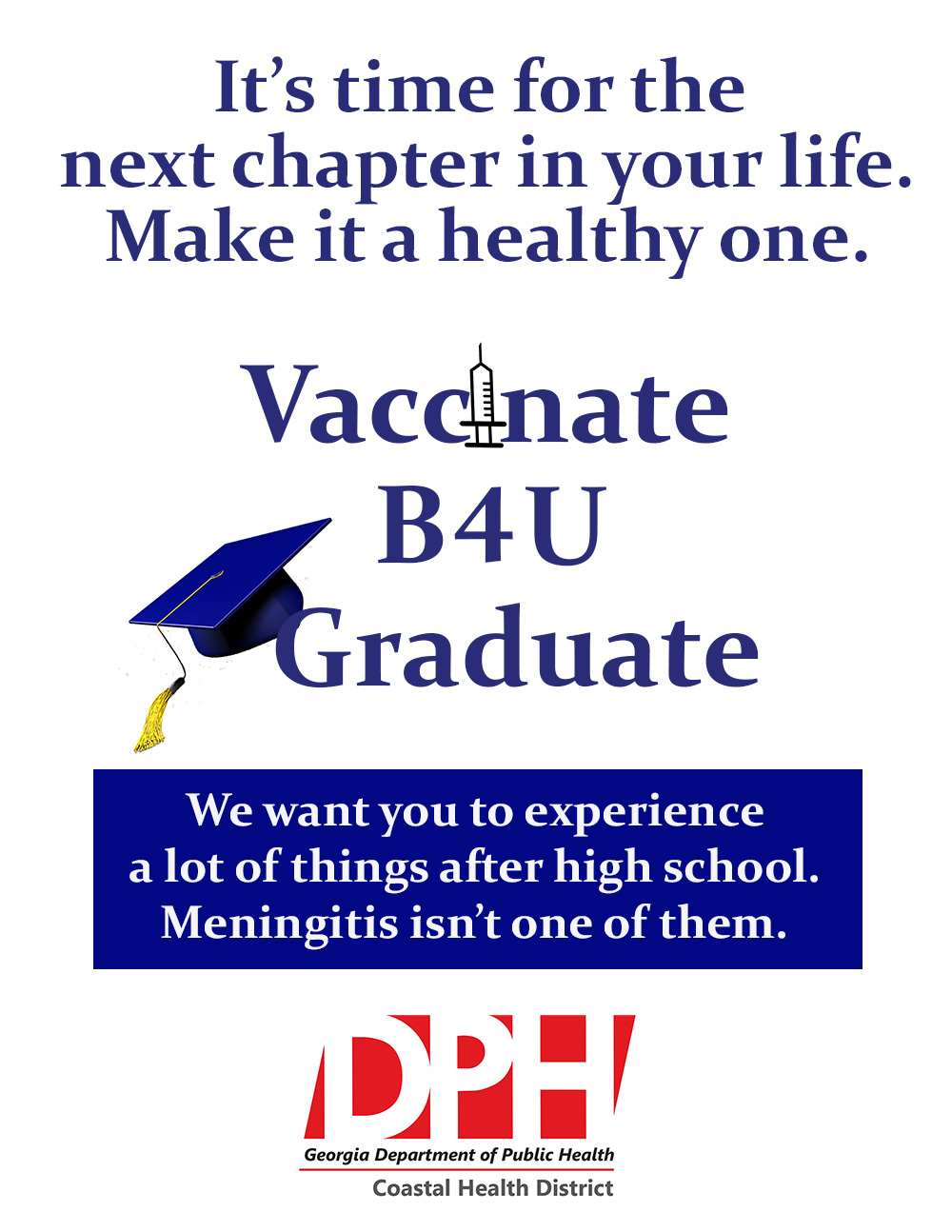
Health Department Officials Urge Students to “Vaccinate B4U Graduate”

As students begin looking ahead to graduation and starting a new and exciting chapter in life, it’s a good time to remind both students and their parents about the important role that immunizations play in that chapter. Health department officials in Bryan, Camden, Chatham, Effingham, Glynn, Liberty, Long, and McIntosh counties want to encourage soon-to-be high school graduates to get vaccinated against meningococcal disease which causes meningitis.

Meningococcal disease is not common; however, when it is contracted it can be dangerous. The bacteria that causes meningococcal disease is spread by exchanging respiratory and throat secretions (saliva or spit) during close (for example, coughing or kissing) or lengthy contact, especially if living in the same household or dorm. There are different kinds of meningitis. Bacterial meningitis can be very serious and can even cause permanent disabilities and death. Viral meningitis is the most common type of meningitis and is usually less serious but can still cause illness.

“We encourage parents of students getting ready to graduate – especially those going off to college – to make sure their children have received the meningococcal vaccine and that all vaccinations are up-to-date,” said Coastal Health District Immunization Coordinator, Paige Lightsey, R.N. “This is an exciting time for our students and we want to do everything we can to make sure that they are protected from meningitis as they start on their new adventure.”

When children are 11 or 12 years old they should receive one dose of the vaccine followed by a booster at age 16. Parents can check with the health department or their healthcare provider to get immunization records for their children or schedule a time to get the meningococcal vaccine.

For more information on meningitis or the meningococcal vaccine, please to cdc.gov/meningitis.
[JPG, 282.12 KB]

McIntosh County Veterinarian Receives Prestigious State Public Health Award

Doctor of Veterinary Medicine at Pine Harbor Animal Hospital, Lara Bailey, is the recipient of the Al Dohany Award for Community Service by the Georgia Public Health Association. Bailey was nominated for the award by McIntosh County Health Department Environmental Health Manager, Eric Rumer.

Established in 1999, the Al Dohany Award for Community Service honors public health leader, Al Dohany, who was highly respected among his peers and who made great contributions to the promotion of public health through his work with family connection and community groups at the local level. This award is presented annually to an individual who has made a positive contribution to community health through collaboration with the community and its leaders. This contribution involves encouraging a collaborative approach with existing community entities that is essential to realizing the long-term health outcomes of a community while recognizing the importance of communities and celebrating the diversity that makes a community vital.

Below is an excerpt from Dr. Bailey’s nomination:

Since 2003, Dr. Bailey has vaccinated more than 2,600 dogs and cats for rabies, a viral disease that is spread through the bite and sometimes scratches of infected animals. Rabies is deadly for both animals and humans. Although most pet owners get their pets vaccinated against rabies, some may not have the resources to pay for such vaccinations, especially in more rural parts of the state such as McIntosh County. That’s where Dr. Bailey holds her rabies vaccination clinics and provides – free of charge –rabies vaccinations for pets during Saturday clinics. She also amputates suspected rabid animals so that they can be processed to determine whether or not they have rabies. Testing suspected rabid animals helps us to alert and caution the public if there is an issue with rabies. Dr. Bailey also performs this service for the McIntosh County Health Department at no charge.

While Dr. Bailey does not charge for rabies vaccinations during the public clinics, she does take donations from those who can afford to pitch in. Over the years, she has collected $13,000 and donated it to local animal rescue programs such as the Humane Animal Resource Team of McIntosh County and McIntosh County Animal Control.

“Dr. Bailey has consistently been an invaluable asset to McIntosh County Animal Control and Animal Services,” said Marianna Hagan, Director of McIntosh County Animal Services. “She is a true humanitarian and animal lover. She has made a huge impact on McIntosh County’s human and animal population. McIntosh County is a better community because of her generous and selfless work.”

Every animal that is vaccinated against rabies is one less animal that is a threat to spread the deadly disease to residents in McIntosh County. Dr. Bailey never asks for recognition; doesn’t want anything in return for giving up her Saturdays, her vaccine, needles and other supplies; and would likely protest if she knew that this nomination was being submitted. But the truth is that even though “technically” Dr. Bailey is not a part of our public health family, she is very much a part of what we do and what we stand for when it comes to preventing illness and disease. Her efforts have had a tremendous impact on our community. Everybody knows “Doc Bailey” and appreciates not only the compassion she has for our animals but the dedication she shows to the improving the health of our small coastal community.

[JPG, 396.35 KB] From L to R: Dr. Selina Smith, GPHA President at the time the Award was presented; Dr. Lara Bailey; Eric Rumer, McIntosh County Environmental Health Manager; Dr. Lawton Davis, Coastal Health District Health Director.


School Health Summit Planned for May 31; School Officials Encouraged to Attend

 The Coastal Health District Chronic Disease Prevention Program will host a School Health Summit from 9 a.m. to 3 p.m. on Wednesday, May 31, at the Liberty County Schools Performing Arts Center located at 2140 E. Oglethorpe Hwy. in Hinesville.

The free one-day training is being offered to school administrators, teachers, nutrition directors, and principals to develop and execute nutrition and physical activity policies and to offer resources to help prevent the incidence of chronic disease in children.

“Obesity continues to be a real problem in children of all ages and unhealthy habits developed early translate into unhealthy habits later in life,” said Coastal Health District Chronic Disease Prevention Director, Cristina Gibson. “The Summit is a way for school leaders to learn about tools that can help promote better health in students and how to go about using those tools.”

Those interested in attending the training can register by calling Gibson at 912-644-5818 or by emailing cristina.gibson@dph.ga.gov.

The 2017 School Health Summit is sponsored by the Georgia Department of Public Health, healthMpowers, Georgia SHAPE, and the Coastal Health District.

CDC: Georgia’s Early Childhood Vaccination Rates Among Nation’s Highest

ATLANTA – Georgia is leading the country with above average early childhood vaccinations with 75.6 percent of children 19-35 months old protected, compared to national averages of 72.2 percent for the 7-vaccine series. However, health officials here say statewide immunization statistics show that more can be done to stop vaccine-preventable disease outbreaks in Georgia.

As recent disease outbreaks demonstrate, immunizing infants and young children remains a critical component of protecting vulnerable infants against potentially deadly diseases.

So far in 2017, the Centers for Disease Control and Prevention has reported more than 1,200 cases of mumps across the U.S. Other recent outbreaks include a pertussis outbreak in 2012 that infected more than 48,000 people, and a measles outbreak that started at Disneyland and impacted 188 people in 2015. Each of these diseases is preventable by vaccines.

During National Infant Immunization Week, April 22-29, the Georgia Department of Public Health and the Georgia Chapter of the American Academy of Pediatrics urge parents to check with their pediatrician to ensure their child is up-to-date on vaccinations.

“Immunizations are the best way to protect infants and children from childhood diseases, like whooping cough and measles that can be life-threatening at young ages,” said Brenda Fitzgerald, M.D., commissioner of the Georgia Department of Public Health. “It is critical for parents to talk to their child’s doctor to ensure they are up-to-date on immunizations, because no child should have to suffer a vaccine-preventable illness.”

The American Academy of Pediatrics encourages parents to become aware of vaccination rates in their community. The AAP offers an interactive map (https://immunizations.aap.org/) that highlights vaccination rates in each state for recommended childhood vaccines, including vaccines that protect against measles, mumps, pertussis, polio and influenza. It also offers state-by-state information about community immunity thresholds, which is the level at which disease outbreaks are prevented.

“High immunization rates in the community provide a buffer of protection that makes it harder for diseases to break through,” said Georgia Chapter AAP President Ben Spitalnick, M.D., Savannah. “Vaccines protect children from diseases, and they also keep communities healthy by protecting infants who are too young to be vaccinated, or those who have compromised immune systems.”

The Georgia Department of Public Health and the Georgia Chapter of the American Academy of Pediatrics encourage everyone – in observance of National Infant Immunization Week – to protect the little ones who cannot yet protect themselves. Please contact your pediatrician or your local public health department to ensure your infant is up-to-date on vaccinations. For more information contact the Georgia Department of Public Health http://dph.georgia.gov/immunization-section or http://www.gaaap.org/immunizations/.


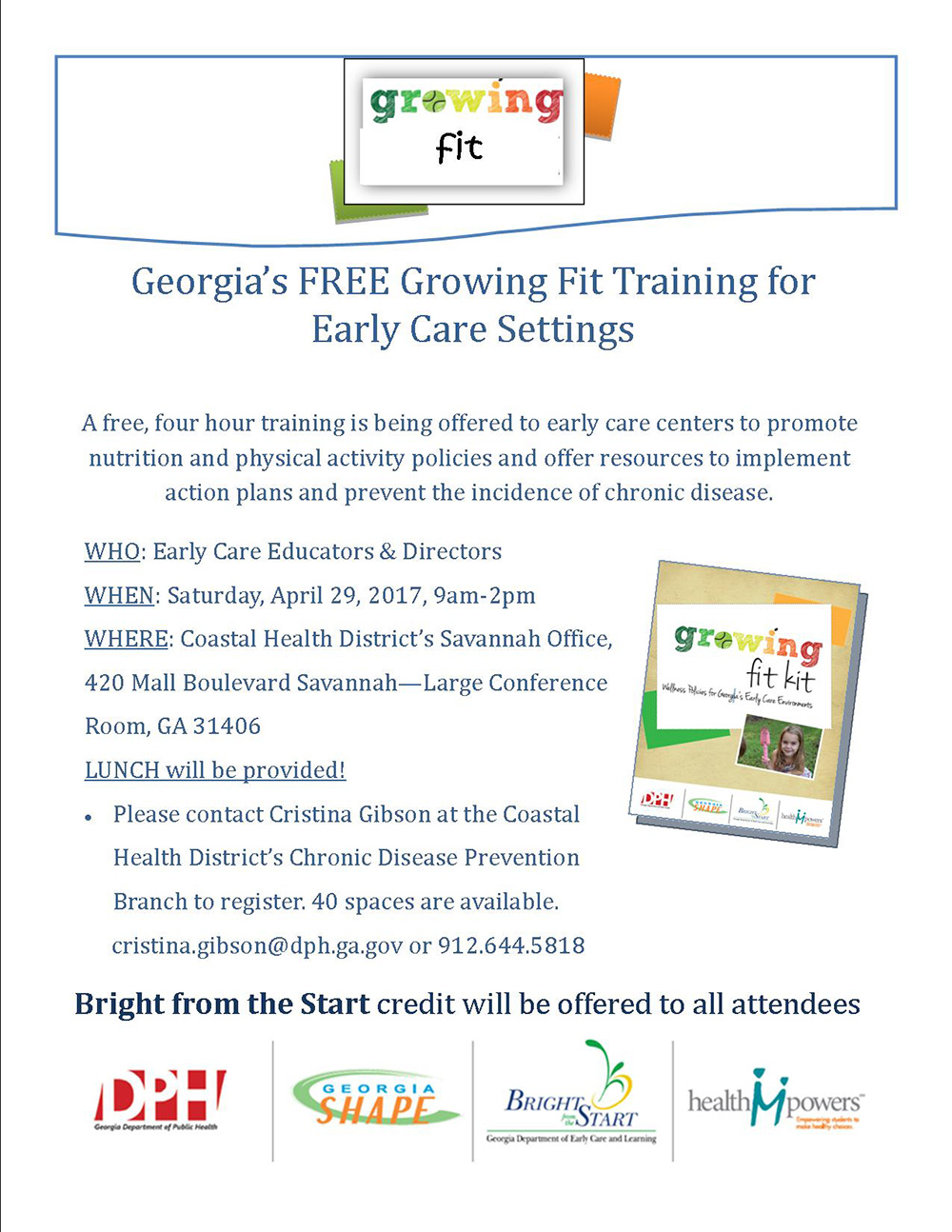
Free “Growing Fit” Training Offered for Early Care Centers

Physical activity and nutrition are essential for children to develop healthy lifestyles that will help reduce the risk of chronic disease later in life. To that end, the Georgia Department of Public Health, Georgia Shape, HealthMPowers, Inc. and Bright from the Start: Georgia Department of Early Care and Learning have developed Growing Fit Kit: Wellness Policies for Georgia’s Early Care Environment. A free training on the kit will be offered to staff from early care centers from 9 a.m. to 2 p.m. on Saturday, April 29, at the Coastal Health District office located at 420 Mall Blvd. in Savannah.

Training will center around a tool kit which provides a step-by-step process to guide early care educators in the development and/or improvement of nutrition and physical activity policies and practices.  It also contains an explanation of the importance of a wellness policy, a self-assessment tool to evaluate current policies and practices, success stories from other early care settings, healthy eating and physical activity resources, and a planning document with suggestions and examples for writing the policy.

This educational learning experience is a Bright from the Start: Georgia Department of Early Care and Learning approved CEU course allowing participants to earn required training units while strengthening their wellness policy efforts to create healthy environments for students to learn and teachers to work. This training also helps move centers toward achievement of Quality Rated standards set by the Department of Early Care and Learning.

To register for either training session, please contact Cristina Gibson at 912-644-5818 or email cristina.gibson@dph.ga.gov.

[JPG, 344.33 KB]

Georgia Health Officials Warn of Potential Phone Scam

ATLANTA – The Georgia Department of Public Health (DPH) is receiving complaints from residents of Georgia and residents of other states about suspicious phone calls. Many of the calls appear to come from a Georgia DPH phone number.

“Right now, we do not know the real reason for the calls or what the caller is truly looking for,” said Rick Keheley, DPH’s inspector general. “We do know the calls are not coming from the Georgia Department of Public Health.”

DPH encourages residents to be extremely cautious when participating in health-related telephone surveys.

DPH does occasionally use telephone surveys to gain information on health trends and it is important to understand the difference. DPH:

  • Will never ask for religious information
  • Will never ask for credit card information
  • Will never try to sell goods or services
  • Will always provide call back or contact information for verification

Residents with questions or those wishing to report a suspicious call should contact DPH’s Office of Inspector General at (404) 656-4409 or reportdphfraud@dhr.state.ga.us


About the Georgia Department of Public Health

The Georgia Department of Public Health (DPH) is the lead agency in preventing disease, injury and disability; promoting health and well-being; and preparing for and responding to disasters from a health perspective. For more information about DPH, visit www.dph.ga.gov.

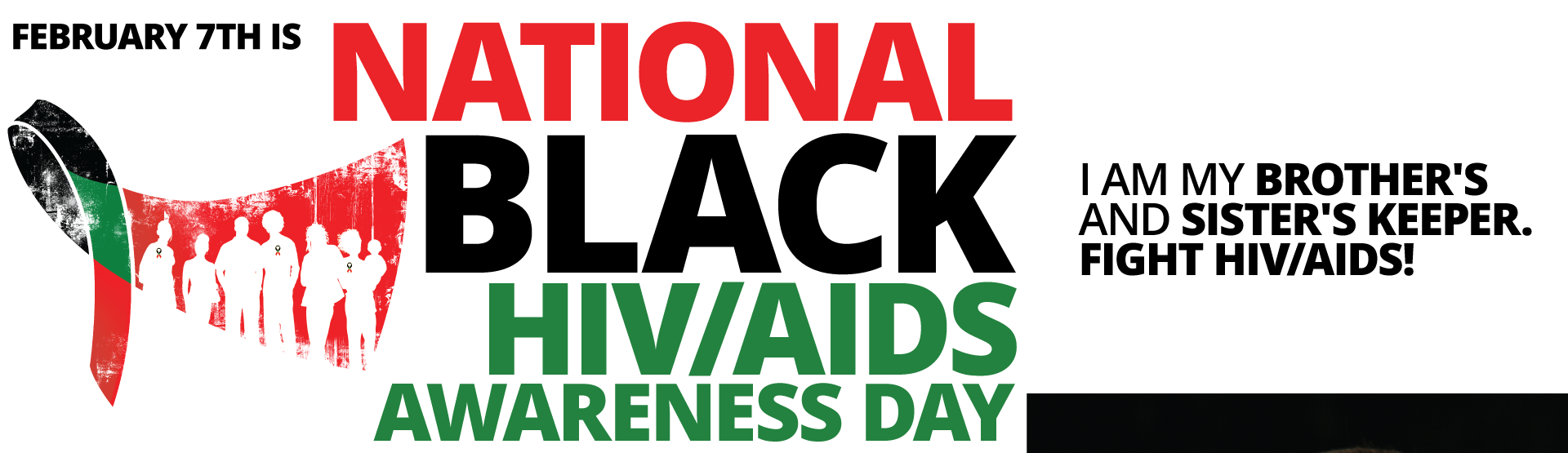
National Black HIV/AIDS Testing Events Scheduled Feb. 7

Tuesday, February 7, will mark the 16th observance of National Black HIV/AIDS Awareness Day (NBHAAD) and the Coastal Health District will recognize the day by holding HIV testing events throughout the eight-county public health district. The Coastal Health District Prevention Program will offer free and rapid confidential HIV testing from 9 a.m. to 3 p.m. on Tuesday, February 7 at health departments in Bryan, Camden, Chatham, Effingham, Glynn, Liberty, Long, and McIntosh counties. No appointment necessary.

The NBHAAD 2017 theme is “I am my Brother’s and Sister’s Keeper: Fight HIV/AIDS.” NBHAAD is directed, planned, and organized by a group known as the Strategic Leadership Committee, a coalition that partners with the Centers for Disease Control and Prevention (CDC) to mobilize communities in an effort to address local epidemics and influence the course of HIV in African American communities across the country.

The Coastal Health District has close to 1,400 active cases of HIV and Georgia ranks 5th highest in the nation for the total number of new diagnosis of HIV. The Coastal Health District encourages the community to use this observance to promote HIV prevention practices and reduce the stigma surrounding the disease.

Go to www.nationalblackaidsday.org to learn more about NBHAAD. To locate services for a free HIV test or to access treatment, visit Georgia Department of Public Health’s CAPUS (Care and Prevention in the U.S.) Care Portal at www.gacapus.com or call the Georgia AIDS/STD Infoline at 1-800-551-2728.

For more information on the testing events, please call Diane DeVore at 912- 644-5828 or email Diane.Devore@dph.ga.gov.

[PNG, 190.42 KB]