The Coastal Health District of Georgia serves the counties of Bryan, Camden, Chatham, Effingham, Glynn, Liberty, Long & McIntosh

News


Georgia Department of Public Health’s Babies Can’t Wait Program Seeks Public Comment; Public Comment Period Until Apr.15, 2016

ATLANTA – The Georgia Department of Public Health’s (DPH) Babies Can’t Wait (BCW) program invites interested persons to participate in a 60-day public comment period for the Federal Fiscal Year (FFY) 2016 Annual State Application under Part C of the Individuals with Disabilities Education Act (IDEA) and Stakeholders, early intervention providers, parents and members of the public are encouraged to comment and may review the grant application and revised policy online or at locations throughout the state.

Comments will be accepted in four ways:

1.    Written comments will be received by mail until Apr. 15, 2016:

Babies Can’t Wait
Attn: Judy Threlkeld, Interim Part C Coordinator
2 Peachtree Street NW, Suite 11th  Floor
Atlanta, GA 30303-13422

2.    Email comments will be received until Apr. 15, 2016:

DPH-MCHDO@dph.ga.gov
(Subject line: Part C or Public Comment)

3.    Facsimile comments will be received until April 15, 2016:

State BCW Office Fax: (404-657-7307)


4.    In Person comments at a Public Hearing:

DPH invites interested persons to attend Public Hearings and present public comments. To allow an opportunity for all to be heard, comments will be limited to five minutes. (See locations listed below.)

The Babies Can’t Wait (BCW) Program is Georgia’s statewide early intervention system for infants and toddlers with special needs, age birth to three, and their families. This program enhances the capacity of families to meet the special needs of their child in order to ensure that each young child with significant developmental delays achieves his or her maximum developmental potential.

To learn more about DPH’s Babies Can’t Wait program, please call 404-657-2850 or 888-651-8224 or visit http://dph.georgia.gov/Babies-Cant-Wait.


District Date/Time Location Contact
Gainesville (2) March 7, 2016

4:00 PM – 6:00 PM

Gainesville Health District Children With Special Needs Conference Room

440 Prior Street

Gainesville, GA 30506

(770) 531-4053

Patricia (Dru) Thomas, Early Intervention Coordinator (770) 531-4053

Dru.Thomas@dph.ga.gov

Columbus (7) March 10, 2016

4:00 PM – 6:00 PM

Health and Human Services Building

2100 Comer Avenue

Columbus, GA 31902

(706) 327-0189

(800) 527-7344

Kiara Loud

Early Intervention Coordinator (706) 321-6362

Kiara.Loud@dph.ga.gov

Clayton    (3-

3)

March 17, 2016

4:00 PM – 6:00 PM

Headquarters Library

Clayton County Library System 865 Battle Creek Road Jonesboro, GA 30236

(770) 473-3850

Nicole Wilson Early Intervention Coordinator (678) 610-7252

Nicole.Wilson@dph.ga.gov

Waycross (9-2) March 17, 2016

4:00 PM – 6:00 PM

Babies Can’t Wait Office 3 West Altman Street Statesboro, GA 30458

(800) 429-6307

Tracy Weeden Early Intervention Coordinator (800) 429-6307

Tracy.Weeden@dph.ga.gov


About the Georgia Department of Public Health

The Georgia Department of Public Health (DPH) is the lead agency in preventing disease, injury and disability; promoting health and well-being; and preparing for and responding to disasters from a health perspective. In 2011, the General Assembly restored DPH to its own state agency after more than 30 years of consolidation with other departments. At the state level, DPH functions through numerous divisions, sections, programs and offices. Locally, DPH funds and collaborates with Georgia’s 159 county health departments and 18 public health districts.

Through the changes, the mission has remained constant – to protect the lives of all Georgians. Today, DPH’s main functions include: Health Promotion and Disease Prevention, Maternal and Child Health, Infectious Disease and Immunization, Environmental Health, Epidemiology, Emergency Preparedness and Response, Emergency Medical Services, Pharmacy, Nursing, Volunteer Health Care, the Office of Health Equity, Vital Records, and the State Public Health Laboratory. For more information about DPH, visit www.dph.georgia.gov.


First Travel-Related Zika Case Confirmed In Georgia

From the Georgia Department of Public Health:

ATLANTA – The Georgia Department of Public Health (DPH) is confirming the first travel-related case of Zika virus in Georgia. Testing was done by the Centers for Disease Control and Prevention. The non-pregnant individual traveled to Colombia between the end of December and the first of January and has made a full recovery. Tests are still being done on specimens from several other Georgia residents with travel history to areas where Zika virus outbreaks are ongoing.

“It is extremely important that individuals who have traveled to countries where there are on-going Zika virus outbreaks keep guard against additional mosquito bites,” said Cherie Drenzek, D.V.M, state epidemiologist for DPH. “During the first week or so of infection, Zika virus can be passed from an infected person to another mosquito through mosquito bites. An infected mosquito can then transmit the virus to other people.”

DPH cautions travelers, especially women who are pregnant, headed to countries where Zika virus transmission is ongoing: Brazil, Colombia, El Salvador, French Guiana, Guatemala, Haiti, Honduras, Martinique, Mexico, Panama, Paraguay, Suriname, Venezuela, the Commonwealth of Puerto Rico and the U.S. Virgin Islands, among others. The complete list of Zika affected countries can be found at http://wwwnc.cdc.gov/travel/page/zika-travel-information.

There are urgent concerns about Zika virus infection and pregnant women. Zika virus infections have been confirmed in infants with microcephaly and in the current outbreak in Brazil, a marked increase in the number of infants born with microcephaly has been reported. Pregnant women or women trying to get pregnant should not travel to areas where Zika virus transmission is ongoing. Pregnant women who have traveled to these areas should consult their physician immediately. Health care providers should ask all pregnant women about recent travel.

Zika virus is primarily spread to people through mosquito bites. The most common symptoms of Zika virus disease are fever, rash, joint pain, and conjunctivitis (red eyes). The illness is usually mild with symptoms lasting from several days to a week. Severe disease requiring hospitalization is uncommon. Most people infected with Zika virus never know they are sick.

Currently, there is no vaccine to prevent or medicine to treat Zika. Travelers should check CDC travel advisories for their destinations and take precautions to protect themselves from mosquitos:

  • Wear long-sleeved shirts and long pants
  • Use EPA-registered insect repellents containing DEET, picaridin, oil of lemon eucalyptus (OLE), or IR3535 (use as directed)
  • Use permethrin-treatedclothing and gear (such as boots, pants, socks, and tents)
  • Stay and sleep in screened-in or air-conditioned rooms

The number of Zika cases among travelers visiting or returning to the United States will likely increase. These imported cases could result in local spread of the virus in some areas of the country, including Georgia.


For more information about Zika virus and current travel advisories, visit dph.georgia.gov or cdc.gov/zika.


Brunswick Woman Bitten by Cat with Rabies; Public Health Officials Remind Residents to be Cautious

A Glynn County woman was bitten by a cat that has tested positive for rabies. The incident happened at the woman’s home in the Highland Park area of Brunswick where she had been feeding the feral cat along with several others. She has been advised to contact her health care provider for follow up.

Glynn County Environmental Health officials want to remind residents to stay alert and keep an eye out for any animals acting out of the ordinary. Foxes, along with other animals that are native to coastal Georgia including raccoons and bats, can be carriers of rabies. Unvaccinated animals, whether pets or stray/feral, are susceptible to rabies.

Rabies is a potentially deadly virus that is primarily spread by infected animals. Symptoms of rabies in animals include a change in behavior, biting, aggression, showing no fear of natural enemies (such as humans), foaming at the mouth, and paralysis. The Glynn County Health Department Environmental Health office offers these tips to protect you and your family from rabies:

  • Avoid contact with animals you don’t know.
  • Make sure your pets receive the proper immunizations. Dogs and cats should get rabies vaccines by four months of age, followed by a booster shot one year later, and another one every one to three years as prescribed by your veterinarian.
  • Do not handle, feed, or unintentionally attract wild animals with open garbage cans or by leaving pet food out at night.
  • Never adopt wild animals or bring them into your home. Do not try to nurse sick animals to health. Call animal control or a properly licensed animal rescue agency for assistance.
  • Teach children to never handle unfamiliar animals, wild or domestic, even if they appear friendly. “Love your own, leave other animals alone” is a good principle for children to learn.

If an animal ever bites you, seek medical care immediately and contact Glynn County Animal Control at 912-554-7500 and the Glynn County Health Department Environmental Health Division at 279-2940.

Zika Precautions Urged for Georgia Travelers: Urgent Zika Warning for Pregnant Women

From the Georgia Department of Public Health:

ATLANTA – The Georgia Department of Public Health (DPH) cautions travelers, especially women who are pregnant, headed to countries where Zika virus transmission is ongoing: Brazil, Colombia, El Salvador, French Guiana, Guatemala, Haiti, Honduras, Martinique, Mexico, Panama, Paraguay, Suriname, Venezuela, the Commonwealth of Puerto Rico and the U.S. Virgin Islands, among others. (CDC Zika Travel Information).

No locally transmitted Zika cases have been reported in Georgia or anywhere in the United States, but cases have been reported in returning travelers. The Centers for Disease Control and Prevention is currently testing specimens from several Georgia residents with travel history to the affected areas.

There are urgent concerns about Zika virus infection and pregnant women. Zika virus infections have been confirmed in infants with microcephaly and in the current outbreak in Brazil, a marked increase in the number of infants born with microcephaly has been reported. Pregnant women or women trying to get pregnant should not travel to areas where Zika virus transmission is ongoing. Pregnant women who have traveled to these areas should consult their physician immediately. Health care providers should ask all pregnant women about recent travel.

Zika virus is spread to people through mosquito bites. Zika virus is not spread human to human. The most common symptoms of Zika virus disease are fever, rash, joint pain, and conjunctivitis (red eyes). The illness is usually mild with symptoms lasting from several days to a week. Severe disease requiring hospitalization is uncommon. Most people infected with Zika virus never know they are sick.

Currently, there is no vaccine to prevent or medicine to treat Zika. Travelers should check CDC travel advisories for their destinations and take precautions to protect themselves from mosquitos:

  • Wear long-sleeved shirts and long pants
  • Use EPA-registered insect repellents containing DEET, picaridin, oil of lemon eucalyptus (OLE), or IR3535 (use as directed)
  • Use permethrin-treated clothing and gear (such as boots, pants, socks, and tents)
  • Stay and sleep in screened-in or air-conditioned rooms

The number of Zika cases among travelers visiting or returning to the United States will likely increase. These imported cases could result in local spread of the virus in some areas of the country, including Georgia.

“It is extremely important that individuals who have traveled to countries where there are on-going Zika virus outbreaks keep guard against additional mosquito bites,” said Cherie Drenzek, D.V.M, state epidemiologist for DPH. “During the first week or so of infection, Zika virus can be passed from an infected person to another mosquito through mosquito bites. An infected mosquito can then transmit the virus to other people.”

Zika virus is transmitted to people primarily through the bite of an infected Aedes species mosquito which can be found in Georgia. The mosquitos bite mostly during the daytime, they do not fly very far, and tend to live around homes. The mosquitos breed in containers so removing them or dumping out standing water at least once a week, or using larvicides such as mosquito dunks or mosquito torpedoes in water that cannot be dumped out, will reduce the number of these mosquitoes.

For more information about Zika virus and current travel advisories, visit dph.georgia.gov or cdc.gov/zika.


About the Georgia Department of Public Health

The Georgia Department of Public Health is the lead agency in preventing disease, injury and disability; promoting health and well-being; and preparing for and responding to disasters from a health perspective. In 2011, the General Assembly restored DPH to its own state agency after more than 30 years of consolidation with other departments. At the state level, DPH functions through numerous divisions, sections, programs and offices. Locally, DPH funds and collaborates with Georgia’s 159 county health departments and 18 public health districts. Through the changes, the mission has remained constant – to protect the lives of all Georgians. Today, DPH’s main functions include: Health Promotion and Disease Prevention, Maternal and Child Health, Infectious Disease and Immunization, Environmental Health, Epidemiology, Emergency Preparedness and Response, Emergency Medical Services, Pharmacy, Nursing, Volunteer Health Care, the Office of Health Equity, Vital Records, and the State Public Health Laboratory. For more information about DPH, visit www.dph.ga.gov.


“Let’s Dance, Savannah!” Scheduled for February 6

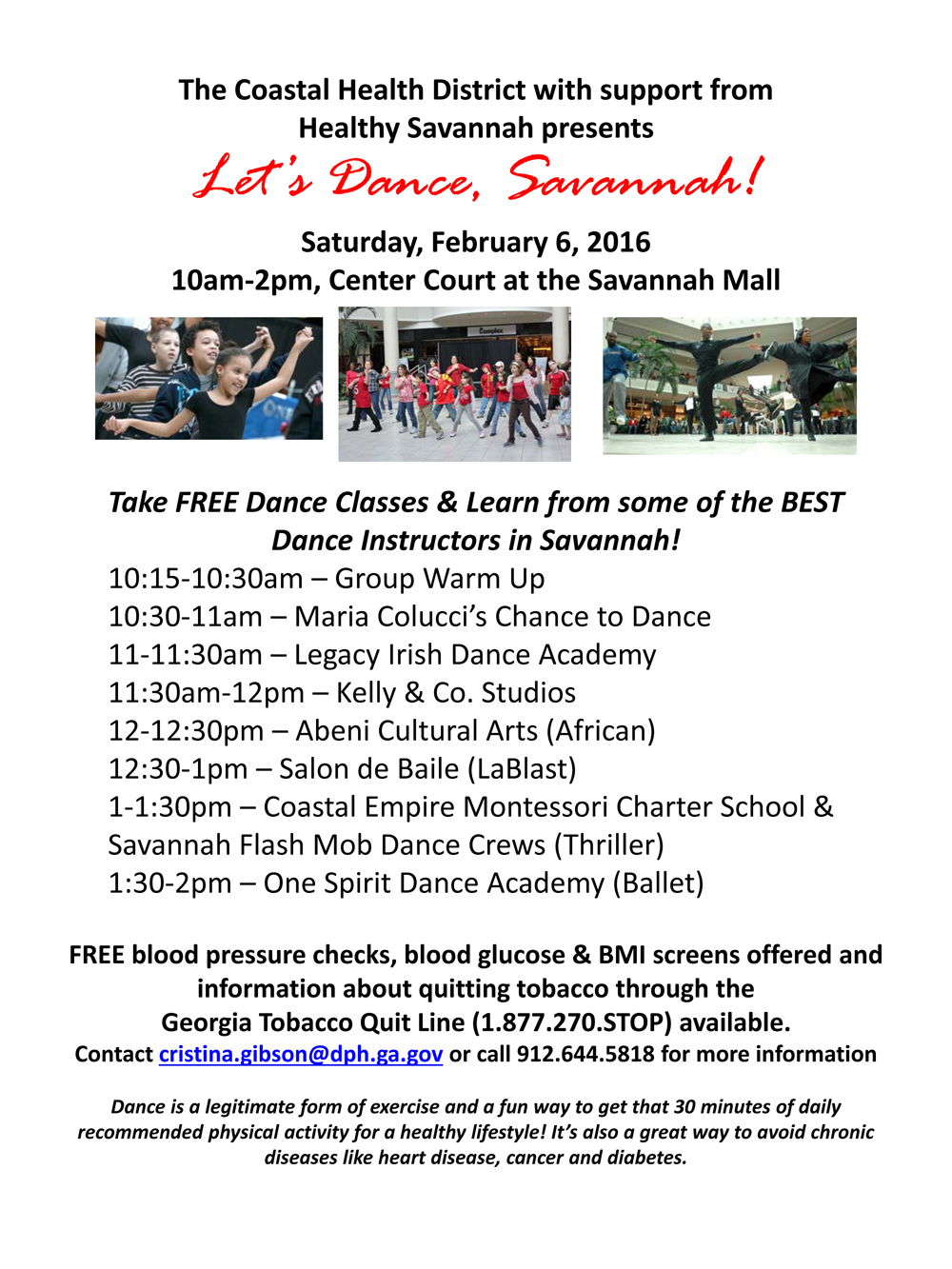
The Coastal Health District, with support from Healthy Savannah, will host “Let’s Dance, Savannah!” from 10 a.m. to 2 p.m. on Saturday, February 6, at Savannah Mall’s Center Court. The day of free dance demonstrations and classes is being offered to encourage dancing as a legitimate form of exercise and to teach people about the importance of cardiovascular health.

The event will include free dance classes, blood pressure screenings, Body Mass Index (BMI) measurements, and blood glucose testing. There will also be information on how to quit tobacco using the Georgia Tobacco Quit Line.

“Dance is truly a fun way to get in that 30 minutes of moderate exercise per day,” said Coastal Health District Chronic Disease Prevention Director, Cristina Gibson. “Dancing as a form of exercise, along with other healthy behaviors, can help keep your heart healthy.”

February is heart month and heart disease is the leading cause of death in the United States. According to the Centers for Disease Control and Prevention (CDC), 800,000 die from heart disease in the U.S. every year. Eating healthy, exercising regularly and maintaining a healthy weight, and not using tobacco can help prevent heart disease which can lead to stroke and heart attacks.

Groups scheduled to take part in the event include Maria Colucci’s Chance to Dance, Legacy Irish Dance Academy, Kelly & Co. Studios, Abeni Cultural Arts, Salon de Baile, Coastal Empire Montessori Charter School & Savannah Flash Mob Dance Crews, and One Spirit Dance Academy.

Microsoft PowerPoint - LDS Flyer [JPG, 569.00 KB]

Coastal Health District Counties Awarded Car Seat Mini-Grant: Buckle Up Right, Every Trip, Every Time

The Georgia Department of Public Health’s (DPH), Injury Prevention Program is pleased to announce that all Coastal Health District counties – Bryan, Camden, Chatham, Effingham, Glynn, Liberty, Long, and McIntosh – have been named recipients of the Child Passenger Safety Mini-Grant. The Child Passenger Safety Mini-Grant program helps county health departments and their community partners reduce the number of injuries and deaths among children in Georgia. This year’s $161,000 award will be used to support the purchase of car seats to be distributed in 137 Georgia counties. Funding for these efforts is provided by the Governor’s Office of Highway Safety (GOHS).

Since 2007, at least 283 children in Georgia who were involved in crashes were saved from serious injury or death by car seats, booster seats, and education provided through the Mini-Grant.

“Motor vehicle crashes are a leading cause of death for children and it’s up to all of us to do everything we can to protect our children on the road,” said Coastal Health District Health Director, Diane Weems, M.D. “Buckling up our children is the best way to save lives and reduce injuries.”

Throughout Georgia, DPH and county health departments work with community partners to educate parents and caregivers on how to properly install and use car seats, offer car seat inspections and provide car seats and booster seats to financially eligible families. Through the Car Seat Mini-Grant, agencies supporting more than 135 counties are working to keep Georgia’s children safe. These programs help families get their children buckled up right, every trip, every time.

DPH takes great pride in providing opportunities to enhance community outreach programs in Georgia. Through our collective efforts, we can make considerable strides in achieving our goals. For more information on the child Occupant Safety Project, please email injury.prevention@dph.ga.gov or call the office at 404-679-0500.

Additional information can be found at: www.gacarseats.com.

BRAVE III Breast Cancer Survivors Hold Successful Fundraiser

LIBERTY COUNTY, GA – Liberty County Health Department staff, along with breast cancer survivors from the BRAVE III (Be Readily Available and Very Empathetic) Project, recently raffled off a handmade quilt and raised close to $500 for the Susan G. Komen Coastal Georgia Affiliate.

The mission of the BRAVE project is to increase access to preventive breast health education, and provide screening mammograms, early diagnostic procedures, and client navigator and tracking services to African American women in rural Liberty County and Hispanic women in Long County. The BRAVE project has received grant funding from the Komen Coastal Georgia Affiliate for the past several years and as a result, more than 500 women have been screened for breast cancer and more than 300 have received screening mammograms free of charge.

“Fundraising is a way that women who have benefited from the BRAVE grant can give something back to the Komen Coastal Georgia Affiliate so other women can benefit from similar services in the future,” said Liberty County Health Department Nurse Manager, Annie Washington, R.N.

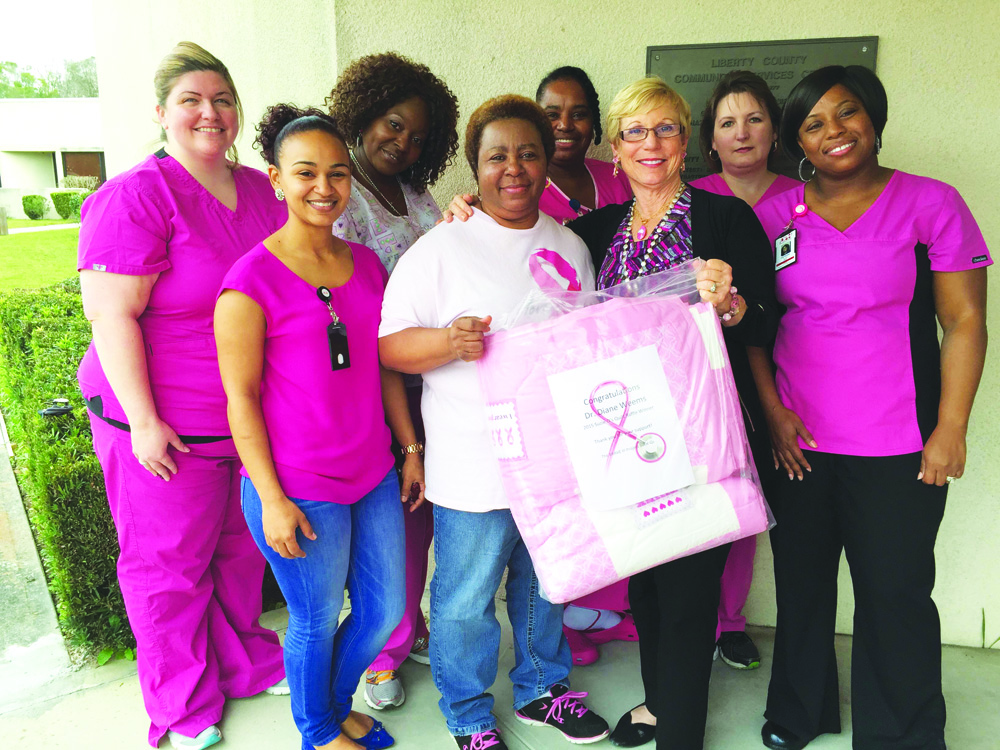
Fleming resident, Eunice Dudley, made the quilt. Coastal Health District Health Director and breast cancer survivor, Diane Weems, M.D., was the lucky winner.

“It is so fitting that Dr. Weems is the recipient of the quilt,” said Washington. “She has really done a lot to promote breast cancer education and awareness in Liberty County and is a great champion for the BRAVE project.”

Suzie Qs & Dr. Diane Weems

[JPG, 1.01 MB] Quilt winner, Dr. Diane Weems, and members of the Suzie Q’s breast cancer support group and BRAVE III Project. Picture IDs are below: Front row left to right: Dahiana Rivas, BRAVE Project patient navigator; Leola Lambert, R.N., cancer survivor; Dr. Diane Weems, breast cancer survivor and Health Director of the Coastal Health District. Back row left to right: Cheryl Banks, LPN; Valarie Smitherman, Public Health Technician; Linda Spellman, LPN; Stephanie Martin, R.N.; and LaTonya Turner, R.N. (Click on image for full screen view).

Beach Monitoring and Notification Program Begins Using New Thresholds to Determine Beach Water Advisories

BRUNSWICK, GA (January 5, 2016) – Effective January 1, 2016, the Beach Monitoring and Notification Program began using a new bacterial level threshold – recommended by the Environmental Protection Agency (EPA) –  in order to determine when swimming advisories should be issued. The Beach Monitoring and Notification Program is a cooperative effort between the Georgia Department of Natural Resources (GDNR) and the Georgia Department of Public Health (GDPH).

The GDNR tests the water weekly at Georgia’s coastal beaches where swimming is a popular activity. When elevated levels of bacteria are found exceeding the EPA recommended threshold, the GDPH, and more specifically the Coastal Health District, issues a swimming advisory for that beach. The new bacterial threshold value recommended by the EPA is more protective of public health. However, since Georgia’s beaches have good water quality overall, the new advisory threshold is not expected to appreciably increase the number of swimming advisories.

More information on the Beach Monitoring and Notification Program can be found on the Coastal Health District website at www.coastalhealthdistrict.org or the Georgia Department of Natural Resources Healthy Beaches website at http://www.GaHealthyBeaches.org/

THIS NEWS RELEASE WAS WRITTEN AND DISTRIBUTED BY THE
GEORGIA DEPARTMENT OF NATURAL RESOURCES COASTAL RESOURCES DIVISION.

Raccoon Tests Positive for Rabies on Wilmington Island

A dog attacked and killed a raccoon on Wilmington Island Road and the raccoon has since tested positive for rabies. The dog is up-to-date on rabies vaccinations and will be given a booster vaccine and remain under observation for 45 days.

Residents are encouraged to call the Chatham County Environmental Health division at 356-2160 or Chatham County Animal Control at 525-2408 if they see any animal exhibiting abnormal behavior. Symptoms of rabies in animals include a change in behavior, biting, aggression, showing no fear of natural enemies (such as humans), foaming at the mouth, and paralysis.

Several species of wild animals that are native to coastal Georgia – including raccoons, foxes, and bats – can carry rabies. Rabies is a potentially deadly virus that is primarily spread by infected animals. The Chatham County Health Department Environmental Health Division offers these tips to protect you and your family from rabies:

  • Avoid contact with animals you don’t know.
  • Make sure your pets receive the proper immunizations. Dogs and cats should get rabies vaccines by four months of age, followed by a booster shot one year later, and another one every year as prescribed by your veterinarian.
  • Do not handle, feed, or unintentionally attract wild animals with open garbage cans or by leaving pet food out at night.
  • Never adopt wild animals or bring them into your home. Do not try to nurse sick animals to health. Call animal control or a properly licensed animal rescue agency for assistance.
  • Teach children to never handle unfamiliar animals, wild or domestic, even if they appear friendly. “Love your own, leave other animals alone” is a good principle for children to learn.

Fox Tests Positive for Rabies; Two Human Exposures Confirmed

Two people in the Nassau Woods area of Dean Forest Road in Chatham County were exposed to a fox that has tested positive for rabies. The fox was initially seen running in the street. It then came onto private property and either bit or scratched two adults on the property. The fox was not provoked.

Residents are encouraged to call the Chatham County Environmental Health division at 356-2160 or Chatham County Animal Control at 525-2408 if they see any animal exhibiting abnormal behavior. Symptoms of rabies in animals include a change in behavior, biting, aggression, showing no fear of natural enemies (such as humans), foaming at the mouth, and paralysis.

Several species of wild animals that are native to coastal Georgia – including raccoons, foxes, and bats – can carry rabies. Rabies is a potentially deadly virus that is primarily spread by infected animals. The Chatham County Health Department Environmental Health Division offers these tips to protect you and your family from rabies:

  • Avoid contact with animals you don’t know.
  • Make sure your pets receive the proper immunizations. Dogs and cats should get rabies vaccines by four months of age, followed by a booster shot one year later, and another one every year as prescribed by your veterinarian.
  • Do not handle, feed, or unintentionally attract wild animals with open garbage cans or by leaving pet food out at night.
  • Never adopt wild animals or bring them into your home. Do not try to nurse sick animals to health. Call animal control or a properly licensed animal rescue agency for assistance.
  • Teach children to never handle unfamiliar animals, wild or domestic, even if they appear friendly. “Love your own, leave other animals alone” is a good principle for children to learn.