Air Quality Monitoring Resources and Health Information
READ MORE »

×

The Coastal Health District of Georgia serves the counties of Bryan, Camden, Chatham, Effingham, Glynn, Liberty, Long & McIntosh

Public Health Topics


Get Smart. Grill Safely.

According to the Centers for Disease and Prevention (CDC), 1 in 6 Americans (or 48 million people) gets sick, 128,000 are hospitalized, and 3,000 die of foodborne diseases every year. As the weather starts to warm up and more families find themselves outside grilling, it’s important to know how to grill foods safely. The last uninvited guest you want at your barbeque is foodborne illness.

BBQ_IQ_7162014 [JPG, 547.41 KB]

Want some more great tips? Click HERE.


Immunization: A Shared Responsibility

Immunization is a shared responsibility. Vaccines are among the most successful and cost-effective public health tools available for preventing disease and death. They not only help protect our children when we vaccinate them, but can also help protect entire communities by preventing and reducing the spread of infectious diseases. National Infant Immunization Week (NIIW) is April 18 – April 25, 2015, and the Coastal Health District urges citizens Bryan, Camden, Chatham, Effingham, Glynn, Liberty, Long, and McIntosh counties to speak with a health care provider or doctor to make sure their babies are up-to-date on vaccinations.

NIIW is a call to action for parents, caregivers and health care providers to ensure that infants are fully vaccinated against 14 vaccine-preventable diseases. Immunization is a shared responsibility. Vaccines are among the most successful and cost-effective public health tools available for preventing disease and death. They not only help protect our children when we vaccinate them, but can also help protect entire communities by preventing and reducing the spread of infectious diseases.

Vaccination is the best way to protect others you care about from vaccine-preventable diseases. According to the CDC, the United States currently has the safest, most effective vaccine supply in its history. Scientists, doctors and health care professionals give vaccines to children only after long and careful review. The disease-prevention benefits of getting vaccines are much greater than the possible side effects for most children.

For those who are under-insured or whose parents or guardians may not be able to afford them, there is the Vaccines for Children (VFC) program. The VCF program helps children get their vaccines according to the recommended immunization schedule and has contributed directly to a substantial increase in childhood immunization coverage levels, making a significant contribution to the elimination of disparities in vaccination coverage among young children.

Microsoft Word - Immunization Schedule

[JPG, 381.16 KB] Click on image for full screen view.


 Infant and Childhood Immunization Facts

FACT: Vaccines are safe, and scientists continually work to make sure they become even safer.
FACT: Most childhood vaccines produce immunity 90 percent to 100 percent of the time. Without vaccinations, your child is at greater risk of catching one of the vaccine-preventable diseases.
FACT: There are 10 vaccines recommended to protect infants from 14 vaccine-preventable diseases:

·  DTaP: Protects against Diphtheria, Tetanus & Pertussis

·  MMR: Protects against Measles, Mumps & Rubella

·  HepA: Protects against Hepatitis A

·  HepB: Protects against Hepatitis B

·  Hib: Protects against Haemophilus influenzae type b

·  Flu: Protects against Influenza

·  PCV13: Protects against Pneumococcal disease

·  Polio: Protects against Polio

·  RV: Protects against Rotavirus

·  Varicella: Protects against Chickenpox

 FACT: Infants traveling abroad may need other vaccines along with the 10 recommended above, depending on the countries they are visiting. These vaccines could include Japanese encephalitis, typhoid, meningococcal or yellow fever.
FACT: One dose of the Tdap vaccine is now recommended for pregnant women during every pregnancy, optimal timing between 27 to 36 weeks gestation regardless of prior vaccination history.
FACT: Measles transmission has been interrupted in the United States through vaccination, but it is still common in many parts of the world, including Europe. Worldwide, there are estimated to be 20 million cases of measles and 197,000 deaths from measles each year.
FACT: Infants 6 months to 11 months of age should receive at least one dose of MMR before traveling outside of the United States.
FACT: Pertussis (whooping cough) in infants is frequently severe resulting in hospitalization and may be fatal.
FACT: Many infants who get pertussis are infected by older siblings, parents or caregivers who might not even know they have the disease. Vaccination with Tdap is particularly important for family members and caregivers of infants who are in close contact with young babies. In 2012, the Advisory Committee on Immunization Practices (ACIP) recommended a dose of Tdap during each pregnancy for women regardless of prior vaccination history.
FACT: Influenza (flu) vaccine is recommended every August to May for infants 6 months of age and older.
FACT: Hospitalization rates for flu are high among infants.
FACT: Rates of hepatitis B have dropped significantly since vaccinating infants became prevalent in 1991.
FACT: Before the varicella (chickenpox) vaccine, almost every child in the United States (about 4 million annually) contracted chickenpox.
FACT: Among infants less than a year old who get chickenpox, about 4 in 100,000 die.
FACT: Mumps in approximately 1 in 10 children can lead to meningitis. Occasionally mumps can also lead to encephalitis, deafness (about 1 in 20,000 children) or death (about 1 in 10,000 children).
FACT: Similar to national trends, the number of pertussis cases in Georgia increased in 2014 with 396 pertussis cases reported to DPH compared to the 269 cases reported in 2013. Of those 396 pertussis cases reported in 2014, 99 (26.8%) were infants < 12 months of age.
FACT: Of the 99 cases of pertussis reported among infants less than 1 year old, 23 (23.2%) were too young to be vaccinated with pertussis-containing vaccine because the first dose is given at 2 months of age. This statistic highlights the importance of pregnant women getting vaccinated during each pregnancy and the importance of fathers, grandparents, caregivers, siblings, etc. who surround the infant to receive the vaccine.
FACT: Thus far, in 2015 Georgia has had one measles case that occurred in a 9-month-old infant, who was too young to be vaccinated.


GYT: Get Yourself Tested

Half of all Sexually Transmitted Diseases (STDs) are in people under the age of 25. Regardless of age, anyone who is sexually active should get tested for STDs and all adults and adolescents from ages 13 to 64 should be tested at least once for HIV. All STDs are treatable and the sooner you know your status the sooner you can begin treatment. Left untreated, STDs can cause a lot of problems. Knowing your status is also the best way to cut down on spreading STDs.

GYT – Get Yourself Tested – is a campaign to encourage young people, in particular, to get tested and treated for STDs and HIV. Health departments in Bryan, Camden, Chatham, Effingham, Glynn, Liberty, Long, and McIntosh counties, along with CARE Centers in Glynn and Chatham Counties, offer confidential STD and HIV testing and treatment options. Other healthcare facilities also offer testing and treatment. To find an STD or HIV testing site near you, go to coastalhealthdistrict.org/hiv.

Want to know more about GYT? Click HERE.

The Low Down on STDs


The Low Down on Some Common STDs [JPG, 343.59 KB]
The Low Down on Some Common STDs [JPG, 323.67 KB]
Click to view larger image.


Ready to Quit Tobacco?

Tobacco use is the leading preventable cause of death in the United States and in Georgia. The Coastal Health District is committed to preventing initiation of tobacco use and helping our smokers to quit. We are also dedicated to ensuring smoke-free air in schools, public parks and indoor places of employment, particularly for infants, children, pregnant women and citizens with asthma and/or other chronic respiratory diseases (those who are at highest risk for illnesses resultant from exposure to second-hand smoke).

At the Coastal Health District we understand that tobacco is addictive and that quitting is difficult. Our goals are to help those who want to quit, quit for good; discourage tobacco usage among those who don’t currently use tobacco; and to help all of our citizens lead healthy, tobacco-free lives.

We offer smoking cessation classes using Freshstart, the American Cancer Society’s smoking cessation program. It is designed to equip tobacco users with the tools they will need to quit for good. Freshstart classes cover topics including stress managment, the benefits of quitting smoking, methods of quitting smoking, and avoiding a return to smoking.

Click HERE [PDF] for more information on Freshstart.

Freshstart classes in Chatham County

2-day Session: Tuesday & Thursday, April 21 & 23
2-4 p.m.
Curtis V. Cooper Primary Health Care
106 E. Broad Street

3-day Session: Tuesday, Wednesday, Thursday, April 21-23
12:30-1:30 p.m.
Chatham County Health Department
(1395 Eisenhower Drive), General Clinic Training Room

For more information, please call 912.644.5818 or email chdstopsmoking@gmail.com

Freshstart classes in McIntosh County

April 7, 8, and 9, 12 – 1 p.m. (light lunch provided)
Darien Telephone Company (conference room 7, 8, 9)
1011 North Way, Darien
Pre-registration required and registration is limited. To register, call Paige at 912-832-5473 or email Paige.Lightsey@dph.ga.gov.

Parents of Preteens: Make a date to vaccinate

Let’s face it – nobody likes getting shots. But a shot lasts a second; diseases last much longer.

In an effort to protect every adult and child, the Georgia Department of Public Health established Georgia Preteen Vaccine Awareness Week, observed February 22-28, 2015, to serve as a reminder for parents to talk with their preteens and teens about getting immunized against vaccine-preventable diseases.

“Our Preteens teens are branching out. They go to overnight camps, attend parties and play team sports – they are becoming increasingly social. While these are all fun parts of being a teenager, they can also increase their risk for contracting potentially life-threatening diseases,” said Sheila Lovett, acting director for the Georgia Department of Public Health Immunization Office. “Let’s help our children grow and protect them every way we can – including their future health and those around them with immunization against vaccine-preventable diseases.”

According to the Georgia  Department of Public Health Rule (511-2-2), all students born on or after January 1, 2002, entering or transferring into seventh grade and any “new entrant” into eighth -12th grades in Georgia need proof of an adolescent pertussis (whooping cough) booster vaccination (called “Tdap”) AND an adolescent meningococcal vaccination (MCV4). This law affects all public and private schools including, but not limited to charter schools, community schools, juvenile court schools and other alternative school settings (excluding homeschool).

Vaccines are the best defense we have against serious, preventable and sometimes deadly contagious diseases. They help avoid expensive therapies and hospitalization needed to treat infectious diseases like influenza and meningitis. Immunizations also reduce absences both at school and after school activities and decrease the spread of illness at home, school and the community.

The CDC currently recommends the following vaccines for preteens and teens:

·         Tetanus, Diphtheria and Pertussis (Tdap)

·         Influenza (flu)

·         Human Papillomavirus (HPV) – three doses

·         Meningococcal Disease (MCV4)

Georgia Preteen Vaccine Awareness Week is an opportunity to raise awareness through schools, health care providers and the media regarding preteen immunizations, particularly Georgia’s new pertussis and meningococcal requirements for incoming seventh-grade students. Speak with your physician today to find out if your preteen is up-to-date and if not, make a date to vaccinate.

National Black HIV/AIDS Awareness Day

National Black HIV/AIDS Awareness Day is held every year in early February to promote HIV education and testing in black communities. To commemorate National Black HIV/AIDS Awareness Day 2015, this A free HIV testing event will be held from 9 a.m. to 3 p.m. on Friday, February 27, at the Chatham County Health Department located at 1395 Eisenhower Drive in Savannah. All testing is completely confidential and no appointment is necessary.

Did you know? …

When we look at HIV/AIDS by race and ethnicity, Blacks have more illness (Blacks represent only 12% of the U.S. population, yet account for 44% of new HIV infections and 44% of people living with HIV disease in 2006); and more deaths (Blacks accounted for 57% of deaths due to HIV in 2007 and the survival time after an AIDS diagnosis is lower on average than it is for most other racial/ethnic groups).  In 2009, Blacks accounted for 44% of all new HIV infections.

The AIDS diagnosis rate per 100,000 among Black adults/adolescents was 8 times that of whites in 2008.  The AIDS diagnosis rate for Black men (103.6) was the highest of any group, followed by Latino men (45.5), and Black women (38.1).  By comparison, the rate among white men was 8.7.  The rate of new infections is also highest among Blacks and was 7 times greater than the rate among whites in 2006.

Among the U.S. population overall, Blacks are more likely than Latinos or whites to report having been tested for HIV in the last 12 months (45% compared to 30% and 14% respectively).  Among those who are HIV positive, CDC data indicate that 33% of Blacks were tested for HIV late in their illness—that is, diagnosed with AIDS within one year of testing positive for HIV (in those states/areas with HIV name reporting); by comparison, 30% of whites and 36% of Latinos were tested late.

In 2009, an estimated 16,741 Blacks were diagnosed with AIDS diagnosis in the US, a number that has slowly decreased since 2006.  By the end of 2008, an estimated 260,800 Blacks with an AIDS diagnosis had died in the US. In 2009, HIV was the ninth leading cause of death for all Blacks and the fourth leading cause of death for both Black men and Black women aged 25–44.

The number of new HIV infections per year among Blacks is down from its peak in the late 1980s, but has exceeded the number of infections among whites since that time; new infections have remained stable in recent years.

A recent analysis of 1999–2006 data from a national household survey found that 2% of Blacks in the U.S. (among those ages 18–49) were HIV positive, significantly higher than whites (0.23%). Also, the prevalence of HIV was higher among Black men (2.64%) than Black women (1.49%).

At some point in their lifetimes, 1 in 16 Black men will be diagnosed with HIV infection, as will 1 in 32 Black women.

From 2005–2008, the rate of HIV diagnoses among Blacks increased from 68 per 100,000 persons to 74 per 100,000. This increase reflects the largest increase in rates of HIV diagnoses by race or ethnicity.
Of all Black men living with HIV/AIDS, the primary transmission category was sexual contact with other men, followed by injection drug use and high risk heterosexual contact.
Of all Black women living with HIV/AIDS, the primary transmission category was high risk heterosexual contact, followed by injection drug use.
Of the estimated 141 infants prenatally infected with HIV, 91 (65%) were Black (CDC, HIV/AIDS Reporting System, unpublished data, December 2006).

There are approximately 1.1 million people living with HIV/AIDS in the U.S, including more than 500,000 who are Black.


If you didn’t know, now you do!

Measles Information


Measles [JPG, 48.58 KB]

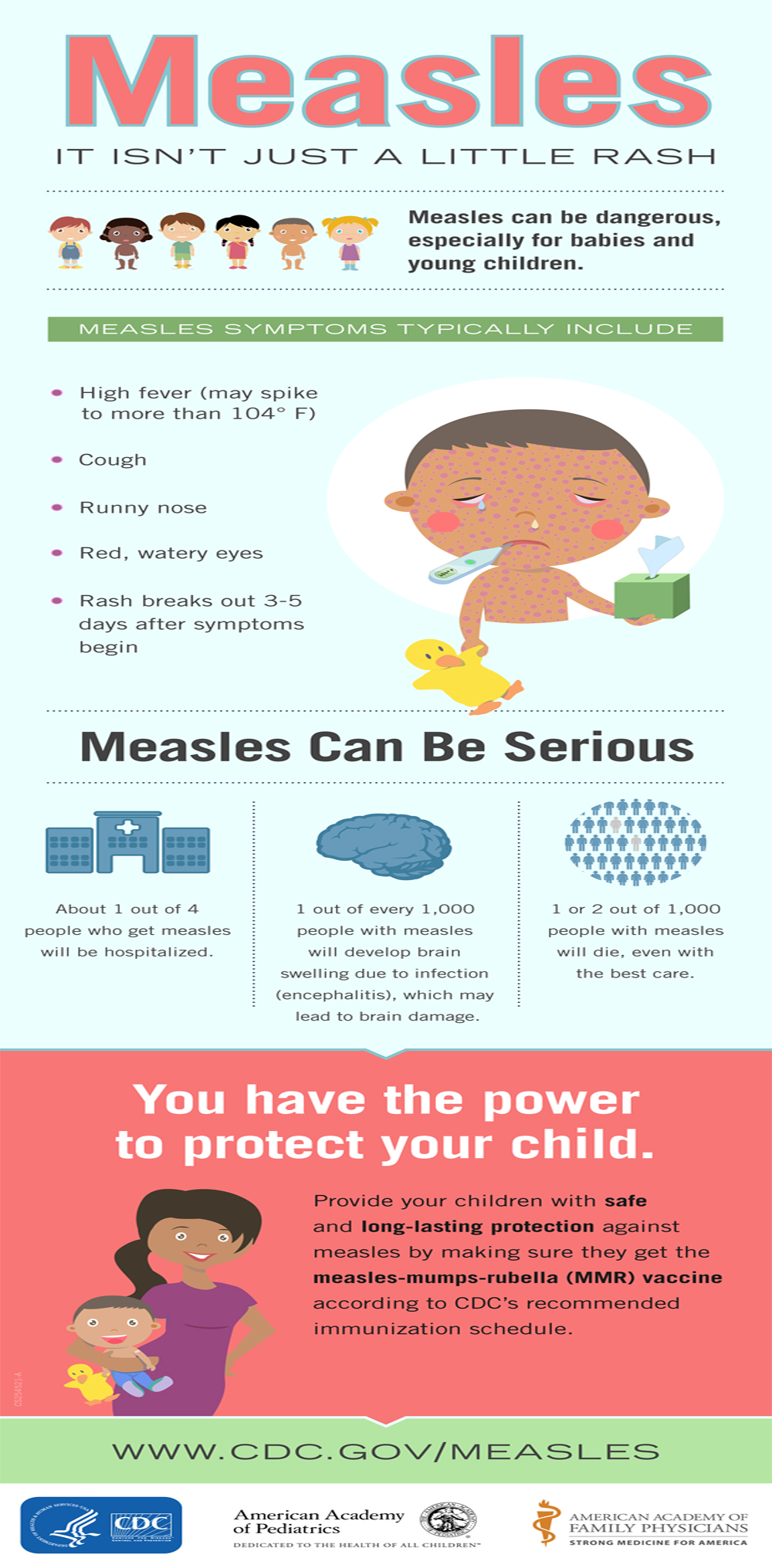
Measles, also called rubeola, is a highly contagious respiratory disease caused by a virus. Measles starts with a fever, runny nose, cough, red eyes, and sore throat, and is followed by a rash that spreads all over the body. Measles spreads through the air by breathing, coughing or sneezing. Measles is highly contagious and can be spread to others from four days before to four days after the rash appears. Infected people are usually contagious from about four days before their rash starts to four days afterwards.

Measles: It Isn't Just a Little Rash

[JPG, 860.37 KB] Click on image for larger view.


     The Top Four Things Parents Need to Know about Measles

According to the Centers for Disease Control and Prevention (CDC), there were 102 cases of measles reported from January 1-30, 2015        and:
– The majority of the people who got measles were unvaccinated.
– Measles is still common in many parts of the world including some countries in Europe, Asia, the Pacific, and Africa.
– Travelers with measles continue to bring the disease into the U.S.
– Measles can spread when it reaches a community in the U.S. where groups of people are unvaccinated.

To find out more about measles, check out great Q&A for parents and caregivers: Measles Fact Sheet [PDF].

For more information on the measles vaccine, click HERE.

For additional information on measles, go the the Georgia Department of Public Health website.


Be Heart Smart

One in four deaths are caused by heart disease every year and heart disease is the leading cause of death for both women and men in the United States. The way you live your life and some health conditions can determine whether or not you get heart disease. Heart disease is also known as coronary artery disease which, according to the Centers for Disease Control and Prevention (CDC), can cause heart attack, angina, heart failure, and arrhythmias.

So what are some steps you can take to get and stay heart healthy? The CDC offers the following:

Eat a healthy diet. Choosing healthful meal and snack options can help you avoid heart disease and its complications. Be sure to eat plenty of fresh fruits and vegetables—adults should have at least 5 servings each day. Eating foods low in saturated fat, trans fat, and cholesterol and high in fiber can help prevent high cholesterol. Limiting salt or sodium in your diet also can lower your blood pressure. For more information on healthy diet and nutrition, visit the CDC’s Nutrition and Physical Activity Program website.

Maintain a healthy weight. Being overweight or obese can increase your risk for heart disease. To determine whether your weight is in a healthy range, doctors often calculate a number called the body mass index (BMI). Doctors sometimes also use waist and hip measurements to measure a person’s body fat. If you know your weight and height, you can calculate your BMI at CDC’s Assessing Your Weight website.

Exercise regularly.
 Physical activity can help you maintain a healthy weight and lower cholesterol and blood pressure. The Surgeon General recommends that adults should engage in moderate-intensity exercise for at least 30 minutes on most days of the week. For more information, see CDC’s Nutrition and Physical Activity Program website.

Monitor your blood pressure. High blood pressure often has no symptoms, so be sure to have it checked on a regular basis. You can check your blood pressure at home, at a pharmacy, or at a doctor’s office. Find more information at CDC’s High Blood Pressure website.

Don’t smoke. Cigarette smoking greatly increases your risk for heart disease. If you don’t smoke, don’t start. If you do smoke, quit as soon as possible. Your doctor can suggest ways to help you quit. For more information about tobacco use and quitting, see CDC’s Smoking & Tobacco Use website.

Limit alcohol use. Avoid drinking too much alcohol, which can increase your blood pressure. Men should stick to no more than two drinks per day, and women to no more than one. For more information, visit CDC’s Alcohol and Public Health website.

Have your cholesterol checked. Your health care provider should test your cholesterol levels at least once every 5 years. Talk with your doctor about this simple blood test. You can find out more from CDC’s High Cholesterol website.

Manage your diabetes. If you have diabetes, monitor your blood sugar levels closely, and talk with your doctor about treatment options. Visit CDC’s Diabetes Public Health Resource for more information.

Take your medicine. If you’re taking medication to treat high blood pressure, high cholesterol, or diabetes, follow your doctor’s instructions carefully. Always ask questions if you don’t understand something.

What are the five major symptoms of a heart attack?

  • Pain or discomfort in the jaw, neck, or back.
  • Feeling weak, light-headed, or faint.
  • Chest pain or discomfort.
  • Pain or discomfort in the arms or shoulder.
  • Shortness of breath.

If you think that you or someone you know is having a heart attack, call 9-1-1 immediately.