The Coastal Health District of Georgia serves the counties of Bryan, Camden, Chatham, Effingham, Glynn, Liberty, Long & McIntosh

View Upcoming Events

News & Events


Georgia DPH Asks Residents to ‘Answer the Call’ in New Contact Tracing Video

The Georgia Department of Public Health (DPH) is releasing a new video explaining the state’s COVID-19 contact tracing efforts, asking residents to ‘answer the call’ if DPH reaches out.

This video is part of a larger campaign rolling out across the state promoting the Healthy Georgia Collaborative, DPH’s expanded contact tracing program to combat the spread of COVID-19. Contact tracing is an important public health tool used to monitor the spread of infection and identify outbreaks of COVID-19 before they become widespread community transmission.

Since May, the Healthy Georgia Collaborative has deployed about 1,300 contact tracers and case investigators statewide to interview individuals who have tested positive for COVID-19, and then alert, quarantine and test contacts who may have been exposed. To date, 16,590 cases have been interviewed and 40,082 contacts identified.

“For contact tracing to be successful, education is critical,” said DPH Commissioner Kathleen E. Toomey, M.D., M.P.H. “We need residents to understand what contact tracing is, why it’s important, and how they can participate in helping Georgia stop the spread of COVID-19.”

Beyond explaining the contact tracing process, DPH’s new video also urges residents to “Answer the Call!” When contacts of COVID-19 cases are identified, the first and fastest way that DPH can notify them of their exposure is by calling. “If you don’t pick up the phone,” explains Dr. Toomey, “Then we can’t alert you and get you the support you need. This puts yourself and others at risk of getting sick.”

To encourage participation and reduce scams, when DPH calls, the caller ID will say, “GA COVID Team.” Contact tracers will provide resources and information on testing, symptom monitoring and protection for family members. Any information provided to DPH staff members is kept confidential per HIPAA, which is the law that protects an individual’s personal health information. Georgia’s contact tracing program does not use GPS or Bluetooth technology to track movements of residents.

Contact tracers will never ask for personal information like Social Security numbers, credit card information or citizenship status. If you suspect fraudulent activity or know of someone else who has experienced this, please contact the DPH COVID-19 hotline immediately to report: 1-844-442-2681.

For more information about COVID-19 visit covid19.gachd.org, or the GDPH site at https://dph.georgia.gov/novelcoronavirus.

Men’s Health Month

This year, Men’s Health Network (MHN) has decided to focus on the theme of a new decade. With a new decade comes the opportunity to both look back and look forward. This time for both reflection and prospection gives us all a unique occasion to evaluate how we have been dealing with our health, both physical and mental. Men, especially, should take this time to do just that.

In general, men are less likely to take care of themselves and their health than women. Men are half as likely to visit the doctor for a check-up as women are, and there are over 7 million American men who have not seen a doctor in over 10 years. In addition, a Cleveland Clinic survey in 2019 found that 82% of men report trying to stay healthy and live longer for those who rely on them, yet only 50% engage in preventive care. Men cited embarrassment, lack of convenience, not wanting to hear a bad diagnosis, and being told as children not to complain about medical problems as reasons for pushing off a visit to their health care provider. Partly as a result of dedicating less time to their personal health, male life expectancy is about 5 years less than women. Now, in 2020 and the new decade, it is time for that to change.

Men of every age need to be taking the time to focus on their mental and physical well-being. From 19 to 90, even if he is in “perfect” shape, a man should still be making routine appointments with his providers. There are several times in his life a man should be getting routine appointments with his healthcare provider to ensure that he is maintaining good health. Men are not invincible and should be engaging with their providers on a regular basis. Regular check-ups and appointments mean taking responsibility for your health and well-being and being a real man.

To coincide with the new decade and renewed responsibility for health, especially in the time of Coronavirus, here’s a breakdown of each decade of a man’s life, and when he should be getting certain check-ups with his healthcare provider:
20s:

  • Every year – a physical exam, blood pressure analysis, blood test & urine analysis, rectal exam, STD testing, self-performed testicular exam
  • Every 5 years – TB skin test
  • Every 10 years – Tetanus booster

30s:

  • Every year – a physical exam, blood pressure analysis, blood test & urine analysis, rectal exam, STD testing, self-performed testicular exam, electrocardiogram (EKG) for heart abnormalities
  • Every 5 years – TB skin test
  • Every 10 years – Tetanus booster

40s:

  • Every year – a physical exam, blood pressure analysis, blood test & urine analysis, rectal exam, STD testing, self-performed testicular exam, electrocardiogram (EKG) for heart abnormalities, prostate specific antigen (PSA) screening, hemoccult test
  • Every 5 years – TB skin test
  • Every 10 years – Tetanus booster
  • With physician’s discretion – chest x-ray, testosterone screening

50s:

  • Every year – a physical exam, blood pressure analysis, blood test & urine analysis, rectal exam, STD testing, self-performed testicular exam, electrocardiogram (EKG) for heart abnormalities, prostate specific antigen (PSA) screening, hemoccult test
  • Every 5 years – TB skin test
  • Every 10 years – Tetanus booster
  • With physician’s discretion – chest x-ray, testosterone screening, bone density screening


Beach Advisory Lifted on Tybee Island

The Chatham County Health Department has lifted the beach water advisory for Tybee Strand Beach at the Pier on Tybee Island.

The advisory was issued on June 9, 2020 after routine water quality tests showed a high level of enterococci bacteria which increase the risk of gastrointestinal illness in swimmers.

Subsequent water samples showed that the bacteria levels had dropped below Environmental Protection Agency’s recommended limits. Therefore, the advisory has been lifted.

For more information, visit our beach water testing page.

National HIV Testing Day Event, June 27

In observance of National HIV Testing Day, the Coastal Health District will hold a drive-through testing event from 10 a.m. – 5 p.m. on Saturday, June 27th, in the parking lot of the Chatham County Health Department at 1395 Eisenhower Drive. Results will be available in one minute. A follow-up visit will be scheduled for anyone who tests positive and counseling will be made available to those individuals.

Those getting tested will receive free giveaways, including gift cards. Staff will also be available to discuss HIV prevention options such as PrEP, the daily pill to prevent HIV.

Around 1.2 million people in the United States are living with HIV, and one in eight people do not know they have it. National HIV Testing Day is an opportunity to raise awareness, encourage people to get the facts, tested, get involved, and get linked to care and treatment services.

This year’s National HIV Testing Day theme is about the “Power of Knowing” – knowing your HIV status, risk, prevention, and treatment options. The Centers for Disease Control and Prevention (CDC) recommends that everyone between the ages of 13 and 64 get tested for HIV at least once as part of routine health care. People at higher risk should get tested more often.

As a reminder, HIV testing is free by appointment at all health departments in Bryan, Camden, Chatham, Effingham, Glynn, Liberty, Long, and McIntosh counties and available Monday through Friday during regular health department hours of operation.

Anyone with questions about testing can call Diane DeVore at (912) 644-5828 or e-mail Diane.Devore@dph.ga.gov.

#GetTested #KnowYourStatus #ENDHIVstigma #ThisIsPublicHealth

Beach Advisories Lifted on St. Simons Island & Jekyll Island

The Glynn County Health Department has lifted the bacteria-related beach water advisories on St. Simons Island and Jekyll Island.

Advisories have been lifted for:

  • North Beach at Goulds Inlet – from Fifteenth to Tenth Streets on St. Simons Island
  • East Beach at the Old Coast Guard Station – from Tenth Street to Driftwood Drive on St. Simons Island
  • Driftwood Beach – from Beach KM Marker 1 to Tallu Fish Lane on Jekyll Island

The advisories were issued on June 9, 2020 after routine water quality tests showed a high level of enterococci bacteria which increase the risk of gastrointestinal illness in swimmers.

Subsequent water samples showed that the bacteria levels had dropped below Environmental Protection Agency’s recommended limits. Therefore, the advisories have been lifted.

For more information, visit our beach water testing page.

Beach Advisory Update for Glynn and Chatham Counties

Today the Glynn County Health Department has issued three beach water advisories and lifted a previous advisory. The Chatham County Health Department has issued one advisory.

Beach advisories issued June 9

St. Simons Island in Glynn County:

  • North Beach at Goulds Inlet – from Fifteenth to Tenth Streets
  • East Beach at the Old Coast Guard Station – from Tenth Street to Driftwood Drive

Jekyll Island in Glynn County:

  • Driftwood Beach – from Beach KM Marker 1 to Tallu Fish Lane

Tybee Island in Chatham County:

  • Tybee Strand Beach at the Pier – from Eleventh to Eighteenth Streets

Previous advisory lifted

  • Captain Wylly Road Crossover Beach – from Brice Lane to the Beach Pavilion on Jekyll Island. The advisory was issued on June 2, 2020. Recent tests show that the bacteria levels now meet the EPA’s recommended standards, and the advisory has been lifted.

The Department of Natural Resources – Coastal Resources Division tests water samples at Glynn County and Chatham County beaches throughout the year. The test screens for enterococcus (pronounced: en·ter·o·coc·cus) bacteria, which are found in humans and some wildlife. The testing program is not related to the capsized motor vehicle carrier in St. Simons Sound.

When a beach is under advisory, it means the level of bacteria found in the water is above the Environmental Protection Agency’s (EPA) recommended standards. Periodic advisories are not unusual, and sources of the bacteria could include animal waste, storm water runoff, or boating waste.

The advisory does NOT mean the beach is closed. Beach water advisories alert the public of a possible risk of illness associated with water contact in the advisory areas. The Health Department recommends you do not swim or wade in the water in the area under advisory. Fish and other seafood caught from the area should be thoroughly washed with fresh water and thoroughly cooked before eating, as should fish or seafood caught from any waters.

The beach areas under advisory will be re-tested this week, and the advisories will be lifted when the bacteria levels meet the EPA’s recommended standards.

For more information, visit our beach water testing page.

COVID-19 Testing Site Changes

Beginning Monday, June 8th, appointments will no longer be required for the Coastal Health District’s COVID-19 specimen collection sites in Savannah and Brunswick. These two sites will be available for drive-through testing several days each week, serving anyone who would like a test at no cost and with no appointment required.

“When these sites were first established, the appointments helped us manage our limited supplies and ensure access for priority testing groups,” said District Health Director, Dr. Lawton Davis. “Now that our supplies have increased and anyone can be tested, we can remove the barrier of scheduling an appointment for two of our busiest testing locations.”

Drive-through testing will be available without an appointment at these two fixed locations beginning June 8, 2020:

Savannah: 7221 Sallie Mood Drive, near the Jennifer Ross Soccer Complex

  • Monday, Wednesday, Friday, 8 a.m. – 1:30 p.m.
  • Saturday, 8:30 a.m. – 12 p.m.
  • “Pop-up” mobile testing sites in various locations on Tuesdays and Thursdays

Brunswick: 2747 4th Street in the parking lot of the Glynn County Health Dept.

  • Monday through Friday, 8 a.m. – 1:30 p.m.
  • “Pop-up” mobile testing sites in various locations on Saturdays

Appointments are still required for the two specimen collection sites in Bryan County. The site in Richmond Hill offers free testing 7 days a week by appointment, and the site in Pembroke offers free testing by appointment every Friday from 8:30 a.m. – 12 p.m. Residents can call the Coastal Health District Testing Call Center at 912-230-9744 to begin the scheduling process for those 2 Bryan County sites.

Please note, as we move into the hot summer months, any testing site may close early and unexpectedly because of excessive heat or storms. Outdoor testing locations are ideal for reducing the risk of virus transmission, but thunderstorms pose a risk to health department staff and other first responders. Also, hot temperatures could lead to heat-related illness, especially for personnel wearing full personal protective equipment including masks, gloves, gowns, and face shields.

For additional information on testing, including a list of upcoming mobile testing sites, visit our COVID-19 testing page.

Beach Advisory Lifted for Captain Wylly Crossover Beach on Jekyll Island

Update on June 9, 2020:

The previous advisory for Captain Wylly Road Crossover Beach on Jekyll Island has been lifted. The advisory was issued June 2nd after routine water quality tests showed a high level of enterococci bacteria which increase the risk of gastrointestinal illness in swimmers.

Subsequent water samples showed that the bacteria levels had dropped below Environmental Protection Agency’s recommended limits. Therefore, the advisories have been lifted.


June 2, 2020:

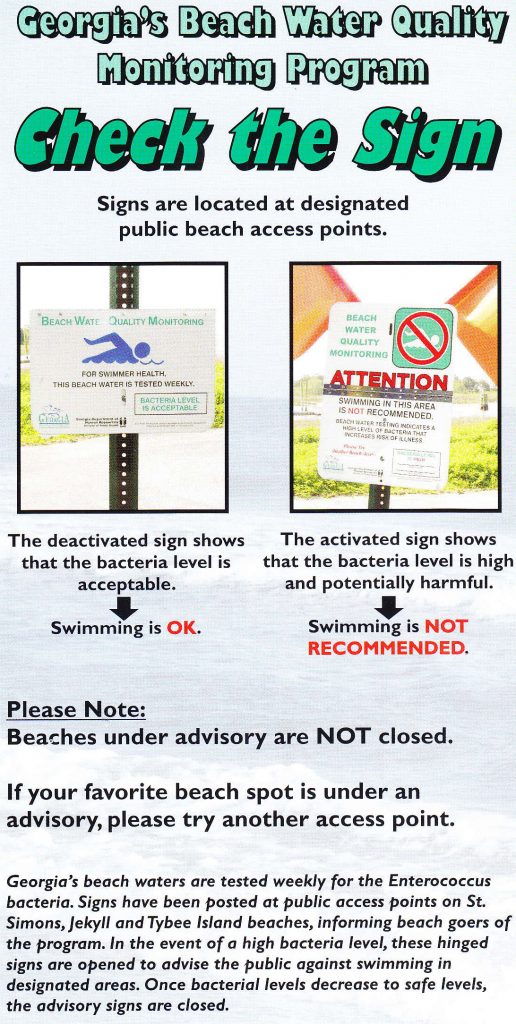
graphic showing the beach water advisory signs

The Department of Natural Resources – Coastal Resources Division tests water samples at Glynn County beaches throughout the year. The test screens for enterococcus (pronounced: en·ter·o·coc·cus) bacteria, which are found in humans and some wildlife. The testing program is not related to the capsized motor vehicle carrier in St. Simons Sound.

When a beach is under advisory, it means the level of bacteria found in the water is above the Environmental Protection Agency’s (EPA) recommended standards. Periodic advisories are not unusual, and sources of the bacteria could include animal waste, storm water runoff, or boating waste.

The advisory does NOT mean the beach is closed. Beach water advisories alert the public of a possible risk of illness associated with water contact in the advisory areas. The Health Department recommends you do not swim or wade in the water in the area under advisory. Fish and other seafood caught from the area should be thoroughly washed with fresh water and thoroughly cooked before eating, as should fish or seafood caught from any waters.

The area will be re-tested this week, and the advisory will be lifted when the bacteria levels meet the EPA’s recommended standards. For more information, visit our beach water testing program web page.

COVID-19 Death in Liberty County

The Coastal Health District has confirmed the death of a Liberty County resident from complications of COVID-19. The individual was an 89-year-old male who had underlying medical conditions.

This is the first confirmed COVID-19 related death in Liberty County, where there have been 82 confirmed cases of the illness.

For more information about COVID-19 in our area, visit the Coastal Health District at covid19.gachd.org.

Improvements Coming to COVID-19 Daily Status Report

Atlanta – Effective Tuesday, June 2, there will be several improvements to the COVID-19 Daily Status Report on the Georgia Department of Public Health’s (DPH) website. These changes are designed to make the dashboard more user-friendly while providing an accurate picture of COVID-19 in Georgia.

The changes to the Daily Status Report will include:

  • Once daily updates at 3 p.m. to allow time to process and validate laboratory and case reports.
  • Reordering the display of key summary metrics as follows: Confirmed COVID-19 Cases, Hospitalizations, Deaths, ICU Admissions.
  • A breakdown of the total number of molecular (PCR) tests, the total number of serology tests, and the number of positives and percentage of positives for each test type.
  • Revised charts of key demographics that more clearly present data.
  • Improved usability of charts and refinements to labelling and supporting documentation of the data. 

DPH will regularly review and update features of the dashboard to improve data quality and accuracy.

For updates on COVID-19, follow @GaDPH and @GovKemp on Twitter and @GaDPH and @GovKemp on Facebook.

For information about COVID-19, visit https://dph.georgia.gov/novelcoronavirus or https://www.cdc.gov/coronavirus/2019-ncov/index.html.