The Coastal Health District of Georgia serves the counties of Bryan, Camden, Chatham, Effingham, Glynn, Liberty, Long & McIntosh

View Upcoming Events

News & Events


COVID-19 Death in McIntosh County

The Coastal Health District has confirmed that a resident of McIntosh County has died from complications of COVID-19. The individual was a 63- year-old female who had underlying medical conditions.

This is the first confirmed COVID-19 related death in McIntosh County, where there have been 16 confirmed cases of the illness to date. For more information about COVID-19 in our area, visit the Coastal Health District at covid19.gachd.org

Beach Advisories Lifted on St. Simons Island


May 28, 2020

Update: The Glynn County Health Department has lifted the bacteria-related beach water advisories for East Beach at the Old Coast Guard Station, Massengale Park Beach, and the 5th Street Crossover Beach on St. Simons Island.

The advisories were issued on May 27, 2020 after routine water quality tests showed a high level of enterococci bacteria which increase the risk of gastrointestinal illness in swimmers.

Subsequent water samples showed that the bacteria levels had dropped below Environmental Protection Agency’s recommended limits. Therefore, the advisories have been lifted.


May 27, 2020:

The Glynn County Health Department has issued beach water advisories for three beach locations on St. Simons Island. Advisories have been issued for East Beach at the Old Coast Guard Station, Massengale Park Beach, and the 5th Street Crossover Beach. These locations stretch from 10th Street on the north end of the island to 9th Street on the south end of the island.

To view a map of the advisory locations, visit gahealthybeaches.org.

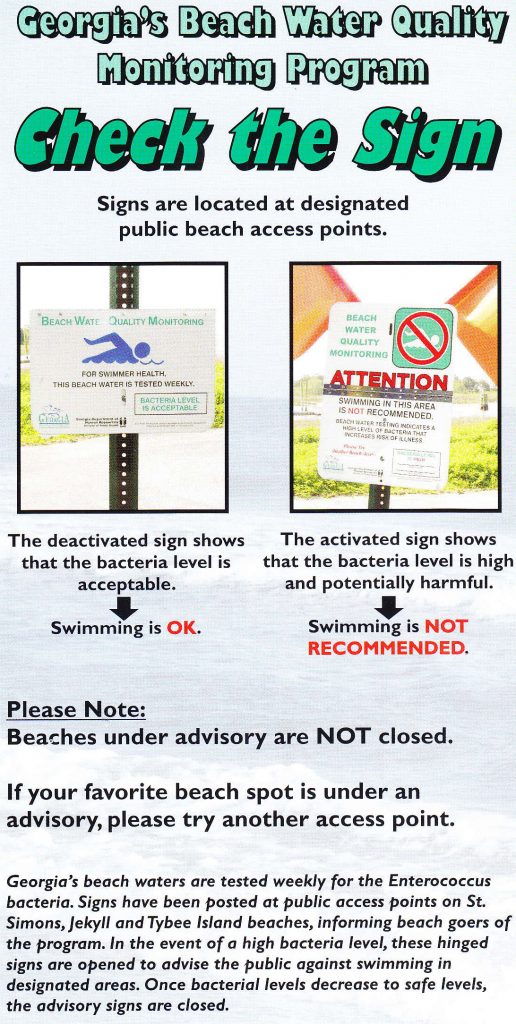
graphic showing the beach water advisory signs

The Department of Natural Resources – Coastal Resources Division tests water samples at Glynn County beaches throughout the year. The test screens for enterococcus (pronounced: en·ter·o·coc·cus) bacteria, which are found in humans and some wildlife. The testing program is not related to the capsized motor vehicle carrier in St. Simons Sound.

When a beach is under advisory, it means the level of bacteria found in the water is above the Environmental Protection Agency’s (EPA) recommended standards. Periodic advisories are not unusual, and sources of the bacteria could include animal waste, storm water runoff, or boating waste.

The advisory does NOT mean the beach is closed. Beach water advisories alert the public of a possible risk of illness associated with water contact in the advisory areas. The Health Department recommends you do not swim or wade in the water in the areas under advisory. Fish and other seafood caught from the areas should be thoroughly washed with fresh water and thoroughly cooked before eating, as should fish or seafood caught from any waters.

The areas will be re-tested this week, and the advisories will be lifted when the bacteria levels meet the EPA’s recommended standards. For more information, visit our beach water testing page.

Additional Allotments of Remdesivir for Treatment of COVID-19 Distributed to Georgia Hospitals

The Georgia Department of Public Health (DPH) this week is distributing 18,440 vials of the drug remdesivir received from the federal government. Nearly 85 hospitals in Georgia will receive remdesivir, enough to treat about 1,676 patients with COVID-19 infection, depending on the duration of an individual’s illness and treatment needs.

Remdesivir is an antiviral medicine being used to treat hospitalized patients with serious symptoms caused by COVID-19 like low oxygen levels or pneumonia. It has been found to shorten the duration of disease in patients being treated in inpatient hospital settings. Remdesivir is given intravenously (IV) and decreases the amount of coronavirus in the body, helping patients recover faster.

Georgia hospitals receiving remdesivir had patients who met the federal criteria for treatment including COVID-19 positive patients on ventilators, in addition to patients currently being treated with extracorporeal membrane oxygenation (ECMO), a machine that takes over the work of the heart and lungs.

Remdesivir has not been approved by the FDA for widespread use because it is considered investigational and it is still being studied. Remdesivir was originally developed for use against Ebola. Clinical trials for remdesivir were done in Georgia at Emory University Hospital.

Georgia Hospitals/Hospital Systems Receiving Allotments of Remdesivir

In the Coastal Health District, the following hospitals are receiving allotments of remdesivir:

  • Memorial Health University Medical Center
  • Southeast Georgia Health System
  • St. Joseph’s/Candler

For a full list of hospitals throughout Georgia receiving remdesivir, view the press release from the Georgia Department of Public Health [PDF, 155.76 KB].

COVID-19 Death in Long County

The Georgia Department of Public Health has announced the death of a Long County resident from complications of COVID-19. The individual was a 75-year-old male who had underlying medical conditions.

This is the first confirmed COVID-19 related death in Long County, where there have been 12 confirmed cases of the illness.

For more information about COVID-19 in our area, visit the Coastal Health District’s COVID-19 website at covid19.gachd.org.

Beach Advisories Lifted on St. Simons Island & Jekyll Island

May 20, 2020

Update: The Glynn County Health Department has lifted the bacteria-related beach water advisories for East Beach at the Old Coast Guard Station on St. Simons Island and South Beach at the 4-H Camp on Jekyll Island.

The advisories were issued on May 19, 2020 after routine water quality tests showed a high level of enterococci bacteria which increase the risk of gastrointestinal illness in swimmers.

Subsequent water samples showed that the bacteria levels had dropped below Environmental Protection Agency’s recommended limits. Therefore, the advisory has been lifted.


May 19, 2020:

The Glynn County Health Department has issued two beach water advisories. One advisory is for East Beach at the Old Coast Guard Station from Tenth Street to Driftwood Drive on St. Simons Island. The second advisory is for South Beach at the 4-H Camp, which is from the South Water Tower to Macy Lane on Jekyll Island.

graphic showing the beach water advisory signs

The Department of Natural Resources – Coastal Resources Division tests water samples at Glynn County beaches throughout the year. The test screens for enterococcus (pronounced: en·ter·o·coc·cus) bacteria, which are found in humans and some wildlife. The testing program is not related to the capsized motor vehicle carrier in St. Simons Sound.

When a beach is under advisory, it means the level of bacteria found in the water is above the Environmental Protection Agency’s (EPA) recommended standards. Periodic advisories are not unusual, and sources of the bacteria could include animal waste, storm water runoff, or boating waste.

The advisory does NOT mean the beach is closed. Beach water advisories alert the public of a possible risk of illness associated with water contact in the advisory areas. The Health Department recommends you do not swim or wade in the water in the area under advisory. Fish and other seafood caught from the area should be thoroughly washed with fresh water and thoroughly cooked before eating, as should fish or seafood caught from any waters. 

Both areas will be re-tested this week, and the advisories will be lifted when the bacteria levels meet the EPA’s recommended standards. For more information about beach water testing, go to GaCHD.org  and click on the Environmental Health tab at the top of the page.
                                                                    

Do You Know Your Tools2Thrive?

While 1 in 5 people will experience a mental illness during their lifetime, everyone faces challenges in life that can impact their mental health. The good news is there are practical tools that everyone can use to improve their mental health and increase resiliency – and there are ways that everyone can be supportive of friends, family, and co-workers who are struggling with life’s challenges or their mental health.

This May is Mental Health Month and a good time to talk about #Tools2Thrive – what individuals can do daily to prioritize their mental health, build resiliency in the face of trauma and obstacles, support those who are struggling, and work towards a path of recovery.

One of the easiest tools anyone can use is taking a mental health screen at mhascreening.org when they need answers. It’s a quick, free, and private way for people to assess their mental health and recognize signs of mental health problems.

This May, we are also exploring topics that can help you build your own set of #Tools2Thrive – recognizing and owning your feelings; finding the positive after loss; connecting with others; eliminating toxic influences; creating healthy routines; and supporting others – all as ways to boost the mental health and general wellness of you and your loved ones.

When it comes to your feelings, it can be easy to get caught up in you emotions as you’re feeling them. Most people don’t think about what emotions they are dealing with but taking the time to really identify what you’re feeling can help you to better cope with challenging situations. It’s ok to give yourself permission to feel. We also know that life can throw us curveballs – and at some point in our lives we will all experience loss. It may be the end of a relationship, being let go from a job, losing a home, or the death of a loved one. It is natural to go through a grieving process. By looking for opportunity in adversity or finding ways to remember the good things about who or what we’ve lost, we can help ourselves to recover mentally and emotionally.

It also is true that connections and the people around us can help our overall mental health – or hurt it. It’s important to make connections with other people that help enrich our lives and get us through tough times, but it’s equally important to recognize when certain people and situations in life can trigger us to feel bad or engage in destructive behaviors. Identifying the toxic influences in our lives and taking steps to create a new life without them can improve mental and physical health over time. And we know that work, paying bills, cleaning, getting enough sleep, and taking care of children are just some of the things we do each day – and it is easy to be overwhelmed. By creating routines, we can organize our days in such a way that taking care of tasks and ourselves becomes a pattern that makes it easier to get things done without having to think hard about them.

For each of us, the tools we use to keep us mentally healthy will be unique. Finding what work for you may not be easy but can be achieved by gradually making small changes and building on those successes. By developing your own #Tools2Thrive, it is possible to find balance between work and play, the ups and downs of life, and physical health and mental health – and set yourself on the path to recovery.

For more information, visit www.mhanational.org/may.

Georgia DPH Distributes Remdesivir to Hospitals for Treatment of COVID-19

Atlanta – The Georgia Department of Public Health(DPH) today is distributing an initial allotment of the drug remdesivir received from the federal government. Georgia received 30 cases, with 40 vials of the drug per case, enough to treat about 110 patients, depending on the duration of an individual’s treatment.

Remdesivir is an antiviral medicine being used to treat hospitalized patients with serious symptoms caused by COVID-19 like low oxygen levels or pneumonia. It has been found to shorten the duration of disease in patients being treated in inpatient hospital settings. Remdesivir is given intravenously (IV) and decreases the amount of coronavirus in the body, helping patients recover faster.

The distribution plan for remdesivir in Georgia was developed by DPH leadership, including district health directors and emergency preparedness staff, in accordance with Food and Drug Administration (FDA) guidelines for its use. It is based on the number of patients on ventilators, the most severely ill, and clinical best practices.

Georgia hospitals receiving remdesivir reported 10 or more COVID-19 positive patients on ventilators, in addition to patients currently being treated with extracorporeal membrane oxygenation (ECMO), a machine that takes over the work of the heart and lungs. These criteria are subject to change based on the availability of remdesivir and the development of patient care at hospital facilities across the state.

The following hospitals are receiving remdesivir; Tift Regional Medical Center, Northeast Georgia Medical Center, Wellstar Kennestone Hospital, Phoebe Putney Memorial Hospital, Grady Health System, Emory University Hospital, Emory University Hospital Midtown, and Augusta University Medical Center.

“DPH is pleased to have the opportunity to share this promising treatment with hospitals on the front lines in the fight against COVID-19,” said Kathleen E. Toomey, M.D., M.P.H., DPH commissioner. “While this drug is not a cure for COVID-19, getting it into the hospitals and improving patient outcomes is moving in the right direction.”

Georgia has received a second, much larger allotment of remdesivir. DPH is surveying hospitals statewide over the weekend to determine need. This second allotment will be distributed next week.

Gilead Sciences, Inc. committed to supplying approximately 607,000 vials of the experimental drug over the next six weeks to treat an estimated 78,000 hospitalized COVID-19 patients under an emergency use agreement (EUA). The donation to the United States is part of 1.5 million vials of remdesivir the company is donating worldwide.

Remdesivir has not been approved by the FDA for widespread use because it is considered investigational and it is still being studied. Remdesivir was originally developed for use against Ebola. Clinical trials for remdesivir were done in Georgia at Emory University Hospital.

UPDATE 5.21.20
Second Allotment of Remdesivir Headed to Hospitals for Treatment of COVID-19

Atlanta – The Georgia Department of Public Health(DPH) is distributing a second allotment of the drug remdesivir received from the federal government. Twenty-nine hospitals in Georgia will receive remdesivir, enough to treat more than 300 patients, depending on the duration of an individual’s illness and treatment needs.

Remdesivir is an antiviral medicine being used to treat hospitalized patients with serious symptoms caused by COVID-19 like low oxygen levels or pneumonia. It has been found to shorten the duration of disease in patients being treated in inpatient hospital settings. Remdesivir is given intravenously (IV) and decreases the amount of coronavirus in the body, helping patients recover faster.

3,440 vials of remdesivir, able to treat approximately 310 patients, will be distributed to 29 hospitals affiliated with the following healthcare systems: Navicent, Northside, Piedmont and WellStar.

Georgia hospitals receiving remdesivir reported 10 or more COVID-19 positive patients on ventilators, in addition to patients currently being treated with extracorporeal membrane oxygenation (ECMO), a machine that takes over the work of the heart and lungs. These criteria are subject to change based on the availability of remdesivir and the development of patient care at hospital facilities across the state.

A third allotment of remdesivir in powder form is expected to arrive in Georgia by Friday. The liquid form of remdesivir is not recommended for pediatric use, but the powder form can be mixed for dosing based on a child’s weight, which will provide treatment for the youngest patients with COVID-19 infection.

Gilead Sciences, Inc., the maker of remdesivir, is donating approximately 607,000 vials of the experimental drug to treat an estimated 78,000 hospitalized COVID-19 patients under an emergency use agreement (EUA). The donation to the United States is part of 1.5 million vials of remdesivir the company is donating worldwide.

Remdesivir has not been approved by the FDA for widespread use because it is considered investigational and it is still being studied. Remdesivir was originally developed for use against Ebola. Clinical trials for remdesivir were done in Georgia at Emory University Hospital.

For more information about COVID-19 visit https://dph.georgia.gov/novelcoronavirus or https://www.cdc.gov/coronavirus/2019-ncov/index.html.

For updates on the COVID-19 situation as it develops, follow @GaDPH, @GeorgiaEMA, and @GovKemp on Twitter, and @GaDPH, @GEMA.OHS, and @GovKemp on Facebook.

Beach Advisory Lifted on St. Simons Island

May 14, 2020

Update: The Glynn County Health Department has lifted the bacteria-related beach water advisory for for Massengale Park Beach, which is from Driftwood Drive to Cedar Street on St. Simons Island.

The advisory was issued on May 12, 2020 after routine water quality tests showed a high level of enterococci bacteria which increase the risk of gastrointestinal illness in swimmers.

Subsequent water samples showed that the bacteria levels had dropped below Environmental Protection Agency’s recommended limits. Therefore, the advisory has been lifted.


May 12, 2020

The Glynn County Health Department has issued a beach water advisory for Massengale Park Beach, which is from Driftwood Drive to Cedar Street on St. Simons Island.

graphic showing the beach water advisory signs

The Department of Natural Resources – Coastal Resources Division tests water samples at Glynn County beaches throughout the year. The test screens for enterococcus (pronounced: en·ter·o·coc·cus) bacteria, which are found in humans and some wildlife. The testing program is not related to the capsized motor vehicle carrier in St. Simons Sound.

When a beach is under advisory, it means the level of bacteria found in the water is above the Environmental Protection Agency’s (EPA) recommended standards. Periodic advisories are not unusual, and sources of the bacteria could include animal waste, storm water runoff, or boating waste.

The advisory does NOT mean the beach is closed. Beach water advisories alert the public of a possible risk of illness associated with water contact in the advisory areas. The Health Department recommends you do not swim or wade in the water in the area under advisory. Fish and other seafood caught from the area should be thoroughly washed with fresh water and thoroughly cooked before eating, as should fish or seafood caught from any waters.

The area will be re-tested this week, and the advisory will be lifted when the bacteria levels meet the EPA’s recommended standards. For more information, visit our beach water testing page.

Georgia Department of Public Health Adds Staff, Expands Contact Tracing for COVID-19

The Georgia Department of Public Health (DPH) is increasing its workforce to expand contact tracing for COVID-19 in Georgia. Contact tracing is used to identify and mitigate hotspots of infection to help prevent further spread of the virus.

Currently, about 250 contact tracers are deployed throughout the state. To date, more than 3,800 individuals testing positive for COVID-19 have been contacted and nearly 13,000 contacts identified.

In partnership with the CDC Foundation, a deployment coordinator and a training and learning coordinator have joined DPH’s COVID-19 response team. Together these individuals will oversee the training and deployment of hundreds of contact tracers being hired by the Department. They will work closely with the 18 public health districts to ensure operational issues and staffing needs are addressed, and that performance metrics established by DPH and district leadership are met.

DPH’s goal is to have over 1,000 contact tracers within weeks to strengthen its contact tracing efforts. Training is underway for 200 new contact tracers and 70 medical students and M.P.H. candidates who joined DPH in the past two weeks.

Along with the additional contact tracers, DPH is introducing a new online monitoring tool developed by Google/MTX to make contact tracing more efficient. Once a COVID-19 case is identified, public health staff work with that individual to help them recall everyone they have had close contact with and where they went while they may have been infectious. Contacts identified during this interview will be called by trained DPH staff indicating that they have been exposed to COVID-19 and asking them to enroll in DPH symptom monitoring and informing them that they must self-quarantine for 14 days after the exposure.

The web-based portal allows identified contacts to easily answer questions about their health and their symptoms related to COVID-19. If the contact reports symptoms, the system will prompt the individual to call 911 if they are in a medical emergency or to consult with their healthcare provider if they are sick and need medical care. Individuals with mild symptoms who do not need medical care will then be provided information on how to schedule COVID-19 testing.

Contacts will receive a daily text message for 14 days reminding them to report if they have symptoms through the monitoring tool, and they will also receive information about what to do if they are or become sick. Individuals who do not report daily will be contacted by DPH. For people who do not wish to use the online system or receive texts, they can call DPH directly to report their symptoms.

Confidentiality is critical to the success of contact tracing. Contact tracing in Georgia is 100% confidential – the identity of the person who tests positive and the information on those who might have been exposed will not be shared. Georgia’s contact tracing does not use GPS or Bluetooth technology to track movements. The monitoring tool does not collect any data other than what is entered by the contact.

COVID-19 Testing Now Available to all Georgians

The Georgia Department of Public Health (DPH) has reached its goal of testing 100,000 individuals in 10 days. More than 108,000 tests were processed since Commissioner Kathleen E. Toomey, M.D., M.P.H, set the DPH goal last week.

“This is an important benchmark for Georgia as we work to stop the spread of COVID-19 in the state,” said Toomey. “Increased testing is critical to understanding where there are hotspots of infection and how best to mitigate them.”

Effective immediately, testing is available to all Georgians who request it, whether they have symptoms or not. There are more than 65 specimen point of collection sites (SPOC) throughout the state, with an additional 30 mobile SPOCs – locations and hours vary daily.

Individuals wanting to be tested can contact any Georgia public health department to schedule an appointment at a SPOC location convenient to them. For phone numbers and more testing information, visit our COVID-19 Testing Page.