The Coastal Health District of Georgia serves the counties of Bryan, Camden, Chatham, Effingham, Glynn, Liberty, Long & McIntosh

View Upcoming Events

News & Events


DPH Identifies First Death From Vaping-Associated Illness

September 25, 2019

Atlanta -The Georgia Department of Public Health (DPH) has identified the state’s first death from a vaping-associated illness. The patient had a history of heavy nicotine vaping, but no reported history of vaping THC. DPH has identified nine cases, including the death, of vaping-associated illness in Georgia, and other possible cases are being reviewed. All patients were hospitalized and developed pneumonia with no known infectious cause. Cases range in age from 18 to 68 years (median age 26 years), 78% are male.

The Centers for Disease Control and Prevention (CDC) is working with states to investigate more than 500 cases of vaping-associated illness. No specific e-cigarette device or substance has been linked to all cases. Most patients have reported a history of using vaping products containing THC. Many patients have reported using THC and nicotine. Some have reported the use of e-cigarette products containing only nicotine.

Governor Brian P. Kemp and DPH Commissioner Kathleen E. Toomey, M.D., M.P.H. urge individuals to follow the CDC recommendation that individuals not use e-cigarettes or other vaping devices while this investigation is ongoing. Without knowing the specific cause of the vaping-associated illness, discontinuing use of e-cigarettes and vaping devices is the best prevention against becoming ill.

E-cigarettes and other vaping devices are not safe for youth, young adults, pregnant women or adults who do not currently use tobacco products. People who use e-cigarette products should not buy vaping products off the street and should not modify or add any substances to e-cigarette products.

Symptoms of vaping-associated illness, which worsen over time, include cough, shortness of breath, fatigue, chest pain, nausea, vomiting and diarrhea. People with a history of vaping who are experiencing breathing problems or any of these symptoms should seek medical care.

For more information about e-cigarettes and vaping, visit https://www.cdc.gov/tobacco/basic_information/e-cigarettes/severe-lung-disease.html#latest-outbreak-information.
Beach Advisory Lifted for East Beach on St. Simons Island

Updated September 25, 2019

The Glynn County Health Department has lifted the advisory for East Beach at the Old Coast Guard Station, which is from 10th Street to Driftwood Drive on St. Simons Island.

The advisory was issued on September 24, 2019 after routine water quality tests showed a high level of enterococci bacteria which increase the risk of gastrointestinal illness in swimmers.

Subsequent water samples showed the bacteria levels had dropped below Environmental Protection Agency’s recommended limits. Therefore, the advisory has been lifted.


September 24, 2019

The Glynn County Health Department has issued a swimming advisory for East Beach at the Old Coast Guard Station, which is from 10th Street to Driftwood Drive on St. Simons Island.

This advisory is based on results from routine, weekly water sample tests for bacteria found in humans and some wildlife, and this testing program is not related to the capsized cargo carrier in St. Simons Sound.

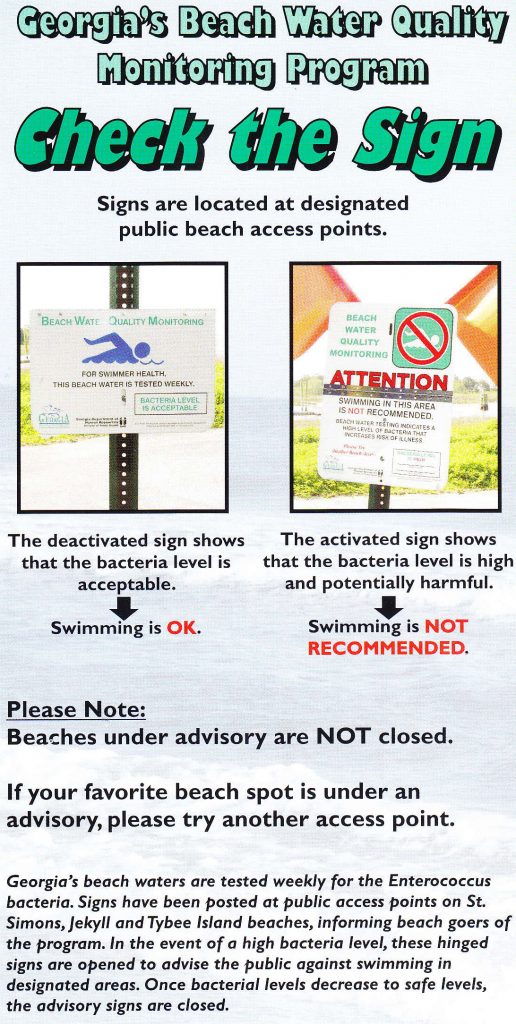
The Department of Natural Resources Coastal Resources Division tests water on St. Simons and Jekyll Islands every week of the year, screening for enterococcus (pronounced: en·ter·o·coc·cus) bacteria. When a beach is under advisory, it means the level of bacteria found in the water is above the Environmental Protection Agency’s (EPA) recommended standards. This does NOT mean the beach is closed.

graphic showing the beach water advisory signs

Periodic advisories are not unusual, particularly during warmer months when bacteria thrive. It is difficult to determine exactly where the bacteria come from, but some sources could include animal waste, storm water runoff, or boating waste.

This beach water advisory is to alert the public of a possible risk of illness associated with water contact in the advisory area. The Health Department recommends you do not swim or wade in the water in the area under advisory. No other beach areas are affected. Fish and other seafood caught from this area should be thoroughly washed with fresh water and thoroughly cooked before eating, as should fish or seafood caught from any waters.

The area will be re-tested this week, and the advisory will be lifted when the bacteria levels meet the EPA’s recommended standards. For more information, visit our beach water testing page.

Diabetes Prevention Program Meeting Sept. 26

Coastal Health District Chronic Disease Prevention Program will hold a National Diabetes Prevention Program kickoff meeting (including blood glucose screening) from 5:30 to 6:30 p.m. on Thursday, September 26, at the Coastal Health District administrative office located at 400 Mall Blvd., Suite G, in Savannah (second floor of the Progressive building).

There are more than 79 million Americans who have prediabetes and many do not know it. In Georgia alone, more than one million people have diabetes and about 44,000 Georgians are diagnosed with diabetes every year. People with prediabetes have blood glucose (sugar) levels higher than normal. The levels are not yet high enough for a type 2 diabetes diagnosis; however, people with prediabetes are more likely to get type 2 diabetes than others. Diabetes can lead to serious health complications, including heart attack, stroke, blindness, kidney failure, or loss of toes, feet, or legs. Even though prediabetes puts you at high risk, there are ways you can lower your chance of getting type 2 diabetes.

The National Diabetes Prevention Program is focused on helping prediabetics avoid type 2 diabetes by making modest lifestyle changes. The Program is free and is designed so that participants receive support not only through a Lifestyle Coach but also from each other by sharing ideas, celebrating successes, and working to overcome obstacles. Participants at high risk for type 2 diabetes will learn how take steps to make positive, sustainable lifestyle changes.

Anyone seeking additional information about the Diabetes Prevention Program can contact Coastal Health District Chronic Disease Prevention Director, Cristina Gibson at 912-644-5818 or email cristina.gibson@dph.ga.gov.

Free Mammograms for Women Who Meet Eligibility Criteria

[JPG, 1.72 MB]In observance of National Breast Cancer Awareness Month, several health departments in the Coastal Health District will host free mammogram screening events in October in observance of National Breast Cancer Awareness Month. Mammograms will be offered at no cost to women who meet certain annual income guidelines and are 40-64 years of age without insurance.

Events will take place in the following counties:

Camden County
Wednesday, October 9
9 a.m. – 1 p.m.
Lowe’s 1410 Boone Ave., Kingsland
For more information, call the Camden County Health Department at 912-576-3040 (Woodbine) or 912-882-8515 (St. Marys)

Long County
Tuesday, October 15
8:30 a.m. – 2 p.m.
IGA, U.S. Hwy. 84, Ludowici
For more information, call the Long County Health Department at  912-545-2107.

Glynn County
Monday, October 28
9 a.m. – 2:30 p.m.
Sparrow’s Nest, 2911 Altama Avenue, Brunswick
For more information, call the Glynn County Health Department at 912-264-3961.

McIntosh County
Tuesday, October 29
8:30 a.m. – 3 p.m.
Piggly Wiggly, 15759 U.S. 17, Eulonia
For more information, call the McIntosh County Health Department at 912-832-5473.

Chatham County
Tuesday, October 29
8:30 a.m. – 3 p.m.
Chatham County Health Department, 1602 Drayton St., Savannah
For more information, call  356-2946.

Although these events are taking place during National Breast Cancer Awareness Month, mammography services are available through the Breast and Cervical Cancer Program all year long for women who meet eligibility criteria.

Beach Water Advisory Lifted for Tybee Island

Updated September 19, 2019

The Chatham County Health Department has lifted the advisory for Tybee Strand Beach at the Pier, which stretches from 11th Street to 18th Street on Tybee Island.

The advisory was issued on September 17, 2019 after routine water quality tests showed a high level of enterococci bacteria which increase the risk of gastrointestinal illness in swimmers.

Subsequent water samples showed the bacteria levels had dropped below Environmental Protection Agency’s recommended limits. Therefore, the advisory has been lifted.


September 17, 2019

The Chatham County Health Department has issued a water quality advisory for Tybee Strand Beach at the Pier, which stretches from 11th Street to 18th Street on Tybee Island.

This advisory is only for the area specified above and does not impact any other beaches on the island. There is no way of knowing if going into water that is under advisory will result in illness; however, this beach water advisory is to alert the public of a possible risk of illness associated with water contact. An area under advisory does not mean the beach is closed.
Water samples are collected weekly on Tybee Island, and are tested for enterococcus (pronounced: en·ter·o·coc·cus) bacteria which is found in warm blooded animals including humans but also birds, raccoons, deer, dolphins and other wildlife.

It is difficult to determine exactly where the bacteria come from, but some sources could include animal waste, storm water runoff, or boating waste. When a beach is under advisory, it means that the level of bacteria found in the water is above the Environmental Protection Agency’s recommended standards. The Chatham County Health Department recommends you do not swim or wade in the water in the area under advisory.

Fish and other seafood caught from this area should be thoroughly washed with fresh water and thoroughly cooked before eating as should fish or seafood caught from any waters. The area will be re-tested, and the advisory will be lifted when tests show the bacteria levels meet the Environmental Protection Agency’s recommended standards.

Raccoon on Dutch Island Tests Positive for Rabies

A raccoon on Dutch Island has tested positive for rabies. A family dog and the dog’s owner had contact with the raccoon. The dog is up to date on rabies vaccinations and will undergo observation for 45 days as a precaution. The owner has been advised to seek follow-up care from his healthcare provider.

Several species of wild animals that are native to coastal Georgia – including raccoons, foxes, and bats – can carry rabies. Rabies is a potentially deadly virus that is primarily spread by infected animals. The Chatham County Health Department Environmental Health office offers these tips to protect you and your family from rabies:

  • Avoid contact with animals you don’t know.
  • Make sure your pets receive the proper immunizations. Dogs and cats should get rabies vaccines after 12 weeks of age, followed by a booster shot within one year and vaccination every 1-3 years depending on veterinary recommendation and vaccine used.
  • Do not handle, feed, or unintentionally attract wild animals with open garbage cans or by leaving pet food out at night.
  • Never adopt wild animals or bring them into your home. Do not try to nurse sick animals to health. Call animal control or a properly licensed animal rescue agency for assistance.
  • Teach children to never handle unfamiliar animals, wild or domestic, even if they appear friendly. “Love your own, leave other animals alone” is a good principle for children to learn.

Symptoms of rabies in animals include a change in behavior, biting, aggression, showing no fear of natural enemies (such as humans), foaming at the mouth, and paralysis.

If an animal ever bites you, seek medical care immediately and contact Chatham County Animal Services at 912-652-6575 and the Chatham County Environmental Health office at 912-356-2160.

Food Safety Education

[JPG, 83.52 KB]September is Food Safety Education Month and a good time to remember that the best way to prevent getting sick from food is to prepare and handle food correctly.

There are more than 250 foodborne diseases. Foodborne illness can be particularly dangerous for older adults, young children, pregnant women, and those with weakened immune systems.

You can be a Food Safety Superhero by always following these Four Steps – Clean, Separate, Cook, and Chill –  to protect you and your family from food poisoning.

Check out these great resources on food safety:

CDC Food Safety

FightBAC! Partnership for Food Safety Education

USDA FoodKeeper App

Beach Advisory Updated for Jekyll & St. Simons

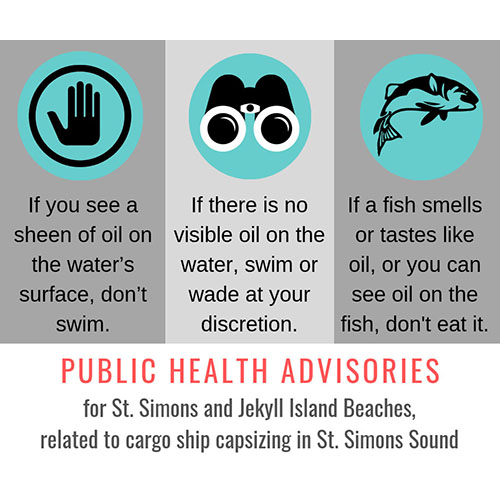
If you’re planning to swim or wade at the beach on St. Simons or Jekyll Islands, the Coastal Health District has some precautionary advice: check the water for any signs of oil, and use your best judgement before swimming.

The Coastal Health District issued a general swimming advisory Sunday, asking visitors to stay out of the water after a cargo ship capsized in the St. Simons Sound. Today, the swimming advisory has been modified, and swimmers are asked to be aware and use discretion. Although oil has not been seen on the ocean-facing beaches of St. Simons or Jekyll Islands, beach visitors are urged to visually check the water before deciding to swim. A similar advisory also applies to fish consumption.

  • If you see a sheen of oil on the water’s surface, don’t swim. Contact with oil could cause skin and eye irritation.
  • If there is no visible oil on the water, then swim or wade at your discretion. Stay alert for changing conditions.
  • If a fish smells or tastes like oil, or you can see oil on the fish, do not eat it.

Officials at the incident command center are working to plug the ship’s vent stacks to prevent any additional release of oil, and absorbent booms are soaking up most of the oil immediately around the vessel. Booms have also been placed at the entrance of nearby creeks to protect local oyster beds. Agencies will continue to monitor the beaches and marshes for signs of oil contamination.

Some of the agencies involved in monitoring any ongoing environmental impacts are the Coastal Resources Division of the Department of Natural Resources, the National Oceanic and Atmospheric Administration, the U.S. Coast Guard, and private contractors. If you see oil on the beach, contact the U.S. Coast Guard National Response Center at 1-800-424-8802 to make a report.

Human Case of West Nile Virus Confirmed in Chatham County Resident

First lab-confirmed human case of West Nile Virus in the Coastal Health District in 2019

graphic of mosquito and words west nile virusAn adult living in Chatham County has been diagnosed with West Nile Virus (WNV), a potentially serious illness transmitted to humans through the bite of an infected mosquito. This is the first human case in the 8-county Coastal Health District in 2019, and the 4th human case of WNV in Georgia this year.
Chatham County Mosquito Control first detected and reported WNV in a sample of local mosquitoes in July, and the virus quickly spread throughout the mosquito population across the county. Already, 2019 is the second most active year for WNV in Chatham County mosquitoes.

According to the Centers for Disease Control and Prevention, 80% of people who get WNV won’t have any symptoms. Those who do become sick typically develop a fever, headache, body aches, joint pain, vomiting, diarrhea, or rash. However, about 1 in 150 will develop severe symptoms affecting the central nervous system, which could be fatal. Last year, there were 36 lab-confirmed cases of WNV in humans in Georgia, and 2 deaths.

graphic linking to insect repellent search toolThere is no vaccine to prevent WNV, and no treatment other than supportive care for the symptoms. That’s why the Coastal Health District is urging everyone to take precautions to avoid mosquito bites.

Mosquitoes that carry WNV are more likely to bite during the evening, night, and early morning. Wearing insect repellent containing the chemical DEET will help keep mosquitoes away. Eliminating standing water around the home and yard to keep mosquitoes from breeding.

Tip containers such as children’s toys, flowerpots, and planters after every rain or at least once a week and toss out anything that holds water, such as old tires or cans. Also clean out gutters, remove piles of leaves, and keep vegetation cut low to prevent landing sites for adult mosquitoes.

The Coastal Health District encourages everyone to follow the 5 Ds of mosquito bite prevention:

Dusk/Dawn

Mosquitoes are most active at dusk and dawn. If you can, avoid going outside at dusk and dawn to reduce your chance of being bitten.


Dress

Wear loose-fitting, long sleeved shirts and pants to reduce the amount of exposed skin. If the mosquitoes can’t get to your skin, they can’t bite you.


DEET

Any skin that is exposed should be covered with an insect repellent containing DEET, which is the most effective repellent against mosquito bites. Be sure to follow the instructions on the label regarding how to apply and how often to reapply.


Drain

Mosquitoes need standing water for breeding, so be sure to empty any containers holding stagnant water, such as buckets, barrels, flowerpots, and tarps. Be especially mindful after a rain, and toss any standing water to discourage mosquito breeding around your home.


Doors

Make sure doors and windows are in good repair and fit tightly. If you have screens on your windows and doors, be sure to fix any rips or tears so mosquitoes can’t get through the screens and into your home.

Long Co. Health Dept. & Co. Extension Service Offer Free Cooking Class

The Long County Health Department and the Long County University of Georgia Extension Service is partnering to offer a free cooking course to residents who prepare meals for children (moms/dads; grandparents; teens; and foster parents). The Expanded Food and Nutrition Education Program (EFNEP) cooking classes will take place at the health department from 10:30 a.m. to 12 p.m. on September 26 and October 3, 10, and 17.

EFNEP teaches recipes, cooking on a budget, and food safety tips. A cooking utensil or cooking-related item is given to attendees each week at the end of the class.

Children may be brought to class. For more information, please call the Long County Health Department at 912-545-2107 or the Long County Extension office at 912-545-9549.