The Coastal Health District of Georgia serves the counties of Bryan, Camden, Chatham, Effingham, Glynn, Liberty, Long & McIntosh

View Upcoming Events

News & Events


Raccoon on Wilmington Island Tests Positive for Rabies

A raccoon in the Wilmington Island Road area of Wilmington Island has tested positive for rabies. A family dog with no history of receiving the rabies vaccine may have had contact with the rabid raccoon. The dog will be under quarantine for 4 months to make sure he does not exhibit any symptoms of the disease.

Several species of wild animals that are native to coastal Georgia – including raccoons, foxes, and bats – can carry rabies. Rabies is a potentially deadly virus that is primarily spread by infected animals.

The Chatham County Health Department Environmental Health office offers these tips to protect you and your family from rabies:

  • Avoid contact with animals you don’t know.
  • Make sure your pets receive the proper immunizations. Dogs and cats should get rabies vaccines after 12 weeks of age, followed by a booster shot within one year and vaccination every 1-3 years depending on veterinary recommendation and vaccine used.
  • Do not handle, feed, or unintentionally attract wild animals with open garbage cans or by leaving pet food out at night.
  • Never adopt wild animals or bring them into your home. Do not try to nurse sick animals to health. Call animal control or a properly licensed animal rescue agency for assistance.
  • Teach children to never handle unfamiliar animals, wild or domestic, even if they appear friendly. “Love your own, leave other animals alone” is a good principle for children to learn.

Symptoms of rabies in animals include a change in behavior, biting, aggression, showing no fear of natural enemies (such as humans), foaming at the mouth, and paralysis.

If an animal ever bites you, seek medical care immediately and contact Chatham County Animal Services at 912-652-6575 and the Chatham County Environmental Health office at 912-356-2160.

Beach Advisory Lifted for the South Dunes Picnic Area on Jekyll Island

UPDATE:

On July 18, 2019, the Glynn County Health Department lifted the advisory for the South Dunes Picnic Area on Jekyll Island, which is from Corsair Beach Park to the South Water Tower.

The advisory was issued on July 16, 2019 after routine water quality tests showed a high level of enterococci bacteria which increase the risk of gastrointestinal illness in swimmers.

Subsequent water samples showed the bacteria level had dropped below Environmental Protection Agency’s recommended limits. Therefore, the advisory was lifted.


July 16, 2019
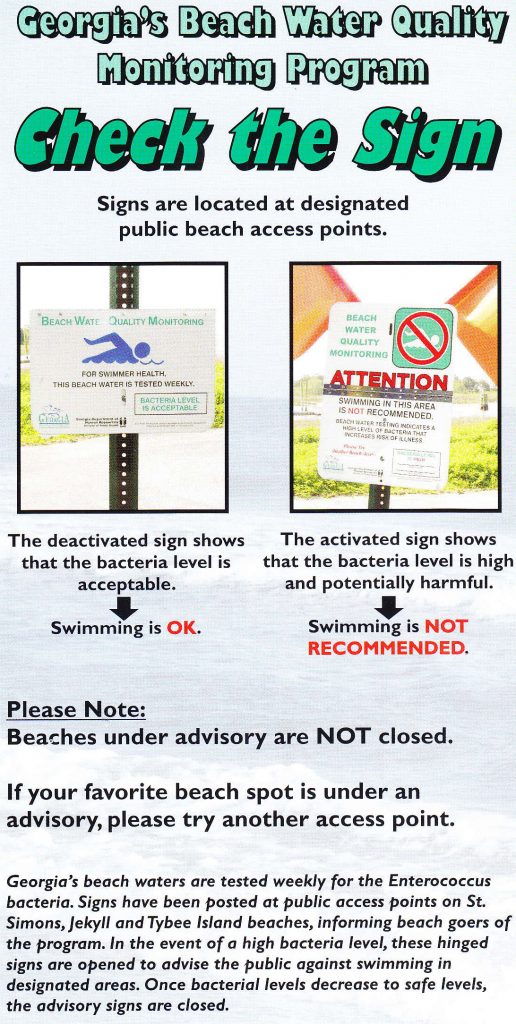
[JPG, 2.57 MB]The Glynn County Health Department has issued a beach water quality advisory for the South Dunes Picnic Area on Jekyll Island, which is from Corsair Beach Park to the South Water Tower.

The advisory is only for the area specified above and does not impact any other beaches on the island. There is no way of knowing if going into water that is under advisory will result in illness; however, this beach water advisory is to alert the public of a possible risk of illness associated with water contact. An area under advisory does not mean the beach is closed.

Water samples are tested only for enterococcus (pronounced: en·ter·o·coc·cus) bacteria which is found in warm blooded animals including humans but also birds, raccoons, deer, dolphins and other wildlife. It is difficult to determine exactly where the bacteria come from, but some sources could include animal waste, storm water runoff, or boating waste. When a beach is under advisory, it means that the level of bacteria found in the water is above the Environmental Protection Agency’s recommended standards.

The Glynn County Health Department recommends you do not swim or wade in the water in the areas under advisory. Fish and other seafood caught from these areas should be thoroughly washed with fresh water and thoroughly cooked before eating, as should fish or seafood caught from any waters.

The area will be retested and the advisory will be lifted when tests show the bacteria level meets the Environmental Protection Agency’s recommended standards.

To view an interactive map of all beach water testing locations in Georgia, visit gahealthybeaches.org.

Frequently Asked Questions about Beach Water Advisories
Why is the water tested and what is it tested for?
The water is tested as part of the Environmental Protection Agency’s beach monitoring program which includes all Georgia beaches. Water samples are taken all along the island and tested for enterococcus (pronounced: en•ter•o•coc•cus) bacteria which is found in warm blooded animals including humans but also birds, raccoons, deer, dolphins and other wildlife.

Do you know where the bacteria come from?
It is difficult to determine exactly where the bacteria come from but some sources could include animal waste, storm water runoff, or boating waste.

What does it mean when a beach is under advisory?
It means that the level of bacteria found in the water is above the Environmental Protection Agency’s recommended standards. When the level of bacteria is higher than it should be there is increased risk of illness to swimmers so the public is advised not to swim or wade in the water in that particular area.

Will I get sick if I go into water that is under advisory?
There is no way to say for sure whether or not you will get sick if you go into water that is under advisory but you will be at an increased risk of illness. Risk of illness comes from contacting beach water in several ways including ingesting water while swimming, getting water in the nose, eyes, and ears or getting water in an open wound. Some examples of possible illness include possible stomach upset, ear infection, sore throat, or wound infection.

What do I do if I have been swimming in water that was under advisory but I didn’t realize it?
There is no way to say for sure whether or not you will get sick if you were swimming or wading in water that was under advisory. The best thing to do is to be aware of any changes in your health. If you start to experience stomach upset, ear infection, sore throat, or wound infection, after you have been in contact with water that was under advisory, contact a healthcare provider.

Is the beach closed?
No, the beach is not closed. An advisory simply means that increased levels of bacteria were found in the water, not on the beach, which is why public health suggests no swimming or wading in the water (risk of illness comes from contact with the water).

Does the advisory cover the entire island?
No. An advisory only covers a certain area. Even if part of the beach is under advisory there are plenty of other beach access points to areas that aren’t under advisory.

How do you know the bacteria are only in one certain area of the water?
Beaches have been divided up into zones. Water samples are taken from the center of each zone and if bacteria levels are found to be higher in a certain zone then an advisory is issued for that area. Because it’s not possible to determine exactly where the bacteria levels switch from “okay” to “elevated,” the advisory is issued for a fairly large area. If water samples from more than one zone indicate higher levels of bacteria then multiple advisories will be issued but again, only for the areas where bacteria is higher.

How long do areas stay under advisory?
When an advisory is issued, another sample of the water in the area under advisory is taken within a few days and retested. An area will stay under advisory until the test shows that bacteria in the water have decreased to an acceptable level as determined by the Environmental Protection Agency.

How often is beach water tested?
Water at the beaches on Jekyll, St. Simons, and Tybee Islands is tested once a week, year-round. Beaches that are under permanent advisory are tested once a quarter (four times a year).

What does it mean if a beach is under a permanent advisory?
A permanent advisory means that there are continually elevated bacteria levels indicating a potential human health risk and therefore swimming or wading is advised against.

Can I eat fish I’ve caught from a beach that’s under advisory?
Yes, fish and other seafood caught in area(s) should be thoroughly washed with fresh water and thoroughly cooked before eating as should fish or seafood caught from any waters.

For more information, visit our beach water testing page.

Long & McIntosh Co. Health Departments & County Extension Service Offer Free Cooking Class

The Long and McIntosh County Health Departments and the University of Georgia Extension Service is partnering to offer a free cooking course to residents who prepare meals for children (i.e. moms/dads; grandparents; teens; and foster parents). The Expanded Food and Nutrition Education Program (EFNEP) cooking classes will take place on
Thursdays through September 5:
Long County Health Department: 2-3:30 p.m.
McIntosh County Health Department: 5:30-6:30

EFNEP teaches recipes, cooking on a budget, and food safety tips. A cooking utensil or cooking-related item is given to attendees each week at the end of the class. Residents who attend at least six of the classes will receive a certificate of completion and a cookbook.

The program will help families learn how to stretch their food budgets and make simple, healthier meals.

For more information, please call the Long County Health Department at 912-545-2107 or the Long County Extension office at 912-545-9549 or the McIntosh County Health Department at 912-832-5473 or the McIntosh County Extension office at 912-437-6651.

Mosquito-Borne Virus Activity Now Widespread in Chatham County

Chatham County Mosquito Control has confirmed that samples of mosquitoes collected in multiple locations across Chatham County have tested positive for West Nile virus (WNV).

“These additional positive mosquito samples are not unexpected,” said Dr. Lawton Davis, Health Director of the Coastal Health District. “Last week, Mosquito Control confirmed West Nile virus in a pool of mosquitoes in midtown Savannah. Once the virus is present in our local mosquito population, we know it’s just a matter of time before the activity becomes more widespread.”

Mosquito Control will continue treating all areas of Chatham County for mosquitoes, and residents are encouraged to protect themselves from mosquito bites. West Nile virus is transmitted to humans by the bite of infected mosquitoes and can cause mild to serious illness. No human cases of WNV have been confirmed in any Coastal Health District counties this year.

About 80% of the people who get WNV never develop symptoms. About 1 in 5 people who are infected will develop a fever with other symptoms such as headache, body aches, joint pain, vomiting, diarrhea, or rash. A very small number of people who become sick can develop swelling of the brain or tissue around the spinal cord, which can be deadly.

Residents are always encouraged to follow the 5Ds of mosquito bite prevention:

Dusk/Dawn

Mosquitoes are most active at dusk and dawn. If you can, avoid going outside at dusk and dawn to reduce your chance of being bitten.


Dress

Wear loose-fitting, long sleeved shirts and pants to reduce the amount of exposed skin. If the mosquitoes can’t get to your skin, they can’t bite you.


DEET

Any skin that is exposed should be covered with an insect repellent containing DEET, which is the most effective repellent against mosquito bites. Be sure to follow the instructions on the label regarding how to apply and how often to reapply.


Drain

Mosquitoes need standing water for breeding, so be sure to empty any containers holding stagnant water, such as buckets, barrels, flowerpots, and tarps. Be especially mindful after a rain, and toss any standing water to discourage mosquito breeding around your home.


Doors

Make sure doors and windows are in good repair and fit tightly. If you have screens on your windows and doors, be sure to fix any rips or tears so mosquitoes can’t get through the screens and into your home.

Free Mammograms (Chatham County)

The Chatham County Health Department’s Breast and Cervical Cancer Program (BCCP) is partnering with the St. Joseph’s/Candler Mobile Mammography Program to offer free mammograms from 8:30 a.m. to 3 p.m. on Tuesday, July 30, at the Chatham County Health Department located at 1602 Drayton Street in Savannah.

Women who meet certain annual income guidelines and are 40-64 years of age without insurance will be eligible to receive a screening mammogram at no cost.

Appointments are preferred but walk-ins will be accepted. To make an appointment, please call 356-2946.

West Nile Virus Detected in Mosquitoes in Chatham County

Chatham County Mosquito Control has confirmed that samples of mosquitoes collected in the midtown Savannah area have tested positive for West Nile virus (WNV). Mosquito control personnel routinely collect and sample mosquitoes in all areas of Chatham County. This is the first positive WNV test in the Chatham County mosquito population this year. No human cases of WNV have been confirmed this year in any Coastal Health District counties, including Chatham.

WNV is transmitted to humans by the bite of infected mosquitoes and can cause mild to serious illness. “Most people who become infected won’t even show symptoms, but about 1 in 5 may develop a fever, headache, body aches, joint pains, vomiting, diarrhea, or rash,” said Dr. Lawton Davis, Health Director of the Coastal Health District. “A small number of people may become seriously ill and could die from West Nile virus.”

The Coastal Health District is encouraging all residents to take extra precautions now that WNV is actively circulating in the local mosquito population. “There are simple things we can all do to protect ourselves from mosquito bites and discourage mosquito breeding around our homes and yards,” said Dr. Davis.

One of the most effective ways to keep mosquitoes from your yard is by eliminating standing water, which mosquitoes need for breeding. Residents are urged to “Tip ‘n Toss.” After every rainfall, tip out water in flowerpots, planters, children’s toys, wading pools, buckets, and anything else that may be holding water. If it holds water and you don’t need it (old tires, bottles, cans), toss it out. It’s also a good idea to change water frequently in outdoor pet dishes, change bird bath water at least twice a week, and avoid using saucers under outdoor potted plants.

For containers without lids or that are too big to Tip ‘n Toss (garden pools, etc.), use larvicides such as Mosquito Dunks© or Mosquito Torpedoes© and follow the label instructions. These larvicides will not hurt birds or animals. In addition, clean out gutters, remove piles of leaves, and keep vegetation cut low to prevent landing sites for adult mosquitoes. Homeowners associations and neighborhoods, along with city and county governments, are encouraged to sponsor community cleanup days.

Chatham County Mosquito Control is actively treating all areas of Chatham County for mosquitoes. Residents should expect to see Mosquito Control’s low flying, yellow helicopters on a regular basis throughout the county.

Personal protection is also important, and residents are always encouraged to follow the 5 Ds of mosquito bite prevention:

Dusk/Dawn – Mosquitoes usually bite at dusk and dawn, so avoid or limit outdoor activity at these times.

Dress – Wear loose-fitting, long sleeved shirts and pants to reduce the amount of exposed skin.

DEET – Cover exposed skin with an insect repellent containing DEET, which is the most effective repellent against mosquito bites.

Drain – Empty any containers holding standing water because they are excellent breeding grounds for virus-carrying mosquitoes.

Doors – Make sure doors and windows are in good repair and fit tightly, and fix torn or damaged screens to keep mosquitoes out of the house.

More information is available at coastalhealthdistrict.org/mosquitoes.

Glynn County Health Department Blood Drive July 9

The Glynn County Health Department will hold a blood drive from 1 p.m. to 4:30 p.m. on Tuesday, July 9, at the health department located at 2747 Fourth Street. All donors will receive a OneBlood cooler, wellness check-up (including cholesterol screening), and buy one/get one admission coupon to the Jacksonville Zoo and Gardens.

Get in and out quickly by making an appointment ahead of time. To make an appointment online, just go to www.oneblooddonor.org and use sponsor code #34120.


Beach Advisory Lifted On Tybee Island

UPDATE:

On June 26, 2019, the Chatham County Health Department lifted the advisory for Tybee Strand Beach at the Pier, which stretches from 11th Street to 18th Street on Tybee Island.

The advisory was issued on June 25, 2019 after routine water quality tests showed a high level of enterococci bacteria which increase the risk of gastrointestinal illness in swimmers.

Subsequent water samples showed the bacteria level had dropped below Environmental Protection Agency’s recommended limits. Therefore, the advisory was lifted.


June 25, 2019

The Chatham County Health Department has issued a beach water quality advisory for Tybee Strand Beach at the Pier, which stretches from 11th Street to 18th Street on Tybee Island.

The advisory is only for the area specified above and does not impact any other beaches on the island. There is no way of knowing if going into water that is under advisory will result in illness; however, this beach water advisory is to alert the public of a possible risk of illness associated with water contact. An area under advisory does not mean the beach is closed.

Water samples are collected weekly on Tybee Island and are tested for enterococcus (pronounced: en·ter·o·coc·cus) bacteria which is found in warm blooded animals including humans but also birds, raccoons, deer, dolphins and other wildlife. It is difficult to determine exactly where the bacteria come from, but some sources could include animal waste, storm water runoff, or boating waste. When a beach is under advisory, it means that the level of bacteria found in the water is above the Environmental Protection Agency’s recommended standards.

The Chatham County Health Department recommends you do not swim or wade in the water in the area under advisory. Fish and other seafood caught from the advisory area should be thoroughly washed with fresh water and thoroughly cooked before eating, as should fish or seafood caught from any waters.

The area will be retested and the advisory will be lifted when tests show the bacteria level meets the Environmental Protection Agency’s recommended standards.

To view an interactive map of all beach water testing locations in Georgia, visit gahealthybeaches.org.

Frequently Asked Questions about Beach Water Advisories
Why is the water tested and what is it tested for?
The water is tested as part of the Environmental Protection Agency’s beach monitoring program which includes all Georgia beaches. Water samples are taken all along the island and tested for enterococcus (pronounced: en•ter•o•coc•cus) bacteria which is found in warm blooded animals including humans but also birds, raccoons, deer, dolphins and other wildlife.

Do you know where the bacteria come from?
It is difficult to determine exactly where the bacteria come from but some sources could include animal waste, storm water runoff, or boating waste.

What does it mean when a beach is under advisory?
It means that the level of bacteria found in the water is above the Environmental Protection Agency’s recommended standards. When the level of bacteria is higher than it should be there is increased risk of illness to swimmers so the public is advised not to swim or wade in the water in that particular area.

Will I get sick if I go into water that is under advisory?
There is no way to say for sure whether or not you will get sick if you go into water that is under advisory but you will be at an increased risk of illness. Risk of illness comes from contacting beach water in several ways including ingesting water while swimming, getting water in the nose, eyes, and ears or getting water in an open wound. Some examples of possible illness include possible stomach upset, ear infection, sore throat, or wound infection.

What do I do if I have been swimming in water that was under advisory but I didn’t realize it?
There is no way to say for sure whether or not you will get sick if you were swimming or wading in water that was under advisory. The best thing to do is to be aware of any changes in your health. If you start to experience stomach upset, ear infection, sore throat, or wound infection, after you have been in contact with water that was under advisory, contact a healthcare provider.

Is the beach closed?
No, the beach is not closed. An advisory simply means that increased levels of bacteria were found in the water, not on the beach, which is why public health suggests no swimming or wading in the water (risk of illness comes from contact with the water).

Does the advisory cover the entire island?
No. An advisory only covers a certain area. Even if part of the beach is under advisory there are plenty of other beach access points to areas that aren’t under advisory.

How do you know the bacteria are only in one certain area of the water?
Beaches have been divided up into zones. Water samples are taken from the center of each zone and if bacteria levels are found to be higher in a certain zone then an advisory is issued for that area. Because it’s not possible to determine exactly where the bacteria levels switch from “okay” to “elevated,” the advisory is issued for a fairly large area. If water samples from more than one zone indicate higher levels of bacteria then multiple advisories will be issued but again, only for the areas where bacteria is higher.

How long do areas stay under advisory?
When an advisory is issued, another sample of the water in the area under advisory is taken within a few days and retested. An area will stay under advisory until the test shows that bacteria in the water have decreased to an acceptable level as determined by the Environmental Protection Agency.

How often is beach water tested?
Water at the beaches on Jekyll, St. Simons, and Tybee Islands is tested once a week, year-round. Beaches that are under permanent advisory are tested once a quarter (four times a year).

What does it mean if a beach is under a permanent advisory?
A permanent advisory means that there are continually elevated bacteria levels indicating a potential human health risk and therefore swimming or wading is advised against.

Can I eat fish I’ve caught from a beach that’s under advisory?
Yes, fish and other seafood caught in area(s) should be thoroughly washed with fresh water and thoroughly cooked before eating as should fish or seafood caught from any waters.

For more information, visit our beach water testing page.

HIV Director Susan Alt Receives Lifetime Achievement and Medical Provider of the Year Awards

Susan Alt, Coastal Health District HIV Director, was recently honored for 35 years of compassion and care for persons living with HIV and AIDS in coastal Georgia. Alt received the Lifetime Achievement Award and the Medical Provider of the Year Award from the Georgia Department of Public Health’s Office of HIV/AIDS.

Coastal Health District HIV Director Susan Alt

“Susan’s approach to all individuals impacted by HIV is marked by empathy, compassion and the highest quality standards possible,” said Georgia’s HIV Prevention Manager Brooke Mootry as she presented the Lifetime Achievement Award. “Her commitment to her work and to the community has been unwavering from day one.”

Alt joined the Chatham County Health Department’s HIV Program in the early days of the HIV epidemic. Since then, the program has grown from just 40 patients to more than 1,470 active patients in 8 counties, with Alt at the helm. The Coastal Health District was the first public health district in the state of Georgia to conduct HIV clinical trials and continues to pursue new and better ways to treat and prevent HIV.

But for Alt, it’s not about the disease – it’s about the people. “Susan is deeply devoted to making sure those living with HIV are treated not only medically but also with respect and compassion,” said Georgia’s HIV Care Manager Marisol Cruz as she presented the Medical Provider of the Year Award. This award is for medical providers (including nurses, physicians and pharmacists) who provide exceptional HIV/AIDS healthcare.

The Coastal Health District’s HIV Program provides comprehensive outpatient HIV care and case management to persons with HIV/AIDS. Every county health department provides free, walk-in HIV testing, and the Coastal Health District has 3 HIV Program centers for expanded services in Savannah, Brunswick and Hinesville. Get more information on our HIV Program page.

Beach Advisory Lifted on St. Simons Island

UPDATE: June 20, 2019

The Glynn County Health Department has lifted the advisory for South Beach at the Lighthouse, which is from 9th Street to the pier on St. Simons Island.

The advisory was issued on June 18, 2019 after routine water quality tests showed a high level of enterococci bacteria which increase the risk of gastrointestinal illness in swimmers.

Subsequent water samples taken showed that the bacteria levels had dropped below Environmental Protection Agency’s recommended limits. Therefore, the advisory has been lifted.


June 18, 2019

The Glynn County Health Department has issued a beach water quality advisory for South Beach at the lighthouse (from 9th Street to the pier) on St. Simons Island.

The advisory is only for the area specified above and does not impact any other beaches on the island. There is no way of knowing if going into water that is under advisory will result in illness; however, this beach water advisory is to alert the public of a possible risk of illness associated with water contact. An area under advisory does not mean the beach is closed.

Water samples are tested only for enterococcus (pronounced: en·ter·o·coc·cus) bacteria which is found in warm blooded animals including humans but also birds, raccoons, deer, dolphins and other wildlife. It is difficult to determine exactly where the bacteria come from, but some sources could include animal waste, storm water runoff, or boating waste. When a beach is under advisory, it means that the level of bacteria found in the water is above the Environmental Protection Agency’s recommended standards.

The Glynn County Health Department recommends you do not swim or wade in the water in the areas under advisory. Fish and other seafood caught from these areas should be thoroughly washed with fresh water and thoroughly cooked before eating, as should fish or seafood caught from any waters.

The area will be retested and the advisory will be lifted when tests show the bacteria level meets the Environmental Protection Agency’s recommended standards.

To view an interactive map of all beach water testing locations in Georgia, visit gahealthybeaches.org.

Frequently Asked Questions about Beach Water Advisories
Why is the water tested and what is it tested for?
The water is tested as part of the Environmental Protection Agency’s beach monitoring program which includes all Georgia beaches. Water samples are taken all along the island and tested for enterococcus (pronounced: en•ter•o•coc•cus) bacteria which is found in warm blooded animals including humans but also birds, raccoons, deer, dolphins and other wildlife.

Do you know where the bacteria come from?
It is difficult to determine exactly where the bacteria come from but some sources could include animal waste, storm water runoff, or boating waste.

What does it mean when a beach is under advisory?
It means that the level of bacteria found in the water is above the Environmental Protection Agency’s recommended standards. When the level of bacteria is higher than it should be there is increased risk of illness to swimmers so the public is advised not to swim or wade in the water in that particular area.

Will I get sick if I go into water that is under advisory?
There is no way to say for sure whether or not you will get sick if you go into water that is under advisory but you will be at an increased risk of illness. Risk of illness comes from contacting beach water in several ways including ingesting water while swimming, getting water in the nose, eyes, and ears or getting water in an open wound. Some examples of possible illness include possible stomach upset, ear infection, sore throat, or wound infection.

What do I do if I have been swimming in water that was under advisory but I didn’t realize it?
There is no way to say for sure whether or not you will get sick if you were swimming or wading in water that was under advisory. The best thing to do is to be aware of any changes in your health. If you start to experience stomach upset, ear infection, sore throat, or wound infection, after you have been in contact with water that was under advisory, contact a healthcare provider.

Is the beach closed?
No, the beach is not closed. An advisory simply means that increased levels of bacteria were found in the water, not on the beach, which is why public health suggests no swimming or wading in the water (risk of illness comes from contact with the water).

Does the advisory cover the entire island?
No. An advisory only covers a certain area. Even if part of the beach is under advisory there are plenty of other beach access points to areas that aren’t under advisory.

How do you know the bacteria are only in one certain area of the water?
Beaches have been divided up into zones. Water samples are taken from the center of each zone and if bacteria levels are found to be higher in a certain zone then an advisory is issued for that area. Because it’s not possible to determine exactly where the bacteria levels switch from “okay” to “elevated,” the advisory is issued for a fairly large area. If water samples from more than one zone indicate higher levels of bacteria then multiple advisories will be issued but again, only for the areas where bacteria is higher.

How long do areas stay under advisory?
When an advisory is issued, another sample of the water in the area under advisory is taken within a few days and retested. An area will stay under advisory until the test shows that bacteria in the water have decreased to an acceptable level as determined by the Environmental Protection Agency.

How often is beach water tested?
Water at the beaches on Jekyll, St. Simons, and Tybee Islands is tested once a week, year-round. Beaches that are under permanent advisory are tested once a quarter (four times a year).

What does it mean if a beach is under a permanent advisory?
A permanent advisory means that there are continually elevated bacteria levels indicating a potential human health risk and therefore swimming or wading is advised against.

Can I eat fish I’ve caught from a beach that’s under advisory?
Yes, fish and other seafood caught in area(s) should be thoroughly washed with fresh water and thoroughly cooked before eating as should fish or seafood caught from any waters.

For more information, visit our beach water testing page.