The Coastal Health District of Georgia serves the counties of Bryan, Camden, Chatham, Effingham, Glynn, Liberty, Long & McIntosh

View Upcoming Events

News & Events


Effingham County Health Department Designates Special Area for Children in Waiting Room

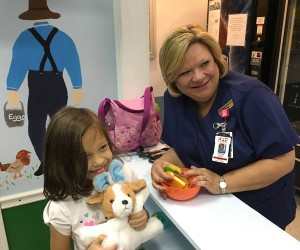
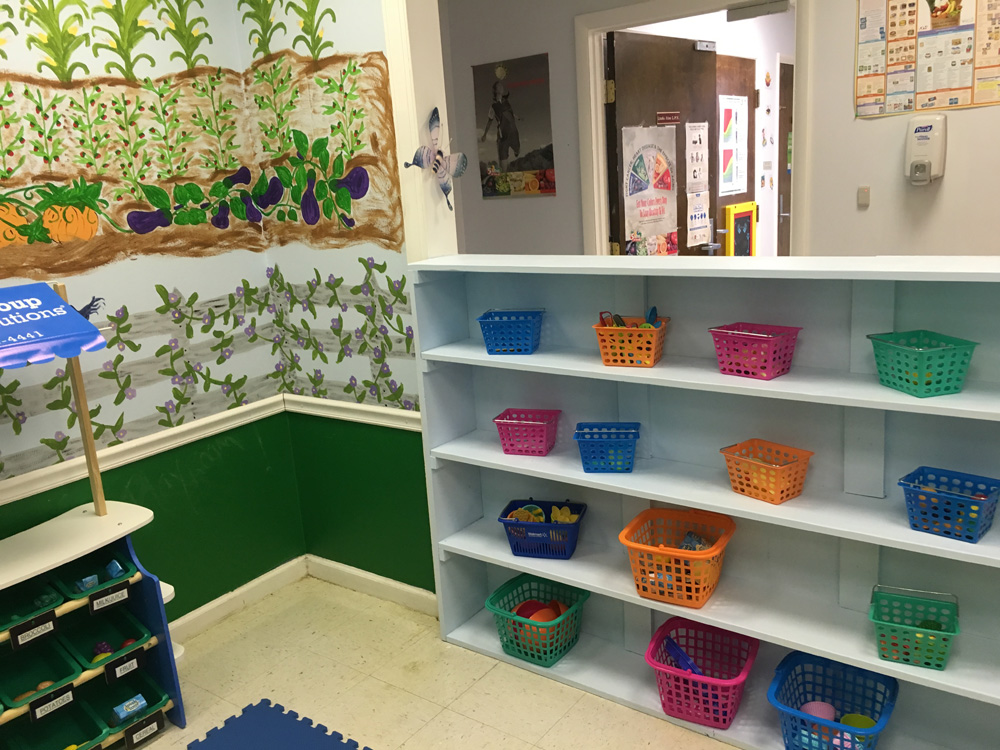
Effingham County Health Department employees recently opened an area in the health department waiting room that is specifically designed for children. “The Farmers Market” is geared toward promoting healthy foods such as fruits and vegetables while at the same time giving children a place to play until it’s time for their appointment.

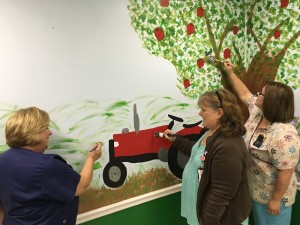
The area is stocked with a small vegetable stand along with plastic fruit and vegetables donated by Amerigroup. Both Amerigroup and Wellcare provided healthy snacks for the grand opening. Health department employees designed and painted colorful wall murals depicting garden and farming scenes. The idea came about after some health department employees attended a Women, Infants, and Children (WIC) conference in Atlanta which focused on the importance of nutrition and young children. WIC provides vouchers for healthy foods along with nutrition education for low-income pregnant, breastfeeding, and non-breastfeeding postpartum women, and to infants and children up to age five who are found to be at nutritional risk.

“We put our heads together and came up with the idea to create a special section of our waiting room that we hope will spark an interest in good nutrition not only for the children who play there but also for their parents,” said Effingham County Health Department Nurse Manager, Cindy Grovenstein, R.N. “Eating healthy is so important for our little ones. Exposing them to fruits, vegetables, and other nutritional foods at an early age will go a long way toward laying the groundwork for a healthy adulthood.”

Eff. 2 [JPG, 321.38 KB]

National Youth HIV/AIDS Awareness Event Promotes Knowing HIV Status

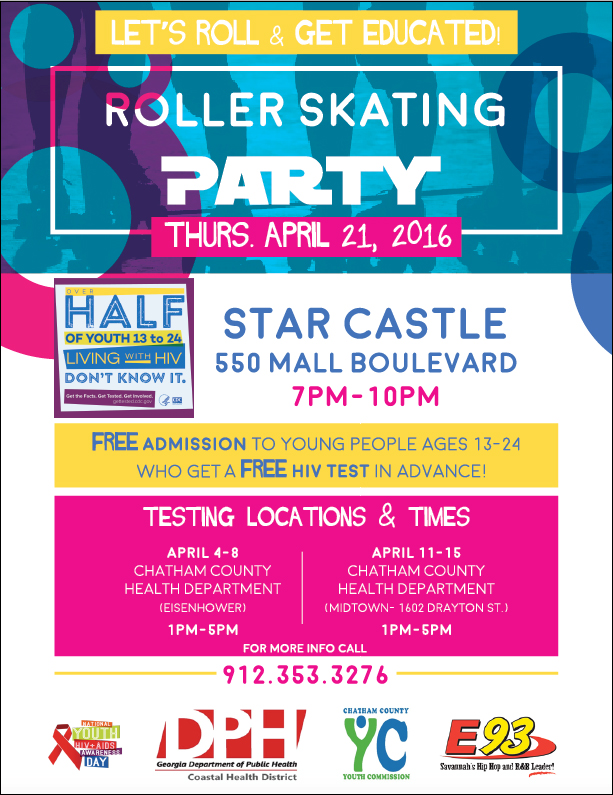
The Coastal Health District is observing National Youth HIV/AIDS Awareness Day with “Know Your Status” Skating Party. Young people ages 13-24 who get tested for HIV at either Chatham County Health Department location between April 4-8 (see below for dates and times) will receive a free admission ticket to a skate party at Star Castle on Thursday, April 21.

HIV testing is free and confidential. No appointment needed.

Testing Locations & Times
1 p.m. – 5 p.m., Monday through Friday, April 4-8
Chatham County Health Department, 1395 Eisenhower Drive, Savannah

1 p.m. – 5 p.m., Monday through Friday, April 11-15
Chatham County Health Department, 1602 Drayton Street, Savannah

Skate Party
7 p.m. – 10 p.m., Thursday, April 21
Star Castle, 550 Mall Boulevard, Savannah

Today’s young people are the first generation that has never known a world without HIV and AIDS. In the United States, almost 40 percent of new HIV infections are young people ages 13 to 29. Despite this harsh reality, young people and their allies are determined to end this pandemic.
It is more important than ever to recommit to the fight against HIV and AIDS. We must continue to invest in scientific advancements like a vaccine and a cure – without forgetting the importance of prevention strategies and ensuring equal access to information and healthcare for everyone.
Most importantly, we must invest in young people – bring them to the table not only as partners, but also as leaders that can truly turn the tide of the HIV and AIDS epidemic. Only by fully investing in young people – in their health, their education, and their leadership – can we reach an AIDS-free generation.

For more information, please call Diane DeVore at (912) 353-3276 or email  Diane.Devore@dph.ga.gov or visit http://www.advocatesforyouth.org/

The event is sponsored by the Coastal Health District Prevention Program, the Chatham County Youth Commission, and WEAS-FM 93.1.

pic2 copy [JPG, 402.02 KB]

World TB Day 2016 Theme: “End TB”

Often when people hear the word “tuberculosis,” they think of a disease that caused harm decades ago. But tuberculosis, commonly referred to as TB, is still a very real problem in the United States and in Georgia where 335 new cases of TB were reported in 2014. In fact, Georgia ranked fifth highest in the country for newly reported TB cases in 2014. March 24 is World TB and this year’s theme is “End TB.”

“TB is still a threat to public health,” said Coastal Health District Tuberculosis Coordinator, Janice Maxwell, R.N. “We had 18 active TB cases in the Coastal Health District in 2014 and while that may not sound like a lot, it just takes one person with active TB to spread it to others. One of the biggest steps we can take toward ending TB is to educate people about the disease in order to prevent its spread.”

TB is a disease that usually affects the lungs but can attack any part of the body. TB is caused by germs that are spread from person to person through the air when a person with active TB coughs, sneezes, speaks, or sings. Although a relatively small number of people exposed to the disease actually contract the infection, active TB disease can be life threatening if left untreated.

People with active TB disease may spread the TB germs to other persons who are usually individuals with whom they have been with in an enclosed space for a prolonged period of time, such as family members and co-workers. Symptoms of TB include a bad cough that lasts three weeks or longer, pain in the chest, coughing up blood or sputum, weakness or fatigue, weight loss, no appetite, chills, fever, and sweating at night.

Anyone who thinks he has been exposed to TB should contact a healthcare provider or local health department to get tested.

For more information on TB, go to cdc.gov/tb.

Breastfeeding Grant to Focus on African American and Underserved Populations

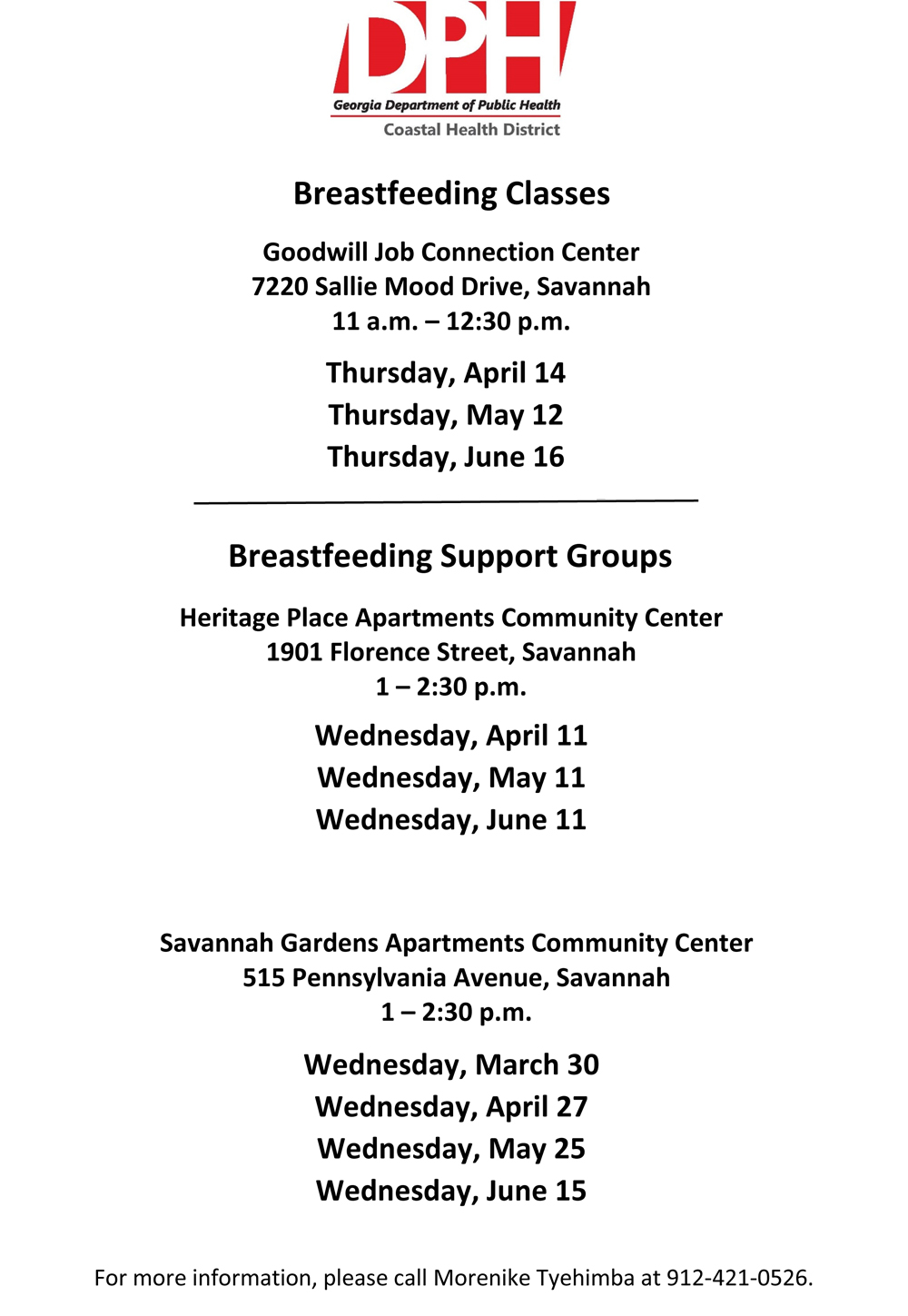
The Coastal Health District’s Breastfeeding Program has received a grant from the National Association of County and City Health Officials (NACCHO) to initiate programs aimed at reducing disparities in breastfeeding in African Americans and underserved communities in Chatham County. The programs will focus on peer and professional lactation support and will last through June 2016.

Funding from the grant will be used to conduct breastfeeding classes; host breastfeeding support groups; train 10 mothers to provide peer support for women who breastfeed; hold a continuing education session for Chatham County Health Department employees; and assist in training a lactation counselor in preparation for the International Board of Certified Lactation Consultant exam.

“This grant will help us promote breastfeeding among underserved populations in Chatham County on a number of different levels,” said Coastal Health District Breastfeeding Coordinator, Monica Lightfoot. “Breastfeeding is not only a great way for mothers and their babies to bond, but breastmilk also contains antibodies that can help protect infants from infections.”

The Coastal Health District provides breastfeeding support through the Women, Infants, and Children (WIC). WIC provides supplemental foods, health care referrals, and nutrition education for low-income pregnant, breastfeeding, and non-breastfeeding postpartum women, and to infants and children who are found to be at nutritional risk.

“Our goal is to educate women about the benefits of breastfeeding and help them become successful at breastfeeding,” said Lightfoot. “While that’s a big part of what we do every day, the NACCHO grant will allow us to expand our efforts even more.”

Microsoft Word - Breastfeeding Support Groups & Classes [JPG, 333.91 KB]

Parents: Made a Date to Vaccinate Your Preteen

Let’s face it – nobody likes getting shots – but a shot lasts a second; diseases last much longer. In an effort to protect every adult and child, the Georgia Department of Public Health established Georgia Preteen Vaccine Awareness Week, observed March 13-19, 2016, to serve as a reminder for parents to talk with their preteens and teens about getting immunized against vaccine-preventable diseases.

“Vaccines are the best way to protect our teens against some serious diseases,” said Glynn County Health Department Administrator, Karen Mikell, R.N. “Immunizations also help reduce school absences and decrease the spread of illness in our community.”

According to the Georgia Department of Public Health Rule (511-2-2), all students born on or after January 1, 2002, entering or transferring into seventh grade and any “new entrant” into eighth -12th grades in Georgia need proof of an adolescent pertussis (whooping cough) booster vaccination (called “Tdap”) AND an adolescent meningococcal vaccination.

“Our preteens are branching out. They go to overnight camps, attend parties and play sports – they are becoming increasingly social. While these are all fun parts of being a teenager, they can also increase their risk for contracting potentially life-threatening diseases,” said Sheila Lovett, director for the Georgia Department of Public Health Immunization Program. “Let’s protect our children by vaccinating them when they are most vulnerable to exposure to vaccine-preventable diseases.”

The CDC currently recommends the following vaccines for preteens and teens:

  • Tetanus, Diphtheria and Pertussis (Tdap)
  • Influenza (flu)
  • Human Papillomavirus (HPV) – three doses
  • Meningococcal Disease (MenACWY)

For more information on vaccines for all ages call the Glynn County Health Department at 912-264-3961 or click HERE.

Don’t Forget Vaccines for Your Preteen

Let’s face it – nobody likes getting shots – but a shot lasts a second; diseases last much longer.

In an effort to protect every adult and child, the Georgia Department of Public Health established Georgia Preteen Vaccine Awareness Week, observed March 13-19, 2016, to serve as a reminder for parents to talk with their preteens and teens about getting immunized against vaccine-preventable diseases.

“Our preteens are branching out. They go to overnight camps, attend parties and play sports – they are becoming increasingly social. While these are all fun parts of being a teenager, they can also increase their risk for contracting potentially life-threatening diseases,” said Sheila Lovett, director for the Georgia Department of Public Health Immunization Program. “Let’s protect our children by vaccinating them when they are most vulnerable to exposure to vaccine-preventable diseases.”

According to the Georgia  Department of Public Health Rule (511-2-2), all students born on or after January 1, 2002, entering or transferring into seventh grade and any “new entrant” into eighth -12th grades in Georgia need proof of an adolescent pertussis (whooping cough) booster vaccination (called “Tdap”) AND an adolescent meningococcal vaccination (MenACWY). This law affects all public and private schools including, but not limited to charter schools, community schools, juvenile court schools and other alternative school settings (excluding homeschool).

Vaccines are the best defense we have against serious, preventable and sometimes deadly contagious diseases. They help avoid expensive therapies and hospitalization needed to treat infectious diseases like influenza and meningitis. Immunizations also reduce absences both at school and after school activities and decrease the spread of illness at home, school and the community.

The CDC currently recommends the following vaccines for preteens and teens:

  • Tetanus, Diphtheria and Pertussis (Tdap)
  • Influenza (flu)
  • Human Papillomavirus (HPV) – three doses
  • Meningococcal Disease (MenACWY)

Georgia Preteen Vaccine Awareness Week is an opportunity to raise awareness through schools, health care providers and the media regarding preteen immunizations, particularly Georgia’s pertussis and meningococcal requirements for incoming seventh-grade students. Speak with your physician today to find out if your preteen is up-to-date and if not, make a date to vaccinate.

Get More Information Here
Georgia Preteen Vaccination Fact Sheet [PDF, 29.71 KB]


Diabetes: It’s a Big Deal

Diabetes is a serious disease. Nearly 30 million children and adults in the United States live with it. More than a quarter of them—8 million—don’t even know they have it and aren’t getting the medical care they need. It’s estimated that another 86 million people have prediabetes, which puts them at high risk for developing type 2 diabetes. People with prediabetes have blood glucose (sugar) higher than normal, but not high enough to be diagnosed with type 2 diabetes. In an effort to promote diabetes awareness, the Coastal Health District’s Chronic Disease Prevention Program will offer FREE blood sugar testing at health departments throughout the month of March.

Free Blood Sugar Testing Events

March 9 – Long County
Long County Health Department, Ludowici
584 N. Macon St., 8:30 a.m. – 4 p.m.

March 21 – Glynn County
Glynn County Health Department, Brunswick
2747 Fourth St.
10 a.m. –  2 p.m.

March 22 – Effingham County
Effingham County Health Department, Springfield
802 Hwy. 119 S.
9 a.m. – 2 p.m.

March 22 – Chatham County
Chatham County Health Department, Savannah
– 1395 Eisenhower Dr.
8:30 a.m. – 12 p.m.

-1602 Drayton St.
1:30 – 5 p.m.

March 23 – Camden County
Camden County Health Department, St. Marys
905 Dilworth St.
8:30 a.m.- 12 p.m.

March 23 – McIntosh County
McIntosh County Health Department, Townsend
1335 GA Hwy. 57
1:30 p.m. – 5 p.m.

March 24 – Bryan County
Bryan County Health Department
Pembroke
-430 Ledford St., 8:30 a.m. – 12 p.m. Bryan County Health Department

Richmond Hill
-66 Captain Matthew Freeman Dr., 1:30 – 5:30p.m.

March 25 – Liberty County
Liberty County Health Department, Hinesville
1113 E. Oglethorpe Hwy.
10 a.m. – 2 p.m.

According to the American Diabetes Association, common symptoms of diabetes include:

  • Urinating often
  • Feeling very thirsty
  • Feeling very hungry – even though you are eating
  • Extreme fatigue
  • Blurry vision Cuts/bruises that are slow to heal
  • Weight loss – even though you are eating more (type 1)
  • Tingling, pain, or numbness in the hands/feet (type 2)

For more information on diabetes symptoms, diagnosis, and treatment: American Diabetes Association.

End TB

Often when people hear the word “tuberculosis,” they think of a disease that caused harm decades ago. But tuberculosis, commonly referred to as TB, is still a very real problem in the United States and in Georgia where 335 new cases of TB were reported in 2014. In fact, Georgia ranked fifth highest in the country for newly reported TB cases in 2014.

In 1882 when Dr. Robert Koch discovered the bacteria that causes TB, one in seven people living in the United States and Europe died from the disease. Although we have come a long with advances in prevention and treatment, TB is still a public health threat.

TB is a disease that usually affects the lungs but can attack any part of the body. TB is caused by germs that are spread from person to person through the air when a person with active TB coughs, sneezes, speaks, or sings. A relatively small number of people exposed to the disease actually contract the infection.

People with active TB disease may spread the TB germs to other persons who are usually

individuals with whom they have been with in an enclosed space for a prolonged period of time, such as family members and co-workers. An open air encounter or casual contact with a person with active TB disease, such as passing them in a hallway, generally does not put you at risk for being infected with TB.

Not everyone with TB becomes sick. If someone has active TB disease it means that he/she is sick with TB germs that are active in the body and they usually have symptoms including weight loss, fever, chronic cough, and night sweats. If someone has latent TB infection it means that he/she has TB germs in their bodies but they are not sick because the germs are not active. These people do not have symptoms of TB disease, and they cannot spread the germs to others. However, they may develop TB disease in the future. They are often prescribed treatment to prevent them from developing TB disease.

Symptoms of TB include:
– A bad cough that lasts three weeks or longer
– Pain in the chest
– Coughing up blood or sputum
– Weakness or fatigue
– Weight loss
– No appetite
– Chills
– Fever
– Sweating at night

It is important that anyone who thinks he or she has been exposed to TB to contact a healthcare provider or local health department to get tested. There is treatment for TB disease but left untreated, TB can be very serious and even fatal. Each year, World TB Day is recognized on March 24 and the theme of World TB Day 2016 is “End TB.” That’s a lofty goal but one that can be accomplished through education and prevention.

Find out more about TB and how you can prevent it.
TB General Information English [PDF, 436.83 KB]

TB General Information Spanish [PDF, 154.45 KB]

TB Facts & Prevention English [PDF, 357.17 KB]

TB Facts & Prevention Spanish [PDF, 185.94 KB]


banner-image_728x90 [JPG, 78.14 KB]


Free Testing Event Scheduled for National Women and Girls HIV/AIDS Awareness Day

The Coastal Health District will observe National Women and Girls HIV/AIDS Awareness Day with “Test Together,” a free day of HIV testing that encourages women to come to the Chatham County Health Department on Eisenhower drive, with a friend, and get tested for HIV. The free testing day will take place from 8 a.m. to 4 p.m. on Thursday, March 10, at the health department located at 1395 Eisenhower Drive in Savannah.

National Women and Girls HIV/AIDS Awareness Day (NWGHAAD) is an annual observance that sheds light on the impact of HIV and AIDS on women and girls. Every year on March 10, and throughout the month of March, federal, national, and community organizations come together to show support for women and girls impacted by HIV and AIDS. This year marks the 11th observance of National Women and Girls HIV/AIDS Awareness Day.

Today, about one in four people living with HIV in the United States is female. Only about half of women living with HIV are getting care, and only four in 10 of them have the virus under control. Women face unique HIV risks and challenges that can prevent them from getting needed care and treatment. Addressing these issues remains critical to achieving an HIV- and AIDS-free generation.


The 2016 theme is “The Best Defense Is a Good Offense.” Whether you’re actively dating or are in a committed relationship, you can take these simple, effective steps to help prevent HIV infection for you and your partner:

  • Use condoms every time you have sex.
  • Get an HIV test, which is free and confidential.
  • Be monogamous.
  • Do not abuse alcohol or drugs.
  • Talk to your doctor about pre-exposure prophylaxis (PrEP) or post-exposure prophylaxis (PEP) if you think you’re at risk for HIV.

For more information, please call Diane DeVore at (912) 353-3276 or email Diane.Devore@dph.ga.gov or visit www.womenshealth.gov/NWGHAAD

P.R.I.D.E. Driver Education Course Offered for Parents and Teens in Chatham County

The Coastal Health District Adolescent Health and Youth Development program is partnering with the Parker’s Emergency & Trauma Center at Memorial Health and the Georgia Traffic Injury Prevention Institute (GTIPI) at the University of Georgia to offer Parents Reducing Injuries and Driver Error (P.R.I.D.E.) course. The free, two-hour driver education program is designed to help teens ages 14, 15, and 16 – along with their parents and guardians – to learn more about driving behaviors and laws. The next class will be held from 5:30 to 7:30 p.m. on Thursday, March 10, at the Savannah-Chatham Police Training Center located at 3401 Edwin Street in Savannah. Registration by a teen and at least one parent or guardian is required. To register, please call 912-644-5816.

“Teen crashes and fatalities are a public health issue,” said Coastal Health District Adolescent Health and Youth Development Coordinator, LeKara Simmons. “This course will help both teens and parents feel more prepared and more confident about the entire process.”

P.R.I.D.E. is funded by a grant from the Governor’s Office of Highway Safety and is focused on helping parent and guardians become more aware of their own driving behaviors; teach parents and guardians how to help teens become safe drivers; help parents, guardians, and teens learn what they need to do during the supervised practice driving time; and alter attitudes and driving behaviors for novice teen drivers.

“We are excited to partner with other community organizations to promote injury prevention and awareness,” said Memorial Health Trauma Outreach and Education Coordinator, Amanda Ramirez.