The Coastal Health District of Georgia serves the counties of Bryan, Camden, Chatham, Effingham, Glynn, Liberty, Long & McIntosh

Posts by District_PIO


Food Safety Education

[JPG, 83.52 KB]September is Food Safety Education Month and a good time to remember that the best way to prevent getting sick from food is to prepare and handle food correctly.

There are more than 250 foodborne diseases. Foodborne illness can be particularly dangerous for older adults, young children, pregnant women, and those with weakened immune systems.

You can be a Food Safety Superhero by always following these Four Steps – Clean, Separate, Cook, and Chill –  to protect you and your family from food poisoning.

Check out these great resources on food safety:

CDC Food Safety

FightBAC! Partnership for Food Safety Education

USDA FoodKeeper App

Beach Advisory Updated for Jekyll & St. Simons

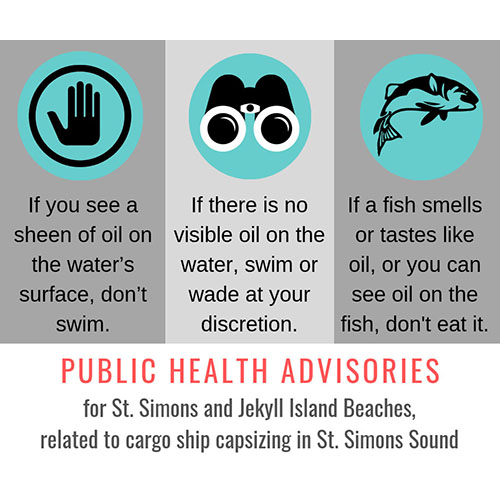
If you’re planning to swim or wade at the beach on St. Simons or Jekyll Islands, the Coastal Health District has some precautionary advice: check the water for any signs of oil, and use your best judgement before swimming.

The Coastal Health District issued a general swimming advisory Sunday, asking visitors to stay out of the water after a cargo ship capsized in the St. Simons Sound. Today, the swimming advisory has been modified, and swimmers are asked to be aware and use discretion. Although oil has not been seen on the ocean-facing beaches of St. Simons or Jekyll Islands, beach visitors are urged to visually check the water before deciding to swim. A similar advisory also applies to fish consumption.

  • If you see a sheen of oil on the water’s surface, don’t swim. Contact with oil could cause skin and eye irritation.
  • If there is no visible oil on the water, then swim or wade at your discretion. Stay alert for changing conditions.
  • If a fish smells or tastes like oil, or you can see oil on the fish, do not eat it.

Officials at the incident command center are working to plug the ship’s vent stacks to prevent any additional release of oil, and absorbent booms are soaking up most of the oil immediately around the vessel. Booms have also been placed at the entrance of nearby creeks to protect local oyster beds. Agencies will continue to monitor the beaches and marshes for signs of oil contamination.

Some of the agencies involved in monitoring any ongoing environmental impacts are the Coastal Resources Division of the Department of Natural Resources, the National Oceanic and Atmospheric Administration, the U.S. Coast Guard, and private contractors. If you see oil on the beach, contact the U.S. Coast Guard National Response Center at 1-800-424-8802 to make a report.

Long Co. Health Dept. & Co. Extension Service Offer Free Cooking Class

The Long County Health Department and the Long County University of Georgia Extension Service is partnering to offer a free cooking course to residents who prepare meals for children (moms/dads; grandparents; teens; and foster parents). The Expanded Food and Nutrition Education Program (EFNEP) cooking classes will take place at the health department from 10:30 a.m. to 12 p.m. on September 26 and October 3, 10, and 17.

EFNEP teaches recipes, cooking on a budget, and food safety tips. A cooking utensil or cooking-related item is given to attendees each week at the end of the class.

Children may be brought to class. For more information, please call the Long County Health Department at 912-545-2107 or the Long County Extension office at 912-545-9549.

Protect Your Family’s Future by Getting Vaccinated this August

August is National Immunization Awareness Month which serves as a reminder that people of all ages require timely vaccinations to protect their health.

Vaccines protect families, teens, and children by preventing disease. Not only do vaccinations help avoid expensive therapies and hospitalization needed to treat infectious diseases like influenza and pneumococcal disease, but they also reduce absences both at school and at work and decrease the spread of illness in the home, workplace and community. Adults should check with their healthcare provider for their current immunization recommendations, as well as parents to check for their children.

[JPG, 11.47 MB]Safe and effective vaccines are available to protect adults and children alike against potentially life-threatening diseases such as tetanus, diphtheria, pertussis, meningococcal disease, hepatitis A, hepatitis B, shingles, measles, mumps, rubella, and varicella (chickenpox).

School Vaccination Requirements

Children born on or after January 1, 2002 who are attending seventh grade and new entrants into Georgia schools in grades 8 through 12 must have received one dose of Tdap vaccine and one dose of meningococcal vaccine. (“New entrant” means any child entering any school in Georgia for the first time or entering after having been absent from a Georgia school for more than 12 months or one school year). The HPV vaccine is also recommended for both girls and boys ages 11–12 to protect against cancers and other diseases caused by human papillomavirus.

Before starting the 2020-2021 school year, all students entering or transferring into 11th grade will need proof of a meningococcal booster shot (MCV4), unless their first dose was received on or after their 16th birthday. Meningococcal disease is a serious bacterial illness that affects the brain and the spinal cord. Meningitis can cause shock, coma and death within hours of the first symptoms. To help protect your children and others from meningitis, Georgia law requires students be vaccinated against this disease, unless the child has an exemption.

Some schools, colleges, and universities have policies requiring vaccination against meningococcal disease as a condition of enrollment. Students aged 21 years or younger should have documentation of receipt of a dose of meningococcal conjugate vaccine not more than five years before enrollment. If the primary dose was administered before the 16th birthday, a booster dose should be administered before enrollment in college

Safe and effective vaccines are available to protect adults and children alike against potentially life-threatening diseases such as tetanus, diphtheria, pertussis, meningococcal disease, hepatitis A, hepatitis B, shingles, measles, mumps, rubella and varicella (chickenpox).

Every adult in Georgia (19 years of age and older) should follow the recommended immunization schedule by age and medical condition. Vaccinations protect our families and communities; especially infants and those individuals who are unable to be immunized or who have weakened immune systems. This link is to the recommended adult immunization schedule:

http://www.cdc.gov/vaccines/schedules/downloads/adult/adult-schedule-easy-read.pdf [PDF]

World Breastfeeding Week Event Scheduled for August 3

The Coastal Health District Women, Infants, and Children (WIC) nutrition program will host a World Breastfeeding Week celebration from 9:30 to 11:30 a.m. on Saturday, August 3, at the Forsyth Park Farmers Market in Savannah. The event is free and family-friendly and will include a walk for breastfeeding awareness, photo booth, the 10th annual Big Latch On, and information on the benefits of breastfeeding.

Free t-shirts (while supplies last) will be given to all participants. To receive a free t-shirt, you must register.

World Breastfeeding Week is celebrated during the first week in August every year in more than 170 countries to encourage breastfeeding and improve the health of babies around the world.  This year’s theme is “Empower Parents, Enable Breastfeeding.” According to the World Alliance for Breastfeeding Action (WABA) , the theme was chosen to be inclusive of all types of parents in today’s world. Focusing on supporting both parents to be empowered is vital in order to realize their breastfeeding goals.

The Coastal Health District is committed to helping mothers breastfeed their babies because breastfeeding is so important for good health. Breast milk is easy to digest, with just the right amount of fat, sugar, water, and protein for a baby’s growth and development. Breastfed babies usually get sick less often, because breast milk contains antibodies that can protect infants from bacterial and viral infections.

For more information on lactation services offered through the Coastal Health District, visit coastalhealthdistrict.org/breastfeeding


Long & McIntosh Co. Health Departments & County Extension Service Offer Free Cooking Class

The Long and McIntosh County Health Departments and the University of Georgia Extension Service is partnering to offer a free cooking course to residents who prepare meals for children (i.e. moms/dads; grandparents; teens; and foster parents). The Expanded Food and Nutrition Education Program (EFNEP) cooking classes will take place on
Thursdays through September 5:
Long County Health Department: 2-3:30 p.m.
McIntosh County Health Department: 5:30-6:30

EFNEP teaches recipes, cooking on a budget, and food safety tips. A cooking utensil or cooking-related item is given to attendees each week at the end of the class. Residents who attend at least six of the classes will receive a certificate of completion and a cookbook.

The program will help families learn how to stretch their food budgets and make simple, healthier meals.

For more information, please call the Long County Health Department at 912-545-2107 or the Long County Extension office at 912-545-9549 or the McIntosh County Health Department at 912-832-5473 or the McIntosh County Extension office at 912-437-6651.

Free Mammograms (Chatham County)

The Chatham County Health Department’s Breast and Cervical Cancer Program (BCCP) is partnering with the St. Joseph’s/Candler Mobile Mammography Program to offer free mammograms from 8:30 a.m. to 3 p.m. on Tuesday, July 30, at the Chatham County Health Department located at 1602 Drayton Street in Savannah.

Women who meet certain annual income guidelines and are 40-64 years of age without insurance will be eligible to receive a screening mammogram at no cost.

Appointments are preferred but walk-ins will be accepted. To make an appointment, please call 356-2946.

Glynn County Health Department Blood Drive July 9

The Glynn County Health Department will hold a blood drive from 1 p.m. to 4:30 p.m. on Tuesday, July 9, at the health department located at 2747 Fourth Street. All donors will receive a OneBlood cooler, wellness check-up (including cholesterol screening), and buy one/get one admission coupon to the Jacksonville Zoo and Gardens.

Get in and out quickly by making an appointment ahead of time. To make an appointment online, just go to www.oneblooddonor.org and use sponsor code #34120.


Hepatitis A: What You Need to Know

Several states, including Georgia, are experiencing outbreaks of Hepatitis A, a very contagious liver infection caused by the hepatitis virus (HAV) that can cause mild to severe illness. Hepatitis A usually spreads when a person unknowingly ingests the virus from objects, food, or drinks that are contaminated by small, undetected amounts of stool from an infected person. 

Symptoms of hepatitis A include:

  • Fever
  • Fatigue
  • Loss of appetite
  • Nausea
  • Vomiting
  • Diarrhea
  • Abdominal pain
  • Clay-colored stools
  • Dark urine
  • Jaundice (yellowing of the skin or eyes)

Symptoms usually start appearing four weeks after exposure but can occur as early as two and as late as seven weeks after exposure; however people can spread hepatitis A even if they don’t look or feel sick.

Careful hand washing, including under the fingernails, with soap and water, is always an important tool to prevent the spread of this and many other diseases. 

Hepatitis A is a vaccine-preventable disease. The best protection against HAV infections and outbreaks is through widespread vaccination, particularly among  populations most at risk:

  • All children at age 1 year
  • Travelers to countries where hepatitis A is common
  • Family and caregivers of adoptees from countries where hepatitis A is common
  • Men who have sexual encounters with other men
  • People who use or inject drugs
  • People with chronic or long-term liver disease, including hepatitis B or hepatitis C
  • People with clotting factor disorders
  • People with direct contact with others who have hepatitis A
  • People experiencing homelessness

Get more information on Hepatitis A.


[JPG, 1.73 MB]

[JPG, 1.33 MB]

National HIV Testing Day Events

The Coastal Health District HIV Prevention Program will hold free HIV testing events on June 27 in observance of National HIV Testing Day. Testing will take place from 10 a.m. to 7 p.m. at the following locations:

Walgreens, 2109 E. Victory Drive, Savannah
Walgreens, 11509 Abercorn St., Savannah
Walgreens, 4210 Augusta Rd., Garden City
Walgreens, 4575 Altama Avenue, Brunswick

Testing is confidential and results will be available in one minute. A follow-up visit will be scheduled for anyone who test positive and counseling will be made available to those individuals. In addition to free HI testing, there will be staff available to discuss HIV prevention options such as PrEP, the daily pill t prevent HIV, and treatment as prevention. Gift cards and door prizes will also be given out at the testing events.

HIV testing is recommended as part of routine health care, yet many Americans are not being tested as often as advised. Whether living with HIV or not, there are more options than ever to stay healthy. The first step is knowing your status and getting tested for HIV.  National HIV Testing Day is an opportunity to normalize HIV testing and encourage people to   make it part of routine health care.

Our testing events are part of a nationwide activation in 245 cities with Walgreens, Greater Than AIDS, health departments, and local organizations to normalize HIV testing and encourage people to make it part of routine health care.

The U.S. Center for Disease Control and Prevention (CDC) estimates around 1.2 million people in the United States are living with HIV, and one in eight people don’t know they have it. National HIV Testing Week is an opportunity to raise awareness, encourage people to get the facts, tested, get involved, and get linked to care and treatment services.

As a reminder, HIV testing is free at all health departments in Bryan, Camden, Chatham, Effingham, Glynn, Liberty, Long, and McIntosh counties and available Monday through Friday during regular health department hours of operation.

Anyone with questions about testing can call Diane DeVore at (912) 644-5828 or e-mail Diane.Devore@dph.ga.gov.