The Coastal Health District of Georgia serves the counties of Bryan, Camden, Chatham, Effingham, Glynn, Liberty, Long & McIntosh

Effingham News


Georgia WIC Farmers Market Nutrition Program

The Georgia Women, Infants and Children (WIC) Farmers Market Nutrition Program is a federally-funded program that provides WIC recipients with fresh, locally grown, unprocessed fruits, vegetables, and edible herbs

WIC farmers markets are held each year during the farmers market season. If you’re a WIC participant, visit one of these farmers market events for NO COST fresh fruits and vegetables. Arrive early – produce is limited. The events are from 8:30 a.m. – 2 p.m. but may close early once the produce is gone.

For more information on the Georgia WIC Farmers Market Nutrition Program, please visit dph.ga.gov/farmers-market

DateCountyLocation NameAddress
June 10EffinghamParks & Recreation Complex22 Josh Reddick Way, Springfield
June 11ChathamSavannah Technical College5717 White Bluff Rd., Savannah
June 12ChathamSavannah Technical College5717 White Bluff Rd., Savannah
June 13LibertyJames Brown Park800 Tupelo Trail, Hinesville
June 14LibertyJames Brown Park800 Tupelo Trail, Hinesville
July 8CamdenCamden Co. Health Dept.905 Dilworth St., St. Marys
July 9GlynnGlynn Co. Health Dept.2747 Fourth St., Brunswick
July 10GlynnGlynn Co. Health Dept.2747 Fourth St., Brunswick
July 11McIntoshMcIntosh Co. Health Dept.1335 GA Hwy 57, Townsend
July 12BryanWetlands Education Center500 Cedar St., Richmond Hill
July 15LibertyJames Brown Park800 Tupelo Trail, Hinesville
July 16LibertyJames Brown Park800 Tupelo Trail, Hinesville
July 17LongLong Co. Health Dept.584 N. Macon St., Ludowici
July 18ChathamSavannah Technical College5717 White Bluff Rd., Savannah
July 19ChathamSavannah Technical College5717 White Bluff Rd., Savannah

Click here [PDF, 485.47 KB] for a downloadable flyer with these dates and locations.

Coastal Health District Now Offering Vaccines at No Cost for Uninsured and Underinsured Adults Through November 30

–> Haga clic aquí para obtener información en español

There is good news for adults without insurance coverage for vaccinations – the health departments of the Coastal Health District are now offering adult vaccines at no cost for individuals without adequate insurance coverage. This offer is only available on in-stock vaccines while supplies last.

Several vaccinations are recommended at different stages for adults, like immunizations against shingles, tetanus, whooping cough, measles and more. Health insurance covers most routine vaccinations, but adults without insurance must sometimes pay a fee.

“Vaccination saves lives, and we believe everyone in our community who wants to be vaccinated should have access to vaccines,” said Paige Lightsey, Immunization Director for the Coastal Health District. “Thanks to a federal grant, we can now offer no-cost vaccines for adults in every county of our health district.”

The no-cost vaccination program runs from May 1st through November 30th on in-stock vaccines while supplies last. To see if you qualify for a no-cost vaccine or to schedule an appointment for vaccination, please call your local county health department.

Each year in the US, as many as 50,000 adults die from vaccine-preventable diseases or their complications. Life-saving vaccines for adults include:

  • Chickenpox
  • Hepatitis A
  • Hepatitis B
  • Human Papillomavirus (HPV)
  • MMR
  • Meningococcal
  • Pneumococcal
  • Shingles
  • Tetanus
  • Pertussis (whooping cough)
  • Diphtheria

If you’re not sure which adult immunizations you may need, check with your health department, or visit our immunization webpage for information about recommended vaccines for adults

Free STI Screening Events in April

Desplácese hacia abajo para obtener información en español.

Health departments in the Coastal Health District will offer free, confidential STI screening events in April as part of STI Awareness Month. About 1 in 5 people in the US have a sexually transmitted infection. Left untreated, STIs can lead to serious health issues, affect fertility, and be passed along to partners. Many infections don’t cause any symptoms, so the only way to know for sure is to get tested.

The good news is that all STIs can be treated, and most can be cured. Testing is the first step. STI testing is available at all health departments in the Coastal Health District throughout the year, but during the month of April, special screening events will offer the testing for free.

The sooner you get tested, the sooner you can take action to protect your health and the health of your partner. For more information about STI prevention, testing, and treatment, visit our STI Services page.

Free STI Testing Events in the Coastal Health District

Bryan County Health Department

  • April 15, 2024
  • 8 a.m. – 4:30 p.m.
  • Appointments and Walk-ins
  • 430 Ledford St. in Pembroke
    & 66 Capt. Matthew Freeman Dr. in Richmond Hill

Camden County Health Department

  • April 17, 2024
  • 8-11 a.m. & 1-3 p.m.
  • Appointments and Walk-ins
  • 905 Dilworth Street in St. Marys

Chatham County Health Department

  • April 15-19, 2024
  • Appointments only. Call 912-356-2441 to schedule.
  • 1395 Eisenhower Dr. in Savannah

Effingham County Health Department

  • April 18, 2024
  • 8:30 a.m. – 6 p.m.
  • Appointments and Walk-ins
  • 802 Highway 119 South in Springfield

Glynn County Health Department

  • April 18, 2024
  • 8:30 a.m. – 6 p.m.
  • Appointments and Walk-ins
  • 2747 Fourth St. in Brunswick

Liberty County Health Department

  • April 18, 2024
  • 8 a.m. – 5 p.m.
  • Walk-ins
  • 113 East Oglethorpe Highway in Hinesville

Long County Health Department

  • April 24, 2024
  • 8 – 11:30 a.m. & 1 – 4 p.m.
  • Appointments only. Call 912-545-2107 to schedule.
  • 584 North Macon St. in Ludowici

McIntosh County Health Department

  • April 18, 2024
  • 8:30 a.m. – 6 p.m.
  • Appointments and Walk-ins
  • 1335 Georgia Highway 57 in Townsend

Eventos gratuitos de detección de ITS en abril

Los departamentos de salud del Coastal Health District ofrecerán eventos gratuitos y confidenciales de detección de ITS en abril como parte del Mes de Concientización sobre las ITS. Aproximadamente 1 de cada 5 personas en los EE. UU. tiene una infección de transmisión sexual. Si no se tratan, las ITS pueden provocar problemas de salud graves, afectar la fertilidad y transmitirse a la pareja. Muchas infecciones no causan ningún síntoma, por lo que la única forma de saberlo con seguridad es haciéndonos una prueba.

La buena noticia es que todas las ITS pueden tratarse y la mayoría curarse. La prueba es el primer paso. Las pruebas de ITS están disponibles en todos los departamentos de salud del Coastal Health Dustrict durante todo el año, pero durante el mes de abril, eventos especiales ofrecerán las pruebas de forma gratuita.

Bryan County Health Department

  • 15 de abril
  • 8 a.m. – 4:30 p.m.
  • No es necesaria cita
  • 430 Ledford St. en Pembroke
    & 66 Capt. Matthew Freeman Dr. en Richmond Hill

Camden County Health Department

  • 17 de abril
  • 8-11 a.m. & 1-3 p.m.
  • No es necesaria cita
  • 905 Dilworth Street en St. Marys

Chatham County Health Department

  • 15-19 de abril
  • Solo con cita. Llame al 912-356-2441 para programar.
  • 1395 Eisenhower Dr. en Savannah

Effingham County Health Department

  • 18 de abril
  • 8:30 a.m. – 6 p.m.
  • No es necesaria cita
  • 802 Highway 119 South en Springfield

Glynn County Health Department

  • 18 de abril
  • 8:30 a.m. – 6 p.m.
  • No es necesaria cita
  • 2747 Fourth St. en Brunswick

Liberty County Health Department

  • 18 de abril
  • 8 a.m. – 5 p.m.
  • No es necesaria cita
  • 113 East Oglethorpe Highway en Hinesville

Long County Health Department

  • 24 de abril
  • 8 – 11:30 a.m. & 1 – 4 p.m.
  • Solo con cita. Llame al 912-545-2107 para programar.
  • 584 North Macon St. en Ludowici

McIntosh County Health Department

  • 18 de abril
  • 8:30 a.m. – 6 p.m.
  • No es necesaria cita
  • 1335 Georgia Highway 57 en Townsend

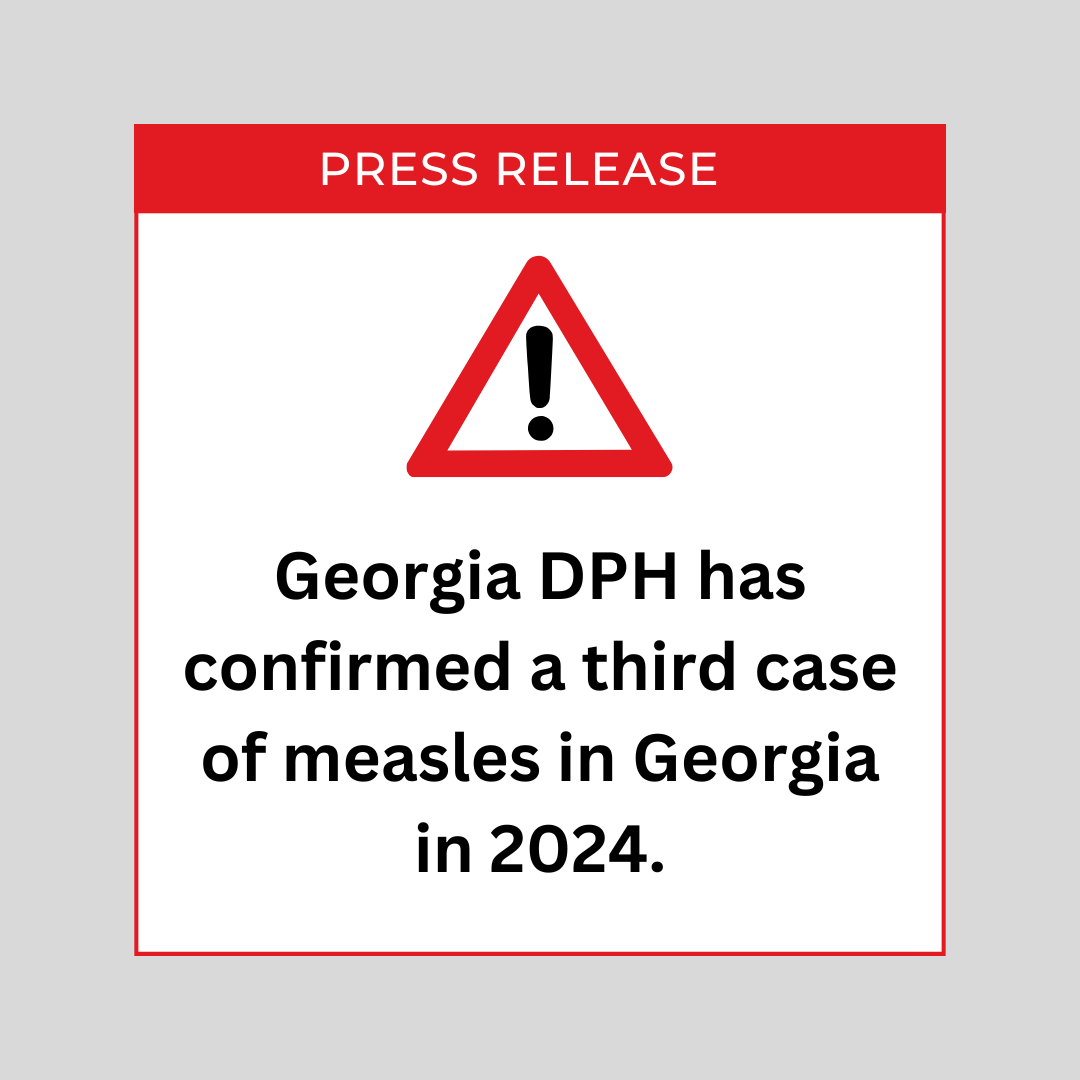
DPH Confirms Third Measles Case in 2024

The following press release was issued by the Georgia Department of Public Health.

ATLANTA – The Georgia Department of Public Health (DPH) has confirmed a case of measles in an unvaccinated individual traveling with an international group of students. The individual, who does not live in the United States, is isolated and receiving treatment at a local hospital. DPH is working with the Centers for Disease Control and Prevention (CDC) to identify and contact anyone who may have been exposed to the individual and to prevent further spread of measles.

Measles is very contagious and spreads through the air when an infected person coughs or sneezes. The measles virus can stay in the air for up to 2 hours after an infected person is there so you can become infected by simply being in a room where an infected person once was. 

Measles symptoms appear 7 to 14 days after contact with the virus and typically include high fever, cough, runny nose, and watery eyes. Then a rash of tiny, red spots breaks out that usually starts at the head and spreads to the rest of the body.

Measles can be prevented with the MMR (measles, mumps, rubella) vaccine. The vaccine is safe and effective. The Centers for Disease Control and Prevention (CDC) recommends children receive their first dose of MMR vaccine between 12-15 months of age and a second dose between 4-6 years old. More than 95% of people who receive a single dose of MMR will develop immunity to all three viruses. A second dose boosts immunity, typically enhancing protection to 98%.

People with symptoms of measles should contact their healthcare provider immediately. DO NOT go to the doctor’s office, the hospital, or a public health clinic without FIRST calling to let them know about your symptoms. Healthcare providers who suspect measles in a patient should notify public health immediately.

For more information about measles, log on to https://dph.georgia.gov/epidemiology/acute-disease-epidemiology/vaccine-preventable-diseases/measles or https://www.cdc.gov/measles/index.html.

Feral Cat Tests Positive for Rabies in Effingham County

The Effingham County Health Department is alerting residents that a feral cat has tested positive for rabies in Bloomingdale. This is an important reminder to avoid contact with wild animals and keep your pets up to date on rabies vaccinations.

On March 24, 2024, in the area of Bloomingdale near the intersection of Highways 80 and 17, a local resident reported an attack by a feral cat. Effingham County Humane Enforcement deputies captured the cat, and the health department’s Environmental Health office assisted with rabies testing.

The positive rabies test was reported on March 28. The Effingham County Health Department has notified all known individuals involved in the incident and is providing guidance about post-exposure rabies treatment.

Several species of wild animals in coastal Georgia – including raccoons, foxes, and bats – can carry rabies. Feral cats and dogs can carry rabies as well. Rabies is a deadly virus that is primarily spread by infected animals.

The Effingham County Health Department Environmental Health office has these tips to protect you and your family from rabies:

  • Avoid contact with animals you don’t know.
  • Make sure your pets receive the proper immunizations. Dogs and cats should get rabies vaccines after 12 weeks of age, followed by a booster shot within one year and vaccination every 1-3 years depending on veterinary recommendation and vaccine used.
  • Do not handle, feed, or unintentionally attract wild animals with open garbage cans or by leaving pet food out at night.
  • Never adopt wild animals or bring them into your home. Do not try to nurse sick animals to health. Call animal control or a properly licensed animal rescue agency for assistance.
  • Teach children to never handle unfamiliar animals, wild or domestic, even if they appear friendly. “Love your own, leave other animals alone” is a good principle for children to learn.

Symptoms of rabies in animals include a change in behavior, biting, aggression, showing no fear of natural enemies (such as humans), foaming at the mouth, and paralysis. If an animal ever bites or scratches you, seek medical care immediately and contact the Effingham County Humane Enforcement Department of the Sheriff’s Office at 912-754-3449 and the Effingham County Health Department’s Environmental Health office at 912-754-6850.

Increase in Measles Cases and Outbreaks in the U.S. and Globally

From the Georgia Department of Public Health

The Georgia Department of Public Health (DPH) is urging parents to make sure their children are up to date with their measles vaccinations. Measles vaccination is important for all children to prevent measles infection and reduce the risk of community transmission, but it is especially important for families with children planning to travel outside of the United States.

Among 58 measles cases reported in the U.S. so far in 2024, 54 (93%) were linked to international travel. Most cases reported this year have been among children over the age of 12 months who had not received MMR vaccine. In Georgia, there have been two reported cases of measles in 2024. The individuals were unvaccinated, from the same family, and had traveled outside of the country.

Measles is very contagious and spreads through the air when an infected person coughs or sneezes. The measles virus can stay in the air for up to 2 hours after an infected person is there so you can become infected by simply being in a room where an infected person once was. 

Measles can be prevented with the MMR vaccine which is safe and highly effective. Two doses of MMR vaccine are 97% effective against measles, one dose is 93% effective. The Centers for Disease Control and Prevention (CDC) recommends children receive their first dose of MMR vaccine between 12-15 months of age and a second dose between 4-6 years old. At least two weeks before traveling internationally, infants aged 6 to 11 months should have one dose of MMR vaccine and children aged 12 months and older should have two doses of MMR vaccine. Parents should consult with their child’s healthcare provider to ensure they are up to date with their MMR vaccines and any additional vaccines that may be needed.

Measles symptoms appear 7 to 14 days (sometimes up to 21 days) after contact with the virus. Symptoms include high fever, cough, runny nose, and watery eyes, followed by a rash of tiny, red spots that starts at the head and spreads to the rest of the body. Individuals infected with measles are contagious from 4 days before the rash starts through 4 days afterward. Measles can cause serious complications, especially for babies and young children.

Individuals with symptoms of measles should contact their healthcare provider immediately. DO NOT go to the doctor’s office, the hospital, or a public health clinic without FIRST calling to let them know about your symptoms. Healthcare providers who suspect measles in patients should notify public health immediately.

For more information about measles, log on to https://dph.georgia.gov/epidemiology/acute-disease-epidemiology/vaccine-preventable-diseases/measles or https://www.cdc.gov/measles/index.html. A list of countries with confirmed measles outbreaks can be found on the CDC website at https://wwwnc.cdc.gov/travel/notices/level1/measles-globe.

Plan Ahead for a Healthy Trip with Travel Vaccines from the Coastal Health District

If your summer travel plans include an international trip, now is the time to book an appointment for required immunizations and recommended prescriptions.  The Coastal Health District has two travel health clinics to assist you in Savannah and Brunswick. Planning ahead is essential as some countries require specific vaccines for entry, and most vaccines must be given about 15 to 30 days in advance for full protection. Some prescription treatments, like those to prevent malaria, must also begin before you travel.

“Nothing ruins a great vacation faster than getting sick,” said Dr. Bonzo Reddick, health director of the Coastal Health District. “Our travel health specialists can help you get the required and recommended vaccinations and medications for your destination on time, but only if you call us early. You can’t wait until the last minute to get your travel shots or prescriptions.”

Travel appointments can fill quickly, so travelers are advised to schedule an appointment as soon as they know their dates of travel, and at least one month before the trip.

Travel health services are offered by appointment only in the following clinic locations in the Coastal Health District:

  • Chatham County Health Department: 1395 Eisenhower Dr. in Savannah. Schedule an appointment by calling 912-353-3182 or send an email to cchd.travelvax@dph.ga.gov. Please include your travel destination, departure date, number of persons, and contact information, including a telephone number in your correspondence.
  • Glynn County Health Department: 2747 Fourth St. in Brunswick. Schedule an appointment by calling 912-264-3961 extension 6004.

In addition to destination-specific vaccines and medications, it’s important to be current on routine vaccines as well. Routine vaccinations protect you from infectious diseases such as measles that can spread quickly in groups of unvaccinated people. Many vaccine-preventable illnesses are not common in the United States but are still common in other countries.

“I also put together a travel health kit before every trip,” said Dr. Reddick. “Make sure you pack enough of your prescriptions and over-the-counter medicines to last your entire trip, plus extra in case of travel delays.” Depending on your destination you may also want to pack a mask, insect repellent, sunscreen, alcohol-based hand sanitizer, water disinfection tablets, and your health insurance card.

For more information, visit our travel health page.

DPH Confirms Measles Case in Metro Atlanta

The following press release was issued by the Georgia Department of Public Health:

The Georgia Department of Public Health (DPH) has confirmed a case of measles in an unvaccinated resident of the metro Atlanta area. The individual was exposed to measles while traveling out of the country. DPH is working to identify anyone who may have had contact with the individual while they were infectious.

Measles is very contagious and spreads through the air when an infected person coughs or sneezes. Measles virus can stay in the air or on surfaces for up to two hours after an infected person has left the room.

Measles symptoms appear 7 to 14 days after contact with the virus and typically include high fever, cough, runny nose, and watery eyes. Then a rash of tiny, red spots breaks out. It starts at the head and spreads to the rest of the body.

Measles can be prevented with the MMR (measles, mumps, rubella) vaccine. The vaccine is safe and effective. The Centers for Disease Control and Prevention (CDC) recommends children receive their first dose of MMR vaccine between 12-15 months of age and a second dose between 4-6 years old. More than 95% of the people who receive a single dose of MMR will develop immunity to all three viruses. A second dose boosts immunity, typically enhancing protection to 98%.

The last reported case of measles in Georgia was in 2020.

People with symptoms of measles should contact their health care provider immediately. DO NOT go to the doctor’s office, the hospital, or a public health clinic without FIRST calling to let them know about your symptoms. Health care providers who suspect measles in a patient should notify public health immediately.

For more information about measles, log on to https://dph.georgia.gov/epidemiology/acute-disease-epidemiology/vaccine-preventable-diseases/measles or https://www.cdc.gov/measles/index.html.

Widespread Flu Activity in Georgia

The following press release was distributed by the Georgia Department of Public Health.

If you have not gotten a flu shot yet, do not wait any longer. Flu activity is widespread throughout Georgia, and the current flu report lists flu activity at the highest level.

“It is not too late to get a flu shot. Every individual over the age of six months should get a flu vaccine – not just for their own protection, but to protect others around them who may be more vulnerable to the flu and its complications,” says Kathleen E. Toomey, M.D., M.P.H., DPH commissioner. “Even if the vaccine doesn’t completely prevent illness from flu, it can help reduce the severity and risk of serious complications and keep people out of the hospital.”

Flu symptoms and their intensity can vary from person to person, and can include fever, cough, sore throat, runny or stuffy nose, body aches, headache, chills, and fatigue. Some people are at higher risk of developing serious flu-related complications if they get sick. This includes people aged 65 years and older, people of any age with certain chronic medical conditions such as asthma, diabetes, or heart disease, pregnant women, and children younger than 5 years old, but especially those younger than 2 years old.

Flu vaccine is widely available at public health departments, doctors’ offices, grocery stores, neighborhood clinics and pharmacies. To find a location near you, click on https://www.vaccines.gov/find-vaccines/.

In some cases, healthcare providers may recommend the use of antiviral drugs that fight against the flu in your body. Antiviral drugs are prescription medicines and are most effective when taken within 48 hours of symptoms appearing.

There are other tried and true measures you can take to help prevent the spread of flu:

  • Frequent and thorough handwashing with soap and warm water.
  • Use an alcohol-based gel if you don’t have access to soap and water.
  • Cough or sneeze into the crook of your elbow or arm.
  • Avoid touching your face as flu germs can get into the body through mucus membranes of the nose, mouth, and eyes.
  • If you are sick, stay home from school or work. You should be free of a fever, without using a fever reducer, for at least 24 hours before returning to school or work.

For more information about flu and how to prevent it, log on to https://dph.georgia.gov/flu. You can monitor Georgia weekly influenza reports at https://dph.georgia.gov/flu-activity-georgia. The reports are updated each Friday.

CDC advises everyone to not eat pre-cut cantaloupes if brand of cantaloupes is unknown

A CDC food safety alert regarding an outbreak of Salmonella infections linked to cantaloupes has been updated: https://www.cdc.gov/salmonella/sundsvall-11-23/index.html

Key Points:

  • So far, 117 people from 34 states have been infected with this outbreak strain of Salmonella, including Georgia.
  • Malichita and Rudy brand whole cantaloupes have been recalled. Many pre-cut cantaloupe products have also been recalled. New recalls include pre-cut cantaloupe products from Kwik Trip, Bix Produce, and Kroger, Sprouts Farmers Market, and Trader Joe’s.
  • CDC is advising people not to eat pre-cut cantaloupes if they don’t know whether Malichita or Rudy brand whole cantaloupes were used.
  • CDC is concerned about this outbreak because illnesses are severe with more than half hospitalized, and people in long-term care facilities and childcare centers have gotten sick. 14 people resided in long-term care facilities and 7 children attended childcare centers before they got sick.
  • CDC advises facilities that care for people who are at higher risk for severe illness to not serve cantaloupes that may be contaminated. This includes recalled cantaloupes and cantaloupe that was supplied pre-cut if the brand of whole cantaloupes used are not known.

What You Should Do:

  • Do not eat pre-cut cantaloupes if you don’t know whether Malichita or Rudy brand cantaloupes were used. This includes cantaloupe chunks and fruit mixes with cantaloupes at restaurants and grocery stores.
  • Do not eat any recalled whole or pre-cut cantaloupe products. If you have any, throw them away or return them to the store.
  • If the whole cantaloupe does not have a sticker, check with the store to make sure it is not a Malichita or Rudy brand cantaloupe.
  • Wash items and surfaces that may have touched the cantaloupe using hot soapy water or a dishwasher.

Call your healthcare provider if you have any of these severe Salmonella symptoms:

  • Diarrhea and a fever higher than 102°F
  • Diarrhea for more than 3 days that is not improving
  • Bloody diarrhea
  • So much vomiting that you cannot keep liquids down
  • Signs of dehydration, such as:
  • Not peeing much
  • Dry mouth and throat
  • Feeling dizzy when standing up

What Long-Term Care Facilities, Childcare Centers, and Hospitals Should Do

  • Do not use any recalled whole or pre-cut cantaloupes.
  • Do not serve any cantaloupe that was supplied pre-cut if you don’t know whether Malichita or Rudy brand cantaloupes were used.

What Businesses Should Do

  • Do not sell or serve recalled cantaloupes or products made with recalled cantaloupe, even if they have been washed.
  • Washing does not remove all germs and does not make recalled products safe to eat.
  • Wash and sanitize items and surfaces that may have come in contact with recalled cantaloupes.

Salmonella Symptoms:

  • Most people infected with Salmonella experience diarrhea, fever, and stomach cramps.
  • Symptoms usually start 6 hours to 6 days after swallowing the bacteria.
  • Most people recover without treatment after 4 to 7 days.
  • Some people—especially children younger than 5 years, adults 65 years and older, and people with weakened immune systems—may experience more severe illnesses that require medical treatment or hospitalization.