The Coastal Health District of Georgia serves the counties of Bryan, Camden, Chatham, Effingham, Glynn, Liberty, Long & McIntosh

News


Glynn County Health Department Schedules Breast Screening/Mammogram Event for September 29


The Glynn County Health Department, in conjunction with Susan G. Komen Coastal Georgia Affiliate and the Southeast Georgia Health System (SGHS), will offer free breast exams and mammograms to women over the age of 40 who have not had a mammogram in the last year and who meet certain criteria, including those with no insurance or limited insurance coverage.

The screening even will be held from 8:30 a.m. to 4 p.m., Tuesday, September 29, at the Winn Dixie parking lot, 284 Hyde Park Commons, Brunswick. Mammogram screenings will be provided by the SGHS Wellness on Wheels (WOW) mobile health vehicle No appointment is necessary.

For more information, please call the Health Department at 912-264-3961 or Southeast Georgia Health System at 912-466-5234.

BCA [JPG, 411.43 KB]

Two Exposed to Rabid Fox; Public Health Officials Remind Residents to be Cautious

One resident was bitten and another exposed to a fox that has tested positive for rabies. The incident happened in the Peppertree Crossing area of Brunswick. Both have been advised to contact their primary care providers for follow up.

Glynn County Environmental Health officials want to remind residents to stay alert and keep an eye out for any animals acting out of the ordinary. Foxes, along with other animals that are native to coastal Georgia including raccoons and bats, can be carriers of rabies.

Rabies is a potentially deadly virus that is primarily spread by infected animals. Symptoms of rabies in animals include a change in behavior, biting, aggression, showing no fear of natural enemies (such as humans), foaming at the mouth, and paralysis. The Glynn County Health Department Environmental Health Division offers these tips to protect you and your family from rabies:

  • Avoid contact with animals you don’t know.
  • Make sure your pets receive the proper immunizations. Dogs and cats should get rabies vaccines by four months of age, followed by a booster shot one year later, and another one every one to three years as prescribed by your veterinarian.
  • Do not handle, feed, or unintentionally attract wild animals with open garbage cans or by leaving pet food out at night.
  • Never adopt wild animals or bring them into your home. Do not try to nurse sick animals to health. Call animal control or a properly licensed animal rescue agency for assistance.
  • Teach children to never handle unfamiliar animals, wild or domestic, even if they appear friendly. “Love your own, leave other animals alone” is a good principle for children to learn.

If an animal ever bites you, seek medical care immediately and contact Glynn County Animal Control at 912-554-7500 and the Glynn County Health Department Environmental Health Division at 279-2940.

Parents in Camden Co. Urged to Talk to Children about Staying away from Wild Animals

A raccoon was captured on the playground at St. Marys Elementary School this week. Although the animal did not test positive for rabies, Environmental Health officials still want to emphasize how important it is to talk to children about staying away from animals they don’t know, either wild or domestic. In addition, residents are encouraged to call the Camden County Environmental Health division at 729-6012 or Camden County Animal Control at 576-7395 if they see any animal exhibiting abnormal behavior.

Rabies is a potentially deadly virus that is primarily spread by infected animals. Symptoms of rabies in animals include a change in behavior, biting, aggression, showing no fear of natural enemies (such as humans), foaming at the mouth, and paralysis.

Several species of wild animals that are native to coastal Georgia – including raccoons, foxes, and bats – can carry rabies. The Camden County Health Department Environmental Health division offers these tips to protect you and your family from rabies:

Avoid contact with animals you don’t know.
Make sure your pets receive the proper immunizations. Dogs and cats should get rabies vaccines by four months of age, followed by a booster shot one year later, and another one every year as prescribed by your veterinarian.
Do not handle, feed, or unintentionally attract wild animals with open garbage cans or by leaving pet food out at night.
Never adopt wild animals or bring them into your home. Do not try to nurse sick animals to health. Call animal control or a properly licensed animal rescue agency for assistance.
Teach children to never handle unfamiliar animals, wild or domestic, even if they appear friendly. “Love your own, leave other animals alone” is a good principle for children to learn.

Raccoons Test Positive for Rabies in Chatham County

Raccoons in two different areas of Chatham County have tested positive for rabies. The first, on Talahi Island, was approached by neighborhood children who thought the animal looked sick and tried to feed it to make it feel better. The second, in Pooler, was observed acting strangely and neighbors called police. A family dog attacked and killed the raccoon before authorities arrived. The dog is up-to-date on rabies vaccinations.

Environmental Health officials want to reiterate how important it is to talk to children about staying away from animals they don’t know, either wild or domestic. In addition, residents are encouraged to calling the Chatham County Environmental Health division at 356-2160 or Chatham County Animal Control at 525-2408 if they see any animal exhibiting abnormal behavior. Symptoms of rabies in animals include a change in behavior, biting, aggression, showing no fear of natural enemies (such as humans), foaming at the mouth, and paralysis.

Several species of wild animals that are native to coastal Georgia – including raccoons, foxes, and bats – can carry rabies. Rabies is a potentially deadly virus that is primarily spread by infected animals. The Chatham County Health Department Environmental Health Division offers these tips to protect you and your family from rabies:

  • Avoid contact with animals you don’t know.
  • Make sure your pets receive the proper immunizations. Dogs and cats should get rabies vaccines by four months of age, followed by a booster shot one year later, and another one every year as prescribed by your veterinarian.
  • Do not handle, feed, or unintentionally attract wild animals with open garbage cans or by leaving pet food out at night.
  • Never adopt wild animals or bring them into your home. Do not try to nurse sick animals to health. Call animal control or a properly licensed animal rescue agency for assistance.
  • Teach children to never handle unfamiliar animals, wild or domestic, even if they appear friendly. “Love your own, leave other animals alone” is a good principle for children to learn.

West Nile Virus Discovered in Mosquito Pool in Chatham County; Public Health Officials Continue to Encourage Precautions

West Nile Virus (WNV) has been identified in a mosquito pool in Chatham County and additional evidence that Eastern Equine Encephalitis is circulating in the mosquito population here has also been detected, according to Chatham County Mosquito Control. Although there has not been a lot of mosquito-borne virus activity in Chatham County to date, Chatham County Health Department officials encourage residents to continue taking precautions to avoid mosquitoes.

“The takeaway here is that the best way to avoid any and all mosquito-borne diseases is to avoid mosquito bites,” said Coastal Health District Health Director, Diane Weems, M.D.

WNV, EEE, and Chikungunya are all transmitted by the bite of infected mosquitoes. Mosquitoes that carry the West Nile Virus are more likely to bite during the evening, night, and early morning. About 80 percent of people infected with WNV will not show any symptoms at all; however, cases can range from mild to severe.

Mosquitoes breed in standing water which is why it is important to remove containers or other items that can hold water from the yard. The following 5 Ds of Prevention can help lessen the risk of getting bitten:

Dusk/Dawn – Mosquitoes carrying WNV usually bite at dusk and dawn, so avoid or limit outdoor activity at these times.
Dress – Wear loose-fitting, long sleeved shirts and pants to reduce the amount of exposed.
DEET – Cover exposed skin with an insect repellent containing the DEET, which is the most effective repellent against mosquito bites.
Drain – Empty any containers holding standing water because they are excellent breeding grounds for virus-carrying mosquitoes.
Doors – Make sure doors and windows are in good repair and fit tightly, and fix torn or damaged screens to keep mosquitoes out of the house.

Raccoon Tests Positive for Rabies in Chatham County

A raccoon that entered the garage of a home in Wilmington Park on Wilmington Island has tested positive for rabies. The family dog, which is up-to-date on his rabies vaccination, was in a crate in the garage at the time. Although it isn’t known if there was any interaction between the dog and raccoon, the dog will receive a rabies booster as a precaution.

Several species of wild animals that are native to coastal Georgia – including raccoons, foxes, and bats – can carry rabies. Rabies is a potentially deadly virus that is primarily spread by infected animals. Symptoms of rabies in animals include a change in behavior, biting, aggression, showing no fear of natural enemies (such as humans), foaming at the mouth, and paralysis.

The Chatham County Health Department Environmental Health Division offers these tips to protect you and your family from rabies:

  • Avoid contact with animals you don’t know.
  • Make sure your pets receive the proper immunizations. Dogs and cats should get rabies vaccines by four months of age, followed by a booster shot one year later, and another one every year as prescribed by your veterinarian.
  • Do not handle, feed, or unintentionally attract wild animals with open garbage cans or by leaving pet food out at night.
  • Never adopt wild animals or bring them into your home. Do not try to nurse sick animals to health. Call animal control or a properly licensed animal rescue agency for assistance.
  • Teach children to never handle unfamiliar animals, wild or domestic, even if they appear friendly. “Love your own, leave other animals alone” is a good principle for children to learn.

If an animal ever bites you, seek medical care immediately and contact Chatham County Animal Control at 525-2408 and the Chatham County Health Department Environmental Health Division at 356-2160.

Public Health Officials Encourage Protection Against Mosquitoes

Chatham County Mosquito Control has evidence that the Eastern Equine Encephalitis (EEE) virus is circulating in the mosquito population and as a result, Chatham County Health Department officials encourage residents to continue taking precautions against mosquito bites. Although EEE infection in humans is rare, finding EEE in the mosquito population indicates the potential of an increased risk to humans.

Horses are susceptible to EEE which is a mosquito-borne virus that causes swelling of the brain. In horses, it is fatal 70 to 90 percent of the time. There is a vaccine that can protect horses from EEE and horse owners are encouraged to get their animals vaccinated. Horse and large animal owners are also encouraged to clean out watering sources, such as buckets and troughs, every three to four days to prevent mosquitoes from breeding there.

West Nile Virus and the Chikungunya virus are also transmitted by the bite of infected mosquitoes. About 80 percent of people infected with WNV will not show any symptoms at all; however, cases can range from mild to severe. Mosquitoes that carry the West Nile Virus are more likely to bite during the evening, night, and early morning. The most common symptoms of Chikungunya are fever and joint pain and symptoms usually begin 3–7 days after being bitten by an infected mosquito.  No human cases of EEE, WNV, or Chikungunya have been reported in the Coastal Health District.

Mosquitoes breed in standing water which is why it is important to remove containers or other items that can hold water from the yard. The following tips can help lessen the risk of getting bitten by mosquitoes:

  • DRAIN all standing water.
  • Avoid DAWN and DUSK when mosquitoes are most active.
  • DRESS appropriately in long sleeves and pants.
  • DEFEND or DEET yourself against mosquitoes with an effective repellent. Repellents containing DEET, picaridin, IR3535, and oil of lemon eucalyptus and para-menthane-diol products provide long lasting protection.
  • DOORS and windows should be in good condition.

World Breastfeeding Week Events 

The Coastal Health District Women, Infants, and Children (WIC) program has planned World Breastfeeding Week celebrations throughout the month of  August that will include public walks, prize giveaways, and information on the benefits of breastfeeding. All of the events are free and family friendly.

Scheduled Events

Chatham County
9 a.m., Saturday, August 1
Forsyth Park Farmer’s Market, Savannah

Liberty County
5 p.m., Thursday, August 6
Hinesville Farmers Market, Bradwell Park on Commerce St., Hinesville

Glynn County
4 p.m., Friday, August 7
First Friday (Newcastle and Gloucester Streets), Brunswick

*All of the above events are free and there is no cost to register.
To register for any of the events and receive a t-shirt, go to www.coastalhealthdistrict.org/bf.

World Breastfeeding Week is celebrated during the first week in August every year in more than 170 countries to encourage breastfeeding and improve the health of babies around the world.  This year’s theme is “Breastfeeding and Work: Let’s Make It Work!” and the goal is to draw attention to the importance of supporting women in combining breastfeeding and work.

The key to best breastfeeding practices is continued day-to-day support for breastfeeding mothers within their home and community. The Coastal Health District is committed to helping mothers breastfeed their babies because breastfeeding is so important for good health. Breastmilk is easy to digest, with just the right amount of fat, sugar, water, and protein for a baby’s growth and development. Breastfed babies usually get sick less often, because breastmilk contains antibodies that can protect infants from bacterial and viral infections.

For more information, contact Monica Lightfoot at Monica.Lightfoot@dph.ga.gov.

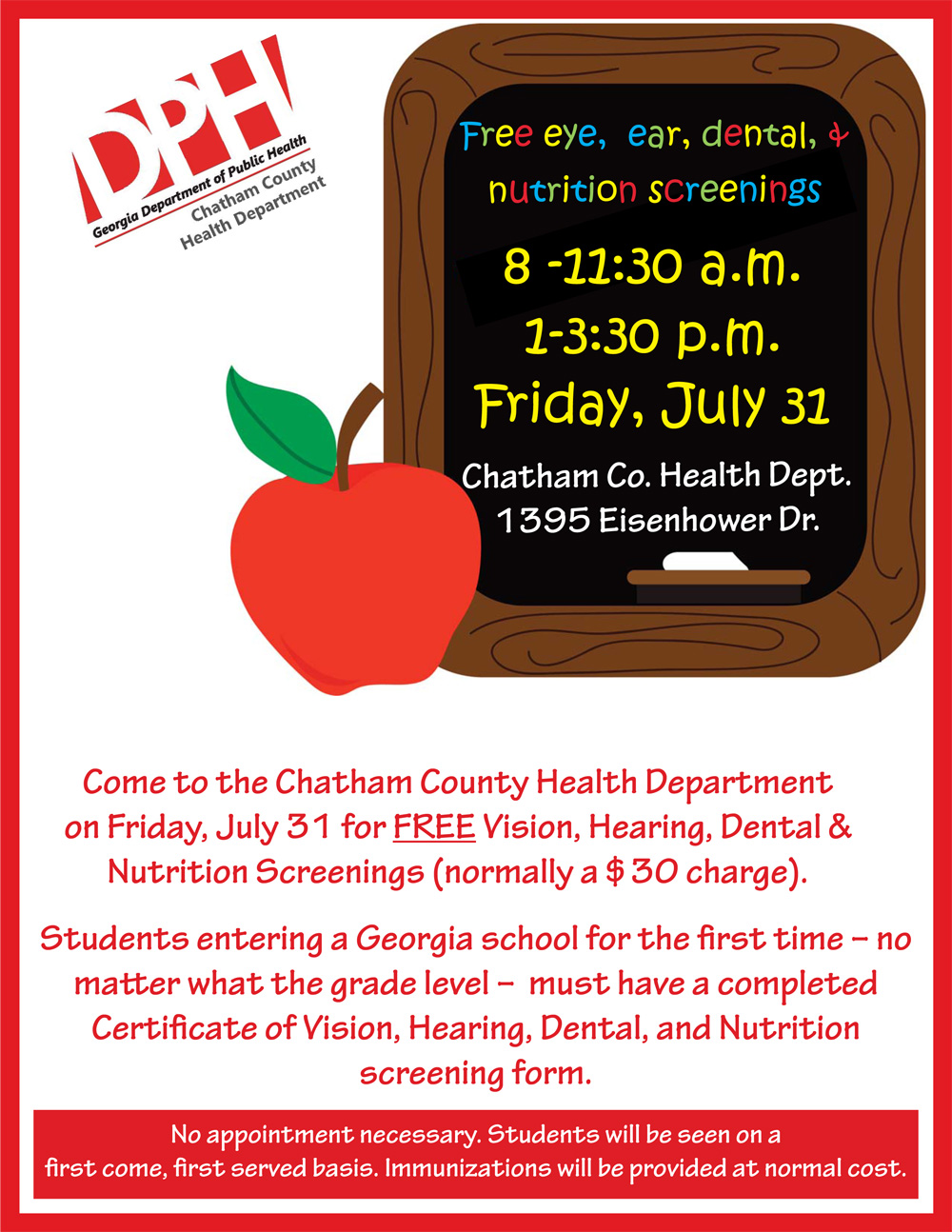
Chatham Co. Health Department to Hold Free Vision, Hearing, Dental, & Nutrition Screening July 31

The Chatham County Health Department will offer free eye, ear, dental, and nutrition screenings for Chatham County school students from 8 a.m. to 11:30 a.m. and 1 p.m. to 3:30 p.m. on Friday, July 31. Normally a $30 fee applies when getting the screening at the health department.The screenings will take place at the Chatham County Health Department located at 1395 Eisenhower Drive in Savannah. Immunizations will be provided at normal cost.

Students entering a Georgia school for the first time – no matter what the grade level –  must have a completed Certificate of Vision, Hearing, Dental, and Nutrition screening form. “First time” means never enrolled in a Georgia school before at any time in their lives.

No appointment is necessary and students will be seen on a first come, first served basis. For additional information, call the Chatham County Health Department at 356-2441.

Chatham EEDN Screeing Flier 7.31.15_Layout 1.qxd

[JPG, 422.96 KB] Click on image for full screen view.

Glynn County Health Department Officials Encourage Precautions Following Human/Pet Exposures to Rabid Fox

Two Glynn County residents and their dog were exposed to a fox that has tested positive for rabies. The incident took place in the Peppertree Crossing area. Glynn County Environmental Health officials remind residents to avoid wild animals and make sure pets are up-to-date on vaccinations. In this instance, the dog is current on his rabies vaccination.

Several species of wild animals that are native to coastal Georgia – including raccoons, foxes, and bats – can carry rabies. Rabies is a potentially deadly virus that is primarily spread by infected animals. Symptoms of rabies in animals include a change in behavior, biting, aggression, showing no fear of natural enemies (such as humans), foaming at the mouth, and paralysis.

The Glynn County Health Department Environmental Health Division offers these tips to protect you and your family from rabies:

  • Avoid contact with animals you don’t know.
  • Make sure your pets receive the proper immunizations. Dogs and cats should get rabies vaccines by four months of age, followed by a booster shot one year later, and another one every one to three years as prescribed by your veterinarian.
  • Do not handle, feed, or unintentionally attract wild animals with open garbage cans or by leaving pet food out at night.
  • Never adopt wild animals or bring them into your home. Do not try to nurse sick animals to health. Call animal control or a properly licensed animal rescue agency for assistance.
  • Teach children to never handle unfamiliar animals, wild or domestic, even if they appear friendly. “Love your own, leave other animals alone” is a good principle for children to learn.

If an animal ever bites you, seek medical care immediately and contact Glynn County Animal Control at 912-554-7500 and the Glynn County Health Department Environmental Health Division at 279-2940.