The Coastal Health District of Georgia serves the counties of Bryan, Camden, Chatham, Effingham, Glynn, Liberty, Long & McIntosh

View Upcoming Events

News & Events


Eastern Equine Encephalitis Detected in Chatham County; Officials Urge Residents to Take Precautions

Chatham County Mosquito Control has confirmed that Eastern Equine Encephalitis (EEE) has been detected in western Chatham County. Mosquito Control has subsequently conducted mosquito abatement activities in that area. West Nile Virus (WNV) has also been detected in mosquitoes in Chatham County. It’s shaping up to be an active mosquito season and continued precautions to prevent mosquito breeding and bites are encouraged.

EEE is a mosquito-borne virus that causes swelling of the brain. In horses, it is fatal 70 to 90 percent of the time. Horse and large animal owners are encouraged to vaccinate their animals against the virus and to clean out watering sources, such as buckets and troughs, every three to four days to prevent mosquitoes from breeding there. The primary mosquito that transmits EEE breeds in freshwater swamps. No human cases of disease have been reported in Georgia this year; however, humans are susceptible to EEE.

EEE is one of several viruses that can be transmitted by the bite of infected mosquitoes including West Nile Virus, chikungunya, and Zika.

One of the most effective ways of preventing the spread of mosquito-borne viruses is controlling the mosquito population by eliminating standing water around the home and in the yard. In addition, clean out gutters, remove piles of leaves, and keep vegetation cut low to prevent landing sites for adult mosquitoes. For containers without lids or that are too big to tip over or toss out (bird baths, garden pools), use larvicides such as Mosquito Dunks or Pre-Strike Mosquito Torpedoes and follow the label instructions. These larvicides will not hurt birds or animals.

It is also important to protect yourself from mosquito bites. Use EPA-registered insect repellents containing 20%-30% DEET, Picaridin, IR3535, or Oil of Lemon Eucalyptus. Wear light colored clothing with long sleeves, long pants and socks to help prevent mosquito bites.

Residents are always encouraged to remember the 5 D’s of Prevention:

  • Dusk/Dawn – Mosquitoes usually bite at dusk and dawn, so avoid or limit outdoor activity at these times.
  • Dress – Wear loose-fitting, long sleeved shirts and pants to reduce the amount of exposed.
  • DEET – Cover exposed skin with an insect repellent containing DEET, which is the most effective repellent against mosquito bites.
  • Drain – Empty any containers holding standing water because they are excellent breeding grounds for virus-carrying mosquitoes.
  • Doors – Make sure doors and windows are in good repair and fit tightly, and fix torn or damaged screens to keep mosquitoes out of the house.

For more information on mosquito-borne diseases click HERE or go to mosquitocontrol.chathamcounty.org.
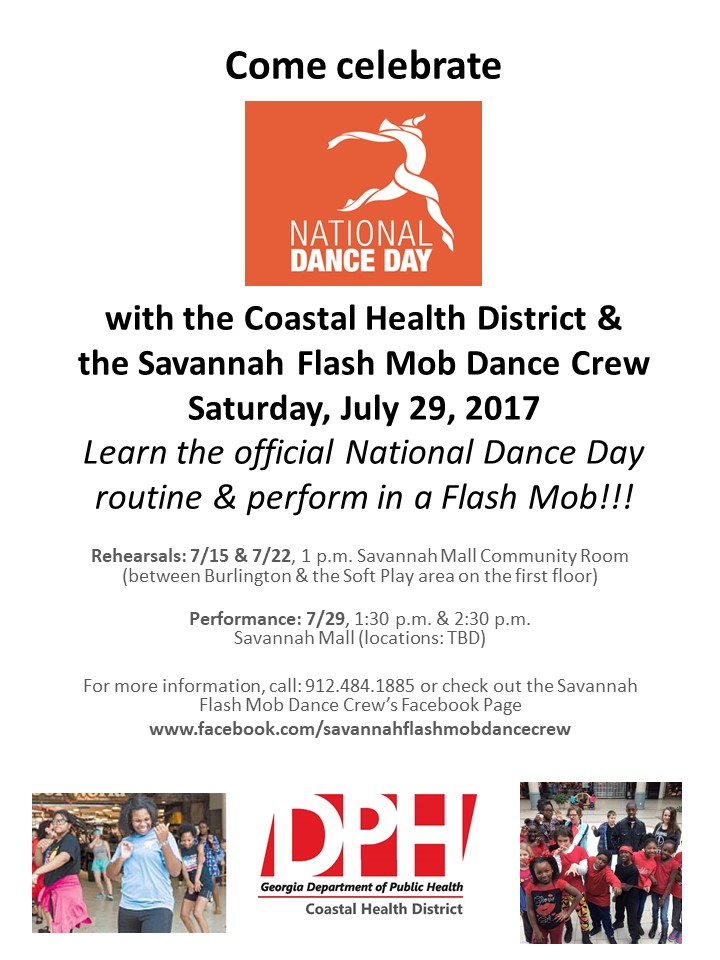


Coastal Health District to Host National Dance Day Event

The Coastal Health District Chronic Disease Prevention Program, in conjunction with Savannah Mall, will host a National Dance Day event at 1:30 p.m. and 2:30 p.m. on Saturday, July 29, at Savannah Mall. The event is free and open to the public.

The Savannah Flash Mob Dance Crew will be on hand at the event to teach participants the 2017 National Dance Day dance. Anyone interested in learning the dance prior to National Dance Day so that they can help teach the dance at the event can attend dance tutorials at the at 1 p.m. on Saturday, July 15, and Saturday, July 22, in the Community Room at Savannah Mall (between Burlington and the Soft Play area on the first floor).

“Dancing is a great way to increase physical activity to help promote a healthier and more active lifestyle,” said Director Chronic Disease Prevention for the Coastal, Cristina Gibson. “Dancing is fun and it’s also good for you. Including dance as part of a regular exercise routine can help prevent chronic disease and obesity.”

National Dance Day was started in 2010 by Nigel Lythgoe, co-creator of the television show “So You Think You Can Dance” and co-president of Dizzy Feet Foundation, a national organization created to “support, improve, and increase access to dance education in the United States.” National Dance Day is celebrated annually on the last Saturday in July.

For more information, please call 912.484.1885 or check out the Savannah Flash Mob Dance Crew’s Facebook Page at www.facebook.com/savannahflashmobdancecrew


[JPG, 138.99 KB] [JPG, 138.99 KB]

Mosquito-borne Virus Activity Detected in Chatham County; Officials Advise Taking Protective Measures

Chatham County Mosquito Control has confirmed that a sampling of mosquitoes collected in southeast Chatham County has tested positive for West Nile virus (WNV).  This indicates that WNV is actively circulating in local mosquito populations this year.  Mosquito control personnel are surveying all areas of Chatham County and scheduling control operations as required. No human cases of WNV have been confirmed in any Coastal Health District counties, including Chatham.

WNV is transmitted by the bite of infected mosquitoes and can cause mild to serious illness. Mosquitoes that carry the West Nile Virus are more likely to bite during the evening, night, and early morning. The Chatham County Health Department and Chatham County Mosquito Control urge residents to take appropriate precautions now and throughout the summer to minimize mosquitoes around their property.

One of the most effective ways of preventing the spread of mosquito-borne viruses is controlling the mosquito population by eliminating standing water around the home and in the yard. Tip ‘n Toss containers after every rain and at least once a week. Dump out standing water in flowerpots and planters, children’s toys, pet dishes. In addition, clean out gutters, remove piles of leaves, and keep vegetation cut low to prevent landing sites for adult mosquitoes. By helping to limit potential breeding grounds for mosquitoes, every resident can contribute to reducing the nuisance caused by mosquitoes and stop the transmission of mosquito-borne diseases.

Residents are always encouraged to follow the 5Ds of mosquito bite prevention:

Dusk/Dawn – Avoid dusk and dawn activities during the summer when mosquitoes are most active.
Dress – Wear loose-fitting, long sleeved shirts and pants to reduce the amount of exposed skin.
DEET – Cover exposed skin with an insect repellent containing the DEET, which is the most effective repellent against mosquito bites.
Drain – Empty any containers holding standing water – buckets, barrels, flower pots, tarps – because they are breeding grounds for virus-carrying mosquitoes.
Doors – Make sure doors and windows are in good repair and fit tightly, and fix torn or damaged screens to keep mosquitoes out of the house.

Chatham County Mosquito Control is actively treating all areas of Chatham County for mosquitoes. Residents should expect to see Mosquito Control’s low flying, yellow helicopters on a regular basis throughout the county.


July 12 UPDATE

Chatham County Mosquito Control has identified positive West Nile Virus (WNV) mosquito samples in east Savannah and the Islands area. This is in addition to the positive samples identified last week in southeast Chatham County. Chatham County Mosquito Control will increase abatement efforts and public health’s message remains the same: We encourage residents to prevent mosquito breeding and mosquito bites.

After every rainfall – or at least once a week –  tip out water in flowerpots, planters, children’s toys, wading pools, buckets and anything else around your yard that can hold water. If it holds water and you don’t need it (old tires, bottles, cans), toss it out.
Use EPA-registered insect repellents containing 20%-30% DEET, Picaridin, IR3535, or Oil of Lemon Eucalyptus when outdoors.
Other tips:

  • Clean out gutters.
  • Remove piles of leaves.
  • Tightly cover water storage containers (buckets, cisterns, rain barrels) so that mosquitoes cannot get inside to lay eggs.
  • Keep vegetation cut low to prevent landing sites for adult mosquitoes.
  • Homeowners associations and neighborhoods are encouraged to sponsor community cleanup days.
  • Make sure to keep doors shut and cover windows with screens. Repair or replace any screens with holes in them.

Georgia Department of Public Health commissioner named head of Atlanta-based CDC


July 7, 2017 – from the office of Georgia Governor Nathan Deal:

Gov. Nathan Deal today announced the appointment of Dr. J. Patrick O’Neal, current director of Health Protection for the Georgia Department of Public Health (DPH), as interim commissioner of DPH, effective immediately. The vacancy was created by the appointment of Dr. Brenda Fitzgerald, current commissioner of DPH, as director of the Centers for Disease Control and Prevention (CDC) by President Donald Trump.

“I am immensely proud of my friend and colleague Dr. Brenda Fitzgerald, and I am grateful to her for her tireless work to promote the health and well-being of Georgia’s citizens,” said Deal. “She has been an asset to the State of Georgia and I know she will bring the same determination and persistence to her new role of CDC director, working for the good of the entire country. I want to thank President Trump for naming one of our own to this prominent role and I am confident Dr. O’Neal will be able to successfully pick up where Brenda left off at DPH.”

“I am humbled by the challenges that lie ahead, yet I am confident that the successes we’ve had in Georgia will provide me with a foundation for guiding the work of the CDC,” said Fitzgerald. “The progress we’ve made in Georgia around early brain development, childhood obesity and creating a model for addressing the Ebola epidemic would not have been possible without the full support of Governor Deal and a dedicated public health staff.”


Brenda Fitzgerald, M.D. [JPG, 4.91 KB]

Fitzgerald formerly served as the commissioner of DPH and as State Health Officer. She is a board-certified Obstetrician-Gynecologist and practiced medicine for more than three decades before coming to Public Health in 2011. As Commissioner, Fitzgerald oversaw various state public health programs including Health Promotion and Disease Prevention, Health Protection, Georgia WIC, Office of Pharmacy, Nursing, Volunteer Health Care and Vital Records. She also directed the state’s 18 public health districts. She earned a bachelor’s degree in Microbiology from Georgia State University and a medical degree from the Emory University School of Medicine. As a Major in the United States Air Force, Fitzgerald served at the Wurtsmith Air Force Strategic Air Command Base in Michigan and at the Andrews Air Force Base in Washington, D.C.


J. Patrick O’Neal, M.D. [JPG, 4.65 KB]

O’Neal serves as the Director of Health Protection for DPH, overseeing more than a dozen public health programs including Epidemiology, Infectious Disease and Immunization, Emergency Preparedness and the Georgia Public Health Lab. He is also the medical director for the Office of EMS and Trauma. O’Neal previously practiced emergency medicine for 29 years at DeKalb Medical Center and also served as the regional medical director for EMS throughout the Metro Atlanta area. He earned a bachelor’s degree from Davidson College and a medical degree from the Tulane University School of Medicine. Following medical school, O’Neal entered the United States Air Force for training in flight medicine and later served as a flight surgeon in Vietnam.


Chatham County Health Department Midtown Location to Reopen July 5

The Chatham County Health Department midtown location at 1602 Drayton Street will reopen on Wednesday, July 5, after being closed for a year while much needed enhancements were made to the building. All public health services will available when the doors open at 8 a.m. on July 5.

The facility has been completely reconstructed to improve patient flow. New furniture and fixtures are also now in place and a new phone system, security system, and heating, ventilation, and air conditioning system have been installed.

“The midtown location was long overdue for a facelift but this goes beyond basic aesthetics,” said Chatham County Health Department Administrator, Randy McCall. “The choices we made during the reconstruction process helped improve efficiencies that will ultimately benefit our clients.”

The project was funded by Chatham County Special Purpose Local Option Sales Tax (SPLOST), the Chatham County Health Department, and Women, Infants, and Children supplemental nutrition program.

Free Mammograms for Women Who Meet Eligibility Criteria

The Chatham County Health Department’s Breast and Cervical Cancer Program (BCCP) is partnering with the St. Joseph’s/Candler Mobile Mammography Program to offer free mammograms from 8:30 a.m. to 3 p.m. on Monday, July 24, at the Chatham County Health Department located at 1395 Eisenhower Drive.

Women who meet certain annual income guidelines and are 40-64 years of age without insurance will be eligible to receive a screening mammogram at no cost.

Appointments are encouraged but walk-ins will be accepted.

To make an appointment, please call 356-2946.


The Opioid Crisis

Opioids are a class of drugs that include the illegal drug heroin, synthetic [JPG, 172.20 KB]opioids such as fentanyl, and pain relievers available legally by prescription, such as oxycodone (OxyContin®), hydrocodone (Vicodin®), codeine and morphine. Many opioids produce a sense of euphoria and may result in addiction. Opioid drugs also pose the danger of accidental overdose, which can cause permanent organ damage and death.*

Opioid abuse has become an epidemic in the state of Georgia and across our nation. According to the Centers for Disease Control and Prevention, 91 Americans die every day from an opioid overdose.

Most overdoses occur in the presence of others. Fear of arrest and prosecution prevent many people from calling 9-1-1. Georgia’s Medical Amnesty Law protects victims and callers seeking medical assistance at drug or alcohol overdose scenes.

To find out more about the signs of opioid overdose, the most commonly abused opioids, and Georgia’s Medical Amnesty Law, check out the Georgia Department of Public Health’s  Emergency Help for Opioid Overdoses.

There are also steps we can take to avoid opioid misuse and addiction.

*Information provided by the Georgia Department of Public Health.

Notice of Possible Disclosure of Protected Health Information for CARE Center Clients

Posted June 12, 2017

We have recently discovered that the personal health information of CARE Center clients may have been disclosed in direct conflict with the Health Insurance Portability and Accountability Act (HIPAA) privacy rule.

On April 20, 2017, we learned that a temporary employee who had access to personal health information including, but not limited to, Social Security number, date of birth, home address, and medical diagnosis and treatment, may have inappropriately released some of that information. The person was employed between the dates of March 24, 2017 and April 20, 2017.

We deeply regret that this occurred.  We consider the privacy of your medical information to be of the utmost importance and we strive to maintain it in a secure manner.  We have reviewed the events surrounding this matter and are taking appropriate steps to prevent incidents like this from happening again including, but not limited to, a review of screening practices for hiring temporary employees and ongoing education and review of patient privacy and security rules with all employees.

We don’t know with absolute confidence that protected health information was improperly used; however, out of an abundance of caution we want to let our clients know about this potential disclosure. Because this information may have been disclosed, we recommend that clients review the guidance on how to detect and prevent identity theft that is available on the website of the   Federal Trade Commission.

Again, we sincerely apologize for this situation.  Please feel free to call 1-844-863-0325 if you have any questions.

Free National HIV Testing Day Events Scheduled in Chatham Co. June 27, 28, & 29

The Coastal Health District HIV Prevention Program will offer free HIV testing in June in observance of National HIV Testing Day. This year’s theme is “Test Your Way. Do It Today.”  Testing will be done without the use of a needle and those tested will get results in 20 minutes. No appointment is necessary. A follow-up visit will be scheduled for anyone who tests positive and counseling will be made available to those individuals.
WHEN/WHERE:  3 p.m. – 7 p.m., Tuesday, June 27*
Walgreens, 2109 E. Victory Drive, Savannah
*(First 50 people will receive a gift card this day ONLY).

3 p.m. – 7 p.m., Wednesday, June 28
Walgreens, 2109 E. Victory Drive, Savannah
(*Free prizes and giveaways)

3 p.m. – 7 p.m., Thursday, June 29
Walgreens, 2109 E. Victory Drive, Savannah
(*Free prizes and giveaways)

The U.S. Center for Disease Control and Prevention (CDC) estimates around 1.2 million people in the United States are living with HIV, and one in eight people don’t know they have it. Nearly 45,000 people find out they have HIV every year. In Georgia, the risk of HIV diagnosis is 1 in 51.  National HIV Testing Week is an opportunity to raise awareness, encourage people to get the facts, tested, get involved, and get linked to care and treatment services. The Coastal Health District is pleased to offer free HIV testing as part of this global effort.

For more information, please call Diane DeVore at (912) 644-5828 or e-mail Diane.Devore@dph.ga.gov

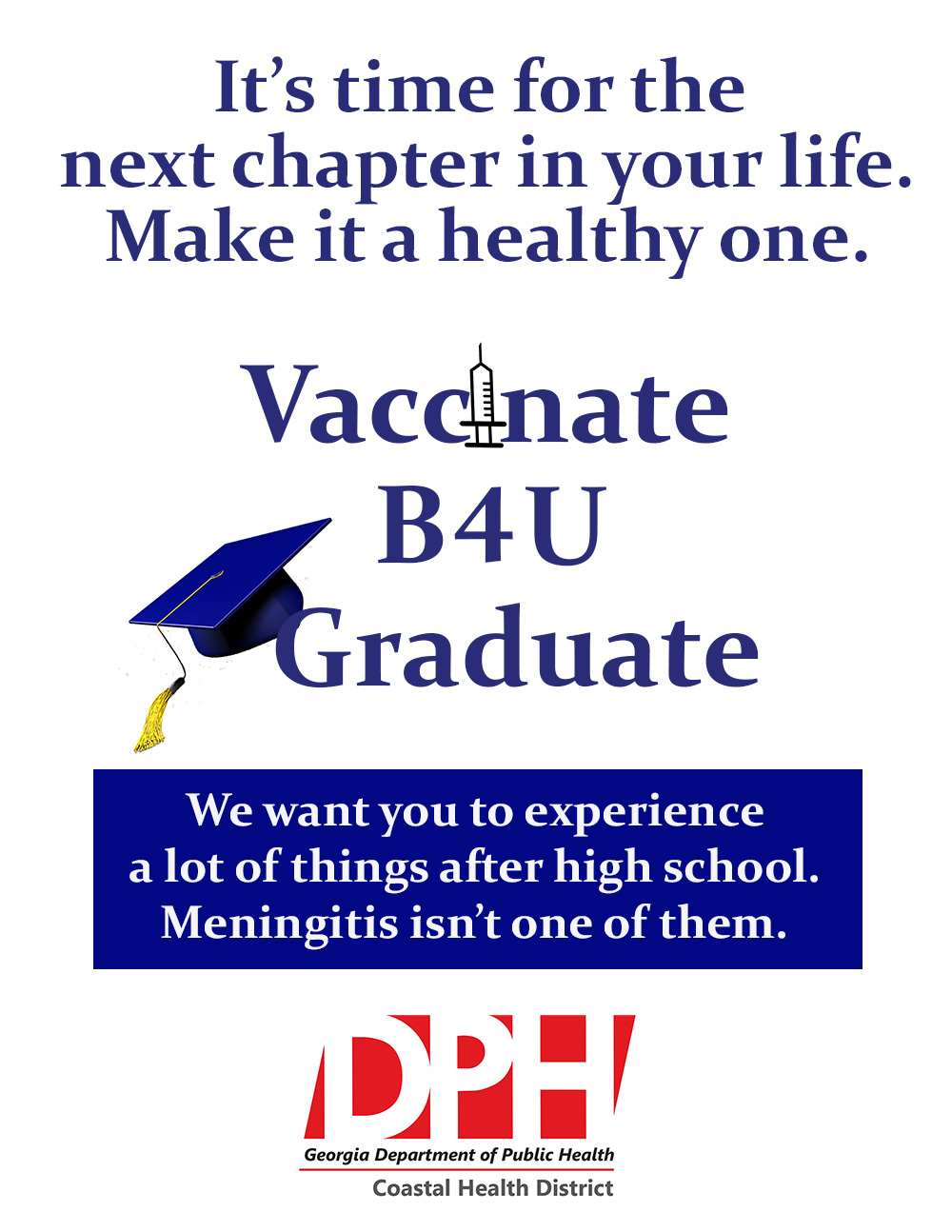
Health Department Officials Urge Students to “Vaccinate B4U Graduate”

As students begin looking ahead to graduation and starting a new and exciting chapter in life, it’s a good time to remind both students and their parents about the important role that immunizations play in that chapter. Health department officials in Bryan, Camden, Chatham, Effingham, Glynn, Liberty, Long, and McIntosh counties want to encourage soon-to-be high school graduates to get vaccinated against meningococcal disease which causes meningitis.

Meningococcal disease is not common; however, when it is contracted it can be dangerous. The bacteria that causes meningococcal disease is spread by exchanging respiratory and throat secretions (saliva or spit) during close (for example, coughing or kissing) or lengthy contact, especially if living in the same household or dorm. There are different kinds of meningitis. Bacterial meningitis can be very serious and can even cause permanent disabilities and death. Viral meningitis is the most common type of meningitis and is usually less serious but can still cause illness.

“We encourage parents of students getting ready to graduate – especially those going off to college – to make sure their children have received the meningococcal vaccine and that all vaccinations are up-to-date,” said Coastal Health District Immunization Coordinator, Paige Lightsey, R.N. “This is an exciting time for our students and we want to do everything we can to make sure that they are protected from meningitis as they start on their new adventure.”

When children are 11 or 12 years old they should receive one dose of the vaccine followed by a booster at age 16. Parents can check with the health department or their healthcare provider to get immunization records for their children or schedule a time to get the meningococcal vaccine.

For more information on meningitis or the meningococcal vaccine, please to cdc.gov/meningitis.
[JPG, 282.12 KB]